
In the ever-evolving landscape of business operations, understanding your truck’s towing capacity is not just a technical detail; it’s a crucial factor that can significantly influence your company’s efficiency and profitability. Whether you are in construction, logistics, or any industry that relies on transporting heavy loads, knowing how much weight your truck can safely tow is essential for making informed decisions. A truck’s towing capacity determines what you can haul and impacts maintenance costs, fuel efficiency, and safety measures.
This understanding ensures that you can select the right equipment for your operations, maximizing productivity while minimizing risks. At Zoomlion, we specialize in providing high-quality machinery solutions with a keen focus on performance and safety. Our expertise extends beyond just heavy equipment; we understand the importance of towing capacity in your business operations. From commercial trucks to specialized towing services, we are here to guide you through the intricacies of calculating towing capacity to help boost your business success. Dive deeper into the subject with us, as we explore how to accurately calculate the towing capacity of your truck for optimal performance and safety.
Factors Affecting Towing Capacity of a Truck
When considering towing capacity for your truck, several key factors come into play, influencing its overall capability. Here are some essential factors that affect your truck’s towing capacity:
- Engine Power and Torque: Higher horsepower and torque enable better hauling and towing performance, ensuring your truck can handle heavier loads without straining.
- Axle Ratio: A suitable axle ratio enhances torque delivery to the wheels, directly affecting how much weight your truck can tow efficiently.
- Transmission Type and Gear Ratios: The type of transmission and its gear ratios determine how power is managed and delivered, which is crucial for heavy towing tasks.
- Drivetrain Configuration: Whether your truck is four-wheel drive (4WD) or rear-wheel drive (RWD) can significantly influence traction and load handling capabilities.
- Gross Combined Weight Rating (GCWR): This rating represents the maximum weight of your truck plus any trailer it may tow, including cargo and passengers.
- Suspension System: A robust suspension system is necessary to handle the stress of towing, ensuring stability and control over rough terrains.
For business owners looking for reliable towing services, learn more about our offerings in the area.
Understand these factors to ensure safe and effective towing, helping to maximize your truck’s performance and lifespan.

How to Calculate Towing Capacity
Calculating the towing capacity of your truck is essential for ensuring safe and efficient hauling. Whether you’re a business owner transporting goods or need to move equipment, understanding the method behind calculating towing capacity is crucial. Below, we explain the steps involved in determining your truck’s towing limits, emphasizing the role of manufacturer guidelines and vehicle specifications.
Step-by-Step Methodology
-
Determine the Gross Combined Vehicle Weight Rating (GCVWR):
The GCVWR is the maximum weight that your truck can safely handle when towing. It includes the truck, its cargo, passengers, and the trailer. This value is provided by the manufacturer and can typically be found in the owner’s manual or on the vehicle’s data plate. -
Identify the Curb Weight:
The curb weight refers to the weight of the truck when it is empty, including all standard equipment, fluids, and a full tank of gas, but excluding any additional cargo or passengers. -
Calculate Payload Capacity:
This involves determining how much weight you can carry in addition to the vehicle itself. Use the formula:
Payload = GVWR – Curb Weight,
where GVWR is the Gross Vehicle Weight Rating.
This value will help establish the maximum load your truck can carry. -
Account for Actual Load:
Subtract the weight of any passengers, gear, and additional cargo from your payload capacity to find out how much weight is still available for towing. -
Determine Trailer Weight:
Measure or obtain the actual weight of the trailer when fully loaded with cargo, such as tools or materials. -
Calculate Tongue Weight:
The tongue weight is often 10-15% of the total weight of the trailer, depending on the trailer type and the load’s distribution.
Ensure this weight does not exceed the tow vehicle’s hitch rating. -
Verify Total Loaded Weight Against GCVWR:
Ensure that the combined weight of the vehicle, passengers, and trailer does not exceed the GCVWR. Exceeding this limit can create unsafe towing conditions. -
Ensure Compliance with Manufacturer Specifications:
Always refer to the manufacturer’s specified limits. Exceeding these limits can jeopardize safety and void warranties.
Importance of Manufacturer Guidelines
Manufacturers design trucks with specific towing limits that are based on extensive research and testing. Adhering to these guidelines protects not only your vehicle’s integrity but also ensures a safe towing experience. Exceeding the specified limits can lead to mechanical failures, accidents, and liability issues.
By following these steps on how to calculate towing capacity, business owners can ensure they operate within safe limits while maximizing their truck’s potential. For more information on our towing services, contact our towing company.
For assistance with towing in various areas, check our services in Arlington and Washington, DC.
| Truck Model | Year | Gross Vehicle Weight (GVWR) | Towing Capacity (lbs / kg) | Payload Capacity (lbs / kg) | Engine | Transmission | Wheelbase (inches) | Length (inches) |
|---|---|---|---|---|---|---|---|---|
| Ford F-150 | 2023 | 6,780-7,990 lbs (3,075-3,624 kg) | Up to 14,500 lbs (6,577 kg) | Up to 3,300 lbs (1,497 kg) | 3.5L EcoBoost V6 | 10-speed automatic | 142.6-148.2 | 234.0-236.7 |
| Chevrolet Silverado 1500 | 2023 | 6,500-7,700 lbs (2,948-3,493 kg) | Up to 13,300 lbs (6,033 kg) | Up to 3,000 lbs (1,361 kg) | 6.2L V8 | 10-speed automatic | 146.2-148.2 | 234.8-236.7 |
| Ram 1500 | 2023 | 6,600-7,700 lbs (3,000-3,493 kg) | Up to 12,600 lbs (5,715 kg) | Up to 2,500 lbs (1,134 kg) | 3.6L Pentastar V6 | 8-speed automatic | 142.6 | 234.7 |
| Toyota Tundra | 2023 | 6,700-7,800 lbs (3,039-3,538 kg) | Up to 12,000 lbs (5,443 kg) | Up to 1,800 lbs (816 kg) | 3.5L V6 | 10-speed automatic | 145.0 | 232.0 |
Sources:
- Ford F-150 2023 Specifications – Ford Motor Company
- Chevrolet Silverado 1500 2023 Specs – Chevrolet
- Ram 1500 2023 Overview – Stellantis
- Toyota Tundra 2023 Features – Toyota USA
Manufacturer Recommendations on Towing Limits
When it comes to towing, adhering to manufacturer recommendations is vital for safety and efficiency. Truck manufacturers provide specific towing limits based on thorough engineering and design assessments. These guidelines ensure that the vehicle functions optimally while towing, minimizing the risks of accidents and mechanical failures.
Importance of Following Manufacturer Guidelines
Manufacturers, such as Ford, Chevrolet, and Toyota, have set clear towing limits for their trucks. For example, the Ford F-150 can tow up to 14,000 lbs when properly equipped, while the Chevrolet Silverado 1500 has a maximum towing capacity of 13,400 lbs. These capacities depend on various factors including the engine type, drivetrain options, and hitch used.
If you exceed these limits-even by a few pounds-it can lead to serious consequences such as impaired braking performance, suspension damage, and increased wear on components, potentially voiding warranties. Manufacturers like Toyota explicitly state that using certified towing equipment is crucial; for the Toyota Tundra, only Class III or IV hitches are recommended to ensure safety and proper function.
Updates and Compliance
Recent regulatory changes from the Federal Motor Carrier Safety Administration (FMCSA) insist on adherence to manufacturer towing specifications to improve safety. The FMCSA highlights that non-compliance can lead to significant penalties for fleet operators, thereby reinforcing the critical nature of these recommendations.
Furthermore, safety experts recommend regular inspections of towing equipment, including hitches and wiring, to guarantee they meet standards. Towing capacity should also be reassessed regularly based on vehicle modifications or changes in load conditions.
Conclusion
In summary, following manufacturer recommendations for towing limits not only protects your vehicle but is essential for ensuring safety on the road. Business owners who utilize trucks for towing should educate their drivers about these limits and conduct thorough pre-trip inspections. To learn more about professional towing services in your area, visit Burke Towing and Washington DC Towing.
When discussing towing capacity, it’s important to refer to expert advice to ensure safety and compliance. As stated by the AAA Foundation for Traffic Safety,
“Over 70% of towing accidents are related to overloading or mismatched towing equipment. Always check the owner’s manual for ‘Maximum Towing Capacity’ and make sure that the total weight of the trailer plus cargo stays below this value.”
This emphasizes the necessity of adhering to manufacturer guidelines, which can help prevent accidents and ensure safe towing practices.
For further insights into safe towing practices, learn more about towing safety and how it can impact your operations.
Safety Implications of Exceeding Towing Capacity
Exceeding the recommended towing capacity of a vehicle can have dire consequences, especially for business owners who rely on their trucks and SUVs for operational tasks. Understanding the safety implications, mechanical hazards, and potential damages can help prevent accidents and ensure more reliable business operations.
Potential Damage to Vehicle Components
When you exceed your vehicle’s towing capacity, you risk critical damage to crucial components, including:
- Braking System: The additional weight puts immense pressure on the brakes, increasing the likelihood of overheated and failed brakes. This situation can lead to a catastrophic failure, risking life and limb.
- Transmission and Drivetrain: Overloading can lead to transmission overheating and excessive wear of drivetrain components, which may collapse under strain.
- Suspension System: Your vehicle’s suspension system is designed to handle specific loads. Overloading can cause parts to bend, crack, or break, affecting handling and stability.
Each of these damages not only affects the truck’s performance but can also lead to significant safety hazards on the road. A malfunctioning vehicle can become a hazard not just for the driver but for everyone on the road.
Safety Hazards
The safety risks associated with exceeding towing capacity are numerous:
- Loss of Control: An overloaded vehicle can swayed due to shifting weight, making it harder to steer and control, especially in emergencies.
- Increased Stopping Distance: Heavier loads require longer stopping distances. This heightens the likelihood of collisions, which can be devastating, especially when towing large trailers or hazardous materials.
- Rollover Risks: Overloading increases the risk of rollovers during sharp turns or evasive maneuvers. This is particularly true for SUVs, which have a higher center of gravity compared to trucks.
Financial Implications
Beyond physical damage, there are financial repercussions of exceeding towing limits:
- Insurance Issues: Exceeding towing capacity may void your vehicle’s warranty and insurance coverage. Should an accident occur while towing beyond the recommended guidelines, your business could face significant liability.
- Repair Costs: Damage from towing beyond limits can lead to costly repairs, resulting in downtime for your business, lost opportunities, and additional repair bills, which directly affect profits.
Conclusion
For business owners using trucks or SUVs for towing, it is crucial to adhere to the vehicle’s towing capacity. Overloading not only jeopardizes safety but can lead to significant operational disruptions and financial losses. Always consult your vehicle’s manual or follow manufacturers’ guidelines to determine safe towing capacities for your truck.Learn more about our towing services in Burke and consider our Alexandria towing solutions to maintain safe operations.
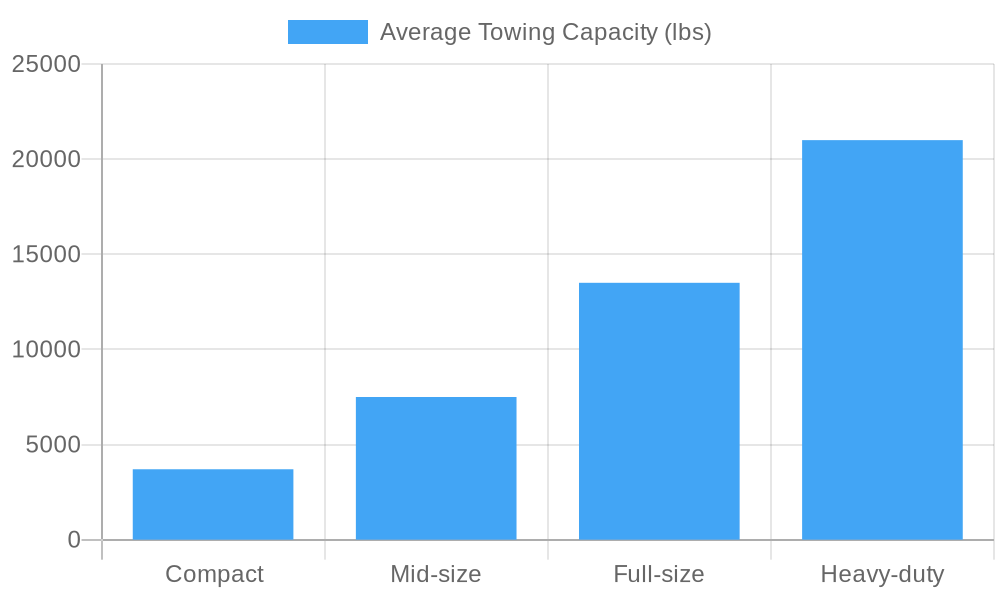
This chart illustrates the average towing capacities of different truck sizes:
| Truck Size | Average Towing Capacity (lbs) |
|---|---|
| Compact | 3,700 |
| Mid-size | 7,500 |
| Full-size | 13,500 |
| Heavy-duty | 21,000 |
Source: Car and Driver
This visual aid is essential for understanding how different truck sizes compare in their towing capabilities.
Conclusion and Call to Action
In conclusion, understanding how to calculate the towing capacity of your truck is crucial for business owners in various industries, including construction, landscaping, and transportation. A truck’s towing capacity determines its ability to pull heavy loads safely and efficiently. Ensuring your vehicle is equipped with the right towing capacity not only enhances operational efficiency but also reduces the risk of mechanical failures, safety issues, and costly downtime.
It’s important to remember that investing in a truck with an adequate towing capacity can lead to improved fuel efficiency, compliance with legal regulations, and lower insurance premiums. As highlighted in industry reports, a high towing capacity may enable businesses to complete tasks more swiftly, boosting productivity and profitability. For instance, a landscaping company can finish multiple jobs in a day with a truck that can efficiently tow a large trailer, while underpowered vehicles may mean decreased efficiency and increased operating costs.
When it comes to your equipment needs, whether for towing or any other operational requirements, we encourage you to reach out to professionals who can assist you. At ZOOMLION, we are here to support you in finding the right equipment tailored to your business needs. Our team is dedicated to providing expert assistance to ensure that you have the leading technologies at your disposal. Don’t hesitate to contact us for any inquiries or support regarding your equipment needs. Let us help you drive your business forward with the right tools!