

Understanding the towing capacity of vehicles is crucial for business owners who rely on trucks for transporting goods and equipment. The significance lies not only in operational efficiency but also in ensuring safety on the road. For instance, research indicates that adhering to proper towing specifications can reduce the chances of accidents significantly. A staggering number of towing-related incidents stem from exceeding a vehicle’s towing limits; in fact, many collisions can be traced back to improper towing practices, leading to injuries and massive financial losses. As a business owner, asking “what will my truck tow” is more than just a logistical question-it’s a decision that impacts the safety of your team and the efficiency of your operations. By understanding your vehicle’s towing capacity and aligning it with your business requirements, you can enhance productivity while safeguarding your workforce. For more on how towing capacities affect your business, learn more about our towing services in Burke and our offerings in Alexandria.
As a business owner reliant on trucks for operations, understanding towing capacity regulations is crucial for legal compliance and safety. Towing capacity refers to the maximum weight a vehicle can safely tow, which varies significantly among truck models due to differences in construction, engine power, and manufacturer specifications. Here are some essential aspects of towing capacity regulations you should know:
Key Regulations and Compliance
-
Federal Guidelines: The Federal Motor Carrier Safety Administration (FMCSA) sets certain regulations that pertain to commercial vehicles, including those related to towing. While there are no specific federal regulations mandating universal towing capacities, the FMCSA enforces weight limits and ensures that trucks comply with safety standards. Operators of commercial vehicles often need a Commercial Driver’s License (CDL) if the truck’s total weight exceeds 26,001 pounds combined with a trailer.
-
State Regulations: Individual states have their own regulations regarding towing capacity that can differ significantly. For instance:
-
Weight Limits: Some states impose stricter limits on the weight that can be towed, especially for heavy-duty trucks.
-
Equipment Requirements: States may require specific types of hitches or safety equipment based on the towing capacity of your vehicle.
For an in-depth overview of state-specific laws related to towing capacities, you can refer to this resource on truck towing regulations.
-
Local Compliance: Local authorities may also enforce their own towing regulations, including permits for certain types of towing activities or specific routes that can be legally towed. It’s imperative to check with your local Department of Transportation for any specific requirements.
-
Manufacturer Specifications: Each truck model comes with its own towing capacity rating as specified by the manufacturer. For example:
- The 2026 GMC Sierra 1500 boasts a maximum diesel towing capacity of up to 13,300 lbs, suitable for heavy-duty tasks.
- The Ford Maverick, when equipped with the 4K Towing Package, offers a maximum capacity of 4,000 lbs. This variance highlights the necessity of consulting the manufacturer’s guidelines or visiting Ram Trucks for details on the 2026 Ram 1500.
Safety Implications
Adhering to towing capacity regulations is not just a legal requirement but also a critical element of safety. Overloading a truck can lead to increased wear and tear on the vehicle, reduced handling capabilities, and a significant risk of accidents. Therefore, businesses must ensure that their towing activities comply with both legal and safety standards.
Conclusion
Understanding towing capacity regulations is essential for businesses that depend on trucks for transporting goods. By staying informed on both federal and state laws, and ensuring compliance with manufacturer specifications, you can operate your towing activities legally and safely. For tailored towing services in your area, consider reaching out to trusted tow service providers such as Ace Towing.
This summary provides an overview of towing capacity regulations affecting trucks. Understanding these regulations ensures that your business operates within legal boundaries while prioritizing safety on the road. If you need further assistance, do not hesitate to contact your local towing service for professional guidance.
Factors Affecting Towing Capacity
Towing capacity is a critical consideration for truck owners, especially for business owners involved in logistics and transportation. Understanding what influences this capacity can significantly impact operational efficiency and safety. Here are some key factors that affect a truck’s towing capability:
1. Engine Type
The engine is arguably the most influential factor in towing capacity. Trucks equipped with powerful engines-such as V8s-can generally tow heavier loads compared to those with smaller engines, like four-cylinders. Engine type also impacts torque, which plays a crucial role in initiating movement with a trailer.
2. Payload and Trailer Weight
The weight of the load being towed-referred to as trailer weight-combined with the weight of the cargo in the truck (payload), contributes significantly to the overall towing capacity. For optimal towing, the combined weight must not exceed the truck’s rated towing capacity, which can be found in the truck’s specifications.
3. Weight Distribution
How the weight is distributed between the truck and trailer affects stability during towing. Proper weight distribution ensures that the truck maintains control while towing and mitigates the risk of swaying or fishtailing.
4. Hitch Type and Trailer Setup
The hitch type plays a significant role in towing safety and effectiveness. A heavier-duty hitch can accommodate greater weights, and ensuring that the trailer setup is matched correctly to the truck’s capabilities is vital for safe towing practices.
5. Tire and Suspension Quality
Quality tires equipped with proper air pressure ensure maximum traction, while a strong suspension system will maintain the vehicle’s stability when hauling heavy loads. Under-rated tires and inadequate suspension can lead to compromised towing performance.
6. Truck Class
Different classes of trucks are designed with varying purposes in mind. For instance, heavy-duty trucks typically have larger towing capacities compared to light-duty trucks. Understanding the truck class can help in making an informed decision about the appropriate vehicle for towing needs.
Understanding these factors helps business owners make informed decisions about purchasing the right truck for their towing needs. Whether managing logistics for a small business or transporting goods, knowing how to consider towing capacity effectively is essential. For professional towing services in your area, consider reaching out to our towing service in Burke or towing experts in Alexandria.
Towing Capacity Comparison Chart
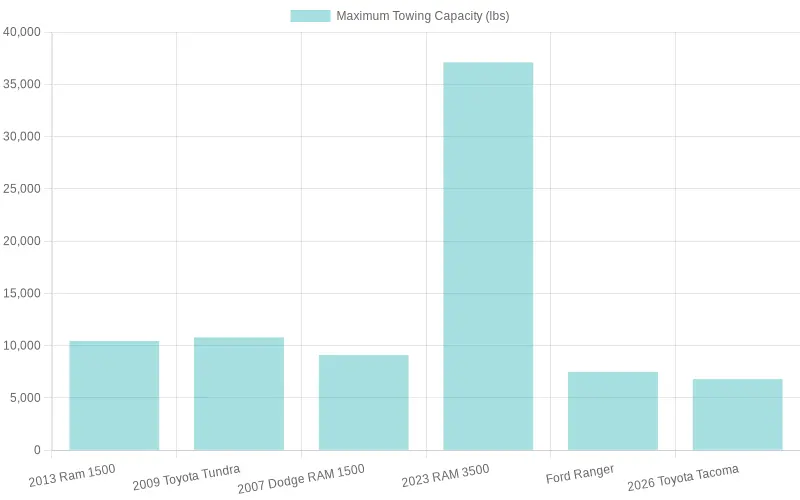
| Truck Model | Engine Type | Maximum Towing Capacity | Payload Capacity | Source |
|---|---|---|---|---|
| 2013 Ram 1500 | V6, V8 | Up to 10,450 lbs | 1,500 – 1,800 lbs | Truck Guider |
| 2009 Toyota Tundra | V6, V8 | Up to 10,800 lbs | 1,500 – 2,000 lbs | Anti chautoeureka |
| 2007 Dodge RAM 1500 | V6, V8 | Up to 9,100 lbs | Varies based on setup | Tow Engine |
| 2023 RAM 3500 | V6, V8 | Up to 37,090 lbs | Varies by configuration | Diehl Hyundai |
| Ford Ranger | EcoBoost I4, V6 | Up to 7,500 lbs | Varies by configuration | Diehl Ford |
| 2026 Toyota Tacoma | I4, V6 | Up to 6,800 lbs | Varies | Toyota Warsaw |
This comprehensive understanding of the various factors affecting towing capacity will help you make informed choices whether you are purchasing a truck for business or personal use.
Comparing Truck Models and Their Towing Capacities
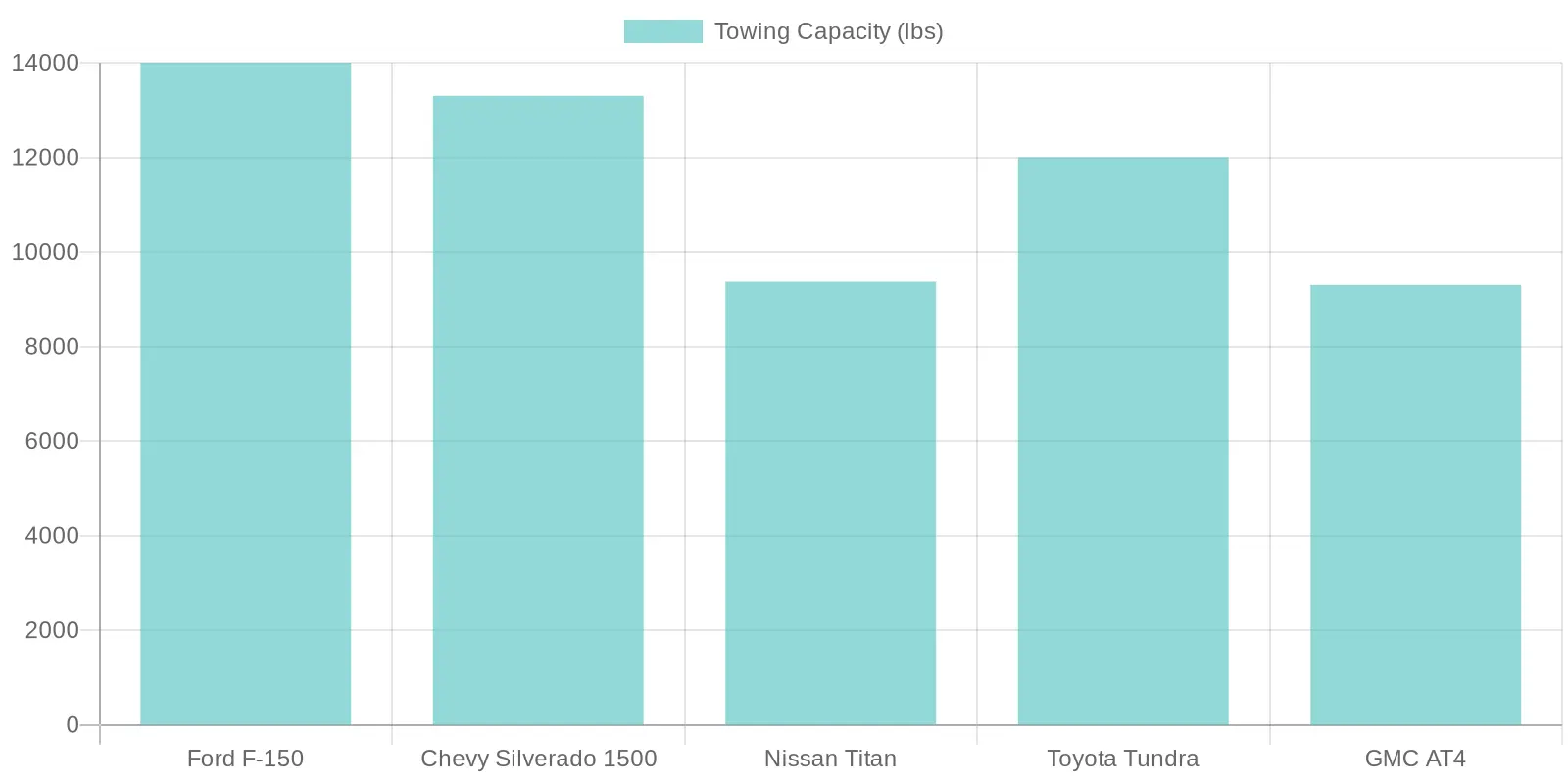
When considering what your truck can tow, it’s important to look at different models and their capabilities. Below is a comparison table of popular truck models for 2023, highlighting their towing capacities, payload ratings, and notable features that enhance towing performance.
| Truck Model | Towing Capacity | Payload Rating | Notable Towing Features |
|---|---|---|---|
| Ford F-150 | Up to 14,000 lbs | Up to 3,325 lbs | Best-in-class towing technology, available Pro Trailer Backup Assist, optional 3.5L EcoBoost V6. |
| Chevy Silverado 1500 | Up to 13,300 lbs | Up to 2,280 lbs | Advanced towing technologies, Trailer Sway Control, Durabed cargo box. |
| Nissan Titan | Up to 9,370 lbs | Up to 1,610 lbs | Integrated trailer brake controller, available 5.6L V8 engine, telescoping towing mirrors. |
| Toyota Tundra | Up to 12,000 lbs | Up to 1,940 lbs | Towing Package with brake controller, adaptive variable suspension, tow/haul driving mode. |
| GMC AT4 | Up to 9,300 lbs | Up to 1,700 lbs | Off-road optimized towing capacity, Advanced Traction System, available MultiPro Tailgate. |
Understanding these differences can help you make informed decisions about your towing needs. You can always learn more about towing services in Arlington if you need assistance with towing options or services.
Additionally, here is a visual representation of the towing capacities of these truck models:
Case Study: Leveraging Towing Capacity for Business Growth
In the dynamic world of towing services, the ability to utilize a truck’s towing capacity effectively can significantly enhance operations and drive business growth. One exemplary story comes from Pablo Matos, the owner of Matos Towing & Recovery. Initially, Pablo operated his business with a basic car dolly, handling smaller vehicles. As demand increased and the variety of jobs expanded, he realized the need for a more versatile fleet.
Transforming Operations through Strategic Investments
Recognizing the limitations of his initial setup, Pablo decided to upgrade his fleet to a range of tow trucks equipped with higher towing capacities. He invested in modern trucks that could handle heavier loads and provide a broader range of services. This strategic move allowed him to take on more significant projects, such as transporting construction machinery and large commercial vehicles, greatly expanding his customer base.
“Investing in the right equipment was a game changer for us. It not only helped us meet customer demands but also improved our operational efficiency,” stated Pablo.
Pablo’s insightful approach also involved optimizing his towing routes and implementing effective scheduling systems. This was essential in managing his fleet efficiently, reducing wait times for clients, and maximizing the usage of each truck’s capacities. With proper training for his drivers on the nuances of towing heavier loads safely, the overall safety of operations improved significantly.
The Impact of Improved Towing Capacity
As a result of these changes, Matos Towing & Recovery saw a remarkable 40% increase in revenue within just one year. The ability to tow larger and heavier vehicles not only satisfied existing customers but also attracted new ones from various sectors, including construction, transportation, and logistics. Pablo noted,
“Our clients appreciate that we can handle not just cars, but larger loads too. It sets us apart in a competitive market.”
Furthermore, this expansion allowed him to offer additional services such as emergency roadside assistance for larger vehicles, making Matos Towing a go-to service provider in his area.
Conclusion: Utilizing Towing Capacity for Business Success
Pablo Matos’s story exemplifies the profound impact of effectively utilizing a truck’s towing capacity on business operations. It highlights how strategic investments, efficient management, and a focus on customer needs can lead to substantial growth in the towing industry. For other business owners, this case study serves as a reminder of the importance of adapting to market demands and investing in the right tools to enhance service capabilities.
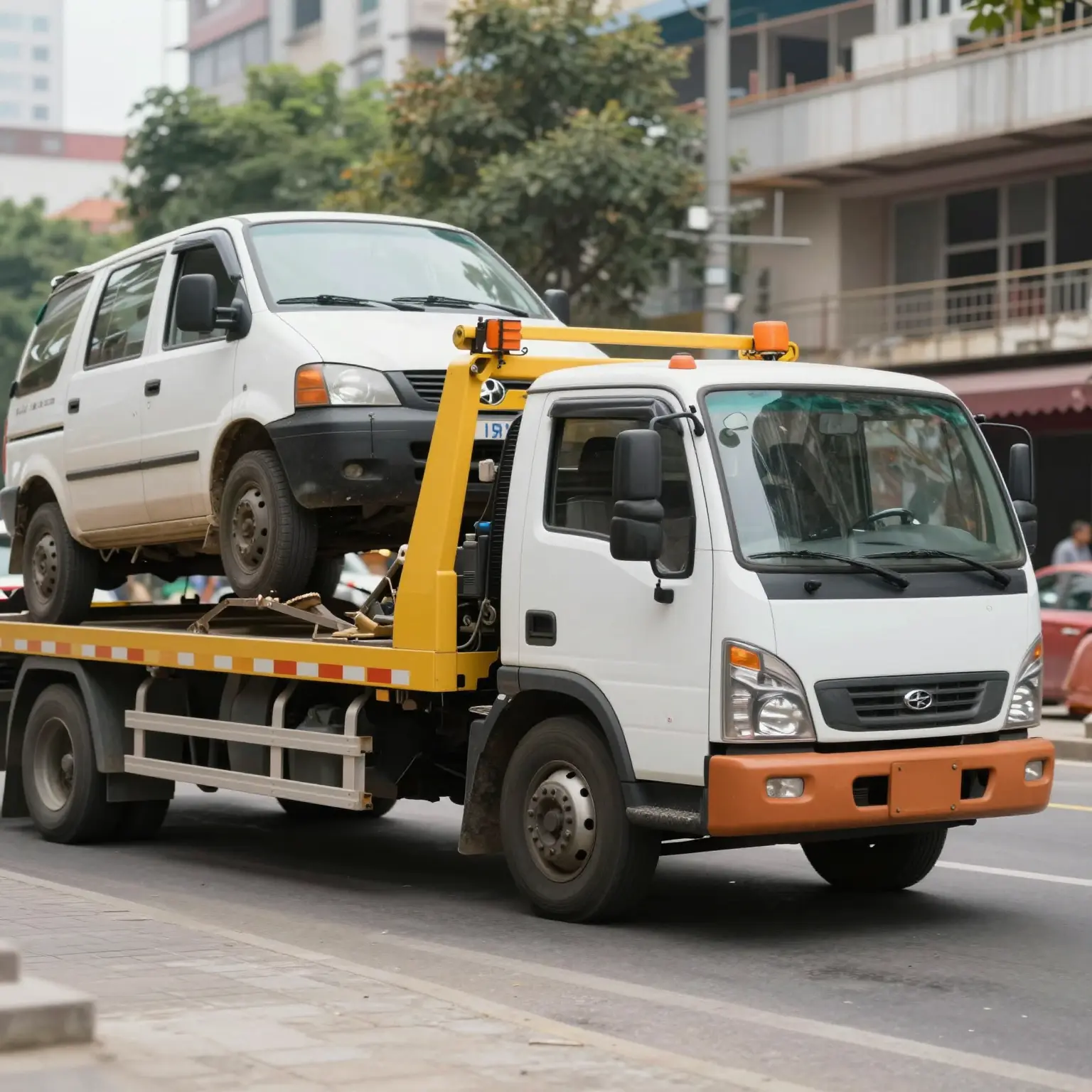
Image showing a tow truck helping to transport a large vehicle.
For more insights on enhancing your towing services, consider exploring our towing services in Burke or learn more about our offerings in Washington D.C..
User Testimonials on Towing Experiences with Different Truck Models
When considering what truck to buy, especially for towing purposes, user testimonials can provide valuable insights into real-world experiences. Here are some detailed summaries of user testimonials focusing on different truck models and their towing experiences, highlighting both positive and negative aspects.
| Truck Model | User Experience | Positive Insights | Negative Insights | Source URL |
|---|---|---|---|---|
| Toyota Tacoma | Testimonials indicate strong towing capabilities and reliability. | Strong towing capacity and comfort. | Some reports of engine issues during heavy loads. | Car and Driver |
| Ford F-150 | Users appreciate the ruggedness and utility of the vehicle for towing. | Excellent for heavy-duty towing. | Occasional transmission problems noted. | Ford |
| Chevrolet Colorado | Participants noted its balance between size and towing capacity. | Maneuvers well and has good power. | Limited cargo space mentioned when fully loaded. | Chevrolet |
| Tesla Model Y | Users express satisfaction with electric towing performance, albeit limited. | Eco-friendly with instant torque. | Lower towing capacity compared to gasoline trucks. | Tesla Motors Club |
| User Testimonials | An aggregation of various experiences from local towing services across states. | Generally positive feedback on service. | Issues with waiting times reported frequently. | Express Towing |
| Ford F-250 | Users report excellent performance with heavy trailers. | Robust and dependable for all loads. | Some users report difficulties with gas mileage. | Roadmaster Testimonials |
| General Towing Experiences | Mixed reviews from various users about towing smaller vehicles. | Great efficiency in lighter towing jobs. | Difficulties during steep descents or inclines. | C&M Express Towing |
Overall, user experiences vary greatly based on the model of the truck, its towing capacity, and the specific needs of the user. Factors such as ruggedness, towing capabilities, and reliability are often praised, while issues like engine and transmission problems sometimes plague specific models. These testimonials provide invaluable insights for potential buyers aiming to make informed decisions regarding which truck to choose for towing needs.
For more insights on local towing services, you can visit Burke Towing Service or explore options in Washington DC Towing.
Towing Capacity Trends Over the Last Decade
The towing capacities of popular truck models have seen significant improvements over the last decade due to advancements in technology and design. Below, we explore the capacity trends of three well-known models: the Ford F-150, Chevrolet Silverado, and Ram 1500.
Chart of Towing Capacity Over the Years
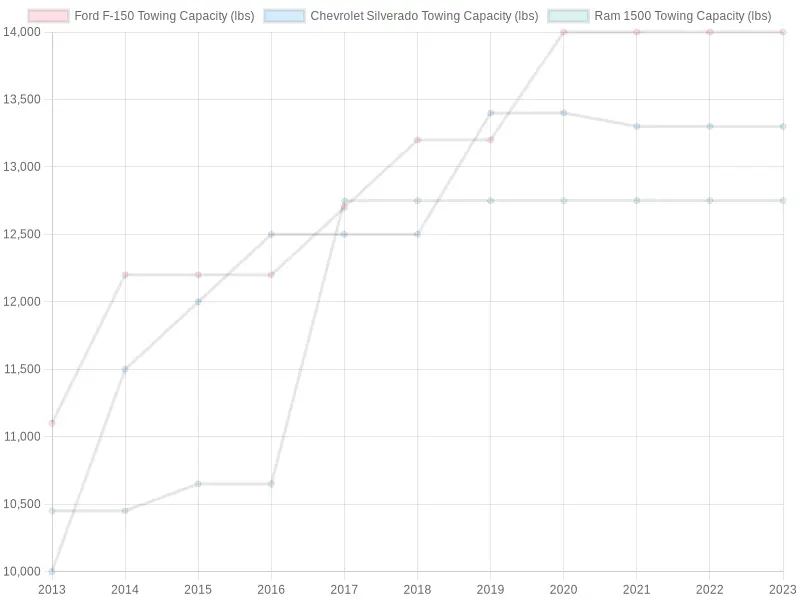
| Year | Ford F-150 Towing Capacity (lbs) | Chevrolet Silverado Towing Capacity (lbs) | Ram 1500 Towing Capacity (lbs) |
|---|---|---|---|
| 2013 | 11,100 | 10,000 | 10,450 |
| 2014 | 12,200 | 11,500 | 10,450 |
| 2015 | 12,200 | 12,000 | 10,650 |
| 2016 | 12,200 | 12,500 | 10,650 |
| 2017 | 12,700 | 12,500 | 12,750 |
| 2018 | 13,200 | 12,500 | 12,750 |
| 2019 | 13,200 | 13,400 | 12,750 |
| 2020 | 14,000 | 13,400 | 12,750 |
| 2021 | 14,000 | 13,300 | 12,750 |
| 2022 | 14,000 | 13,300 | 12,750 |
| 2023 | 14,000 | 13,300 | 12,750 |
These trends clearly indicate how the industry has responded to increasing demands for towing capabilities, driven primarily by innovations in engine design and vehicle structuring. For business owners engaged in towing services, understanding these trends can help in making informed decisions about the vehicles they utilize for transporting loads effectively.Learn more about our towing services.
Essential Towing Safety Tips for Business Owners
When it comes to towing, safety should always be your top priority, especially for business owners utilizing trucks for various operations. Implementing the right towing safety practices can prevent accidents and protect your assets. Here is a practical list of safety tips to consider:
- Perform Regular Inspections: Ensure your truck and trailer are in optimal condition by conducting thorough inspections before each trip. Check for any mechanical issues, tire conditions, brakes, and lights.
- Understand Weight Limits: Be aware of your truck’s towing capacity. Overloading can cause significant damage and lead to dangerous situations on the road.
- Secure the Load: Properly distribute the weight across the trailer and use appropriate tie-downs to secure your load. This minimizes the chances of sway and ensures stability.
- Use the Right Equipment: Make sure you’re using appropriate towing equipment, such as hitches, chains, and brakes suited for the load you’re carrying.
- Practice Safe Driving: Towing alters your vehicle dynamics. Drive at a cautious speed, increase your stopping distance, and avoid sudden maneuvers.
- Adhere to Local Laws: Be aware of and comply with local towing laws and regulations to avoid fines and ensure safety standards.
- Develop a Towing Plan: Prepare a detailed towing plan, especially for long journeys, covering potential routes, rest stops, and emergency contacts.
- Train Your Staff: If your team is involved in towing activities, ensure they are trained in safe towing practices and emergency response.
Remember, the principles of towing best practices extend beyond just safety. Adopting these guidelines can also enhance operational efficiency, minimize wear on vehicles, and protect your business from liabilities. By prioritizing safety, you are not only safeguarding your business but also ensuring the well-being of others on the road.
Conclusion
In summary, understanding your truck’s towing capacity is critical for any business owner who relies on towing as part of their operations. A truck’s towing capacity indicates the maximum weight it can safely pull, which is pivotal for ensuring safety and compliance with legal regulations. If a load exceeds this capacity, not only does it risk damaging the truck, but it also increases the likelihood of accidents, which can lead to serious repercussions for businesses, including legal liabilities and increased insurance costs. Knowing this capacity empowers business owners to make informed decisions when selecting trailers and freight, thus optimizing performance and efficiency in their operations.
Moreover, being aware of how to determine your truck’s towing capacity-whether through the owner’s manual, manufacturer specifications, or by using your truck’s VIN-can simplify the process of planning your hauling needs. For comprehensive insights and safe towing practices, you can refer to resources like this guide on how to calculate towing capacity which covers essential calculations and safety tips.
Call to Action
Equipped with the right knowledge, you can ensure that your business operates smoothly and safely. If you have any questions about your truck’s towing capacity, or if you need assistance with towing services, contact Zoomlion today. Let us help you with your towing needs, and provide you with a competitive quote tailored to your requirements. Our mission is to ensure that you have the right tools and support for your business, because at Zoomlion, your success is our priority.
For more personalized assistance, don’t hesitate to reach out through our contact page and see how we can help you thrive in your business ventures!