
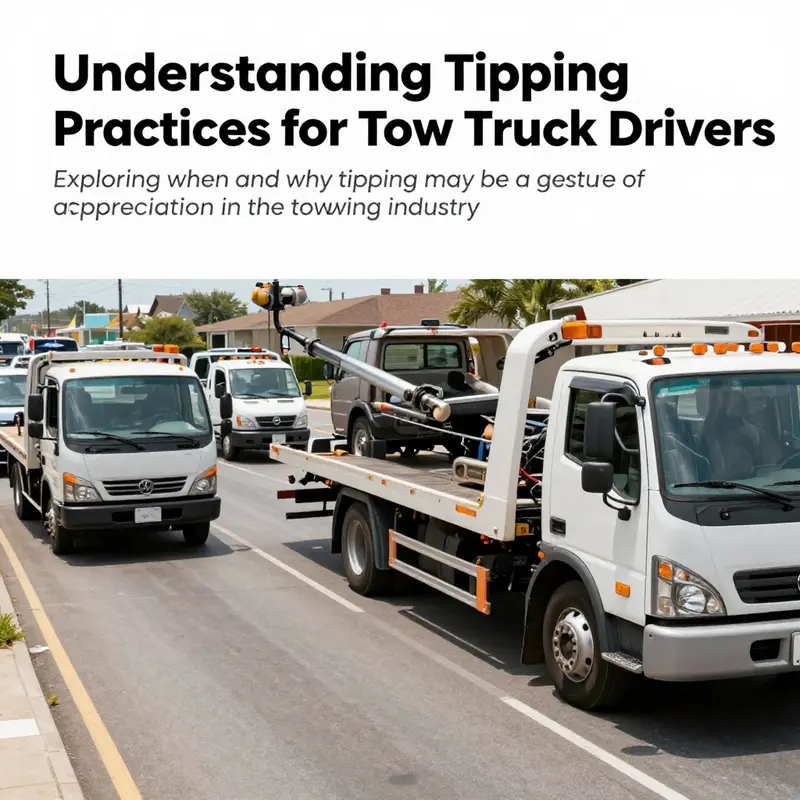
Tipping in the towing industry can often be nuanced, especially in the context of professional services provided by tow truck drivers. As business owners, understanding whether to tip these professionals is essential, as it not only reflects your appreciation of the service rendered but also helps to maintain positive relationships within the community. In the first chapter, we delve into the practices surrounding tipping, addressing scenarios where tipping is appropriate and the impact of exceptional service. The second chapter provides insights into the economic structure of towing services, enlightening business owners on pricing factors and how these influence service expectations. Together, these chapters will give a comprehensive understanding of the tipping culture related to tow truck drivers.
null
null
Tow, Tax, and Tipping: Unraveling the Economics and Etiquette of Gratuities for Tow Truck Drivers
The question of whether we should tip tow truck drivers sits at an unusual crossroads of etiquette, economics, and regulation. In many service industries, tipping is part of the salary story. In towing, the economics look different, with fees often set by contract, insurance terms, or government-driven rates, and the driver’s compensation not typically tied to gratuities. Yet people still wonder if a small gesture of thanks is appropriate when a driver’s performance exceeds expectations. To explore this, think of tipping as a social signal that exists within a pricing regime designed to be transparent and protective for consumers. The result is a nuanced view: tipping is discretionary, not normative, and should occur in limited circumstances, while staying within professional standards and legal boundaries.
Pricing and regulation play a central role in shaping tipping norms. In jurisdictions like Australia, the Towing Services Act 2024 and the Towing Services Regulations 2025 created a framework intended to make the cost of towing predictable and fair. These measures emphasize pricing transparency—service providers must display clear fees for towing services so a customer can assess value without guessing what the bill will look like. They also prohibit unfair or deceptive practices, protecting customers from being misled about what a tow entails, what it costs, and what additional work might be needed. Taken together, these provisions reduce information asymmetry that tipping might otherwise attempt to compensate for in other industries. If you can see the price up front and know what the service includes, there is less perceived need to reward a driver with a tip to secure better treatment or faster service. The social expectation can then shift toward appreciating the service through communication, reliability, and professional conduct rather than through cash or other gratuities.
Pricing in towing often rests on three pillars: contracts, insurance claims, and government-mandated rates. Contracts are set between the service provider and the customer (or the insurer) before a tow occurs and spell out the scope, the fees, and the expected process. Insurance claims often define the price pathway, with rates negotiated within policy terms. Government-mandated rates, where they exist, cap the maximum charges that can be billed. This architecture creates a predictable framework for both providers and customers, discouraging discretionary price adjustments that might otherwise invite tipping as a compensatory mechanism for perceived value. When the price of a tow is anchored to a known contract or policy arrangement, the marginal impact of tipping on the actual service level can appear negligible to the consumer. In this sense, tipping becomes a personal decision rather than a market-driven signal for better service.
Even within a regulated or semi-regulated market, tipping can still emerge as a spontaneous expression of appreciation. It tends to occur only when a driver goes notably beyond the basic expectations. There are moments when a tow proves critical in an emergency: a driver may diagnose a situation quickly, communicate clearly about what is feasible, and execute a complex maneuver in poor conditions. In such cases, a small gesture—perhaps a snack or a drink offered during a tense roadside moment—becomes less about negotiating value and more about acknowledging exceptional effort. Some drivers may accept a modest tip as a rare thank-you for extraordinary service, but this should be framed as a genuine exception rather than a rule. The ethical line is subtle: a tip that tries to influence the outcome of a tow or rewards substandard practice runs counter to the professional standard; a small gesture that recognizes skill, care, and communication can feel appropriate, particularly when the driver has spent more time, effort, or risk to solve a problem than the situation demanded.
This is where the economics of tipping intersects with trust in the towing market. When pricing is visible and fair, the incentive to rely on a tip as leverage to secure better outcomes diminishes. The regulatory emphasis on transparency bolsters consumer trust. A customer who reads a clear price, understands what is included in the service, and sees the absence of hidden fees will feel less pressure to reward behavior that should be standard. Conversely, where pricing is opaque or where there is confusion about what a tow entails, a tip might be used—intentionally or not—as a compensatory mechanism by which the customer tries to influence the driver’s next steps or the pace of service. The presence of a strong regulatory framework and standardized rates helps reduce that risk. It does not erase the human element—the courteous gesture, the conversation that calms a frightened driver on a dark highway—but it does reframe how tipping is perceived and practiced.
The chapter’s broader point is not to prescribe rigid rules but to illuminate the economics of tipping in a world where pricing is designed to be fair, predictable, and transparent. It invites readers to reflect on how their own expectations align with regulatory realities and professional standards. The social etiquette around tipping for tow services varies by location and culture, and it can shift as regulations evolve. In regions that emphasize accountability and price clarity, tipping is less about the driver needing a tip to deliver quality service and more about the customer choosing a personal way to express gratitude for exceptional handling of a stressful situation. This distinction matters for both consumer behavior and industry practice. It also has implications for how towing companies communicate with customers. When service terms are explicit, a company can frame the customer’s experience in terms of service delivery, safety, and efficiency rather than in terms of tipping incentive. That reframing can contribute to a more professional image and may help attract customers who value straightforward pricing and reliable outcomes more than discretionary gratuities.
To connect these ideas to day-to-day experience, consider how a consumer might approach a tow service in a high-pressure moment. The car breaks down, you are stranded, and you must choose a provider quickly. The first instinct is often to ask about price. If the price is clear and the service scope is well explained—whether it is a standard tow, a winch, or a lockout—there is a sense of confidence that the provider is operating within a fair framework. If the driver also communicates clearly about timing, routing, and any safety considerations, the chance that you will feel satisfied with the service increases. In such scenarios, the decision to tip or not to tip becomes a personal moral choice rather than a practical economic decision. Some people will mimic practices from other service industries, offering a small fee or the equivalent of a coffee to the driver as a gesture of appreciation. Others may prefer to withhold gratuities, focusing instead on leaving a positive online review or providing a clean, well-timed tip in a way that does not complicate compensation structures. Either approach can be appropriate, so long as it remains consistent with a transparent pricing regime and with the professional standards that guide the profession.
A useful way to anchor this discussion is to acknowledge that tipping, when it occurs, should be a small, optional gesture. It should not be expected as a norm, nor should it be used as a lever to demand faster service or better outcomes. In practice, many drivers will be grateful for the chance to help but will also recognize that their wages, licensing, and professional responsibilities are designed to function without gratuities. This is not frictionless, of course. The roadside is a tough place to earn a living, and drivers invest in training, equipment, and dependability. Yet the regulatory environment aims to ensure that the base service price covers the core labor and overhead, making tipping less essential as a market incentive. For consumers, this means adopting a balanced approach: appreciate the service with courtesy, ask questions about pricing in advance, and consider a personal gesture only when the service clearly merits extra effort beyond the ordinary.
In tying these ideas to practical guidance for readers, a few points emerge. First, awareness of the regulatory backdrop matters. When a consumer knows that pricing is transparent and that the cost structure is anchored in contracts, insurance terms, or statute, they are better positioned to judge whether a tip would be appropriate or needed at all. Second, consider the context of the service. If a driver is calm, communicative, and methodical about safety, and if the tow is technically demanding or time-consuming, a very small gesture may be a meaningful sign of appreciation that respects professional boundaries. Third, remember that the social practice of tipping varies by place and by the individual. Where tipping is not standard, expressing gratitude through a thank-you note, a positive review, or a straightforward compliment about the driver’s professionalism can carry more lasting value than cash, especially when it risks complicating payment arrangements or creating misunderstandings about remuneration.
As this chapter looks across borders and markets, it becomes clear that the economics of towing favors clarity, consistency, and ethical conduct over tipping as a universal lever. The presence of strong regulatory controls helps ensure that consumers are treated fairly and that service providers can rely on predictable revenue streams. That does not erase the personal, human dimension of roadside assistance, but it reframes how we think about gratitude in the towing context. The end result is a culture that appreciates competence and care while maintaining the professional separation between a regulated service and a voluntary gratuity. For readers who wish to explore a nearby market’s approach to towing and pricing in more depth, a practical reference is the local guide to services in Washington, DC, which offers a concrete example of how pricing and service quality interact on the ground: towing service in Washington, DC. This linkage helps translate the abstract discussion into a tangible understanding of how regulated pricing shapes everyday choices.
In sum, tipping tow truck drivers is not a normative expectation in most regulated markets. It is a personal, exceptional gesture reserved for circumstances where a driver has delivered extraordinary service under challenging conditions. The economic logic of towing—rooted in contracts, insurance terms, and government-driven rates—reduces the necessity of tipping while preserving room for appreciation when service rises above standards. This approach aligns with the broader aim of the industry: to deliver reliable, transparent, and fair service, so that customers can feel confident that the price they see is the price they pay, with the possibility to acknowledge outstanding effort through a modest, voluntary gesture if they choose. As regulations tighten and consumer protection strengthens, tipping remains a thoughtful, context-dependent act rather than a default expectation. For readers seeking a wider regulatory frame, the official framework governing towing services in Australia offers further clarity on pricing transparency and protections for consumers: https://www.legislation.gov.au
Final thoughts
Navigating the waters of tipping within the towing industry reveals a complex balance between appreciation and professional service. For business owners, understanding the nuances of when to tip can foster better relationships within the industry and establish a culture of respect and gratitude. While tipping is not a customary practice, recognizing exceptional service can make a significant difference. By considering the economic framework of towing services, you can align your appreciation with industry standards, making informed choices that reflect both gratitude and professionalism.