

Understanding towing capacity is crucial for truck owners, especially for business owners whose operations rely heavily on the ability to transport goods. Towing capacity reflects the maximum weight a truck can safely tow, which directly impacts logistics, efficiency, and profitability. For businesses, choosing the right truck with an appropriate towing capacity can mean the difference between seamless operations and costly delays. Whether you are transporting heavy equipment or delivering materials to a job site, knowing your truck’s towing capacity helps ensure that you remain compliant with safety regulations while optimizing your workload. Additionally, misjudging towing capabilities can lead to damages, increased maintenance costs, and even jeopardize valuable business contracts. In a competitive market, understanding and maximizing your truck’s towing potential can significantly influence your operational success. To dive deeper into the specifics of finding your truck’s towing capacity, learn more about Burke towing services and how it can enhance your business operations.
Understanding Towing Capacity
Towing capacity is a vital specification for any truck owner, especially for business owners relying on vehicle performance for transporting goods. It represents the maximum weight a vehicle can safely tow, including trailers and other loads. This figure is crucial for ensuring both safety and efficiency on the road.
Industry Standards and Specifications
The towing capacity of a vehicle is determined by manufacturers based on various factors such as the vehicle’s engine power, drivetrain, suspension capacity, and braking systems. Industry standards, like SAE J 1143, provide guidelines on how to quantify and assess towing capabilities to ensure safety and operational efficiency. These standards ascertain that vehicles have been tested under various conditions to ensure they can handle the weight safely without risking mechanical failure.
Importance for Truck Owners
For business owners, knowing the maximum towing capacity is essential. Exceeding a vehicle’s specified towing limit can lead to severe complications:
- Safety Risks: Overloading can compromise braking effectiveness, lead to loss of vehicle control, and increase the likelihood of accidents.
- Legal Compliance: There may be legal repercussions for towing beyond your truck’s rated capacity, potentially leading to fines or increased insurance costs.
- Vehicle Longevity: Regularly towing beyond a vehicle’s capacity can cause undue strain and damage to the vehicle, leading to costly repairs and reduced lifespan.
As outlined by sources like Consumer Reports and Edmunds, understanding and adhering to towing capacity not only ensures safety but also enhances business efficiency. Careful consideration of your vehicle’s towing capabilities is not just a technical specification; it’s a cornerstone of responsible vehicle ownership.
Key Factors Influencing Truck Towing Capacity
Understanding the various factors that affect a truck’s towing capacity is crucial for business owners who rely on heavy-duty vehicles for their operations. Here are the key elements:
- Engine Power and Torque: The strength of the truck’s engine and its torque output significantly influence how much weight it can pull. Higher horsepower generally allows for greater towing capacities.
- Transmission Type: The efficiency of the transmission (automatic vs. manual) can affect towing performance. An efficient transmission helps in power delivery under load.
- Drivetrain Configuration: Whether the truck is 4×2 or 4×4 impacts traction and stability, especially when towing on varied terrains.
- Axle Ratio: A higher axle ratio can improve towing capability but may reduce fuel efficiency.
- Gross Combined Weight Rating (GCWR): This rating is set by the manufacturer and indicates the maximum weight of the loaded truck plus any additional trailers or loads.
- Frame and Suspension Strength: The integrity of the truck’s chassis, suspension system, and braking systems are vital for safe towing.
- Hitch Type and Weight Distribution: Proper hitch selection and correct weight distribution are crucial for maintaining vehicle stability while towing.
For more assistance related to towing services, contact us to learn about our options.

How to Determine Your Truck’s Towing Capacity
Understanding your truck’s towing capacity is essential for ensuring safety and compliance when hauling heavy loads. Whether you are a business owner needing to transport equipment or a recreational enthusiast, knowing how to accurately determine your towing capacity will help you avoid potential accidents and legal issues. Here’s a step-by-step guide to finding your truck’s towing capacity:
1. Consult the Owner’s Manual
The first step in determining your truck’s towing capacity is to consult the owner’s manual. This manual typically contains the manufacturer’s specifications, including essential information such as:
- Maximum towing capacity
- Payload limits
- Gross Vehicle Weight Rating (GVWR)
- Curb weight and other important metrics
The maximum towing capacity is often the most critical figure, as it indicates the highest weight your truck can safely tow. Look for a section specifically labeled as “towing capacity” to find this information.
2. Locate the Manufacturer’s Statement of Origin (MSO)
In addition to the owner’s manual, the Manufacturer’s Statement of Origin (MSO) is another vital document that can help you understand your vehicle’s specifications. The MSO includes the Vehicle Identification Number (VIN), which usually can be found on:
- The driver’s side door jamb
- The windshield dashboard
- The vehicle’s registration documents
The MSO will provide critical data, such as weight ratings, which can help you verify the information found in the manual. This compliance with official documentation is crucial for safety regulations.
3. Check the Weight Ratings
Understanding different weight ratings is essential for accurate towing. Here are some key terms to be aware of:
- Curb Weight: The weight of your truck without any cargo or passengers.
- Payload Capacity: This is calculated by subtracting the curb weight from the GVWR. It indicates how much weight your truck can carry in addition to its own weight.
- Gross Combined Weight Rating (GCWR): This is the total allowable weight of the truck, its cargo, passengers, and the trailer combined. It’s crucial to ensure that the combined weight does not exceed this rating to comply with safety regulations.
4. Calculate Your Towing Capacity
To calculate your truck’s towing capacity, you can use the following formula:
Towing Capacity = GVWR – (Curb Weight + Passenger Weight + Cargo Weight)
This calculation will provide you with the maximum weight you can tow while ensuring all safety measures are adhered to. Remember to include any accessories and consider the weight of the trailer itself to avoid overloading your truck.
5. Verify Hitch Ratings and Compliance
It is not enough to know your truck’s towing capacity alone; you also need to ensure that the hitch and trailer components are rated for the load. Check for:
- Hitch class and rating: Ensure it can handle the towing weight.
- Tongue weight: This should be about 10-15% of the total trailer weight.
- Trailer brake requirements: Proper braking systems are crucial for safety and compliance with legalities.
Exceeding any component’s limit can result in significant safety hazards such as brake failure or loss of control, not to mention the legal implications of non-compliance with federal regulations.
Conclusion
Knowing how to determine your truck’s towing capacity is not just about being informed; it is a critical aspect of safety and compliance. Follow these steps and ensure you utilize your truck within safe limits. For further assistance or towing services, consider reaching out to professionals for guidance or help in specific situations. Learn more about our towing services in Burke or contact us for expert advice.
Truck Models Towing Capacity Comparison
When it comes to choosing a truck, understanding its towing capacity is essential, especially for business owners who rely on heavy-duty performance for their operations. Below is a comparison of popular truck models for the year 2023, showcasing their towing capabilities, engines, and key features.
| Truck Model | Towing Capacity (lbs) | Engine | Key Features |
|---|---|---|---|
| Ford F-150 2023 | 14,000 | 3.5L EcoBoost V6 | Pro Trailer Tow Package, Integrated Trailer Brake Controller, Smart Rearview Monitor, Available 10.1″ Touchscreen with Sync 4, Advanced Safety Features (Pre-Collision Assist, Blind Spot Monitoring) |
| RAM 1500 2023 | 12,750 | 5.7L HEMI V8 | Adaptive Cruise Control, Uconnect 5 Infotainment System, Premium Interior Materials, RamBox Cargo Management System, Active Level Air Suspension |
| Chevy Silverado 1500 2023 | 13,300 | 6.2L V8 | Trailering Package (includes trailer brake controller and heavy-duty cooling), MyLink Infotainment System, HD Radio, OnStar 4G LTE, Available 12.3″ Digital Driver Cluster |
| Toyota Tundra 2023 | 12,000 | 3.5L Twin-Turbo V6 | Toyota Safety Sense 2.5, Dual-Clutch Transmission, Multi-Terrain Select, Available 12.3″ Digital Instrument Cluster, Standard 360-Degree Camera System |
| GMC Sierra 1500 2023 | 13,200 | 5.3L V8 | IntelliLink Infotainment System, Available Bose Audio, Night Vision, Remote Start, Chrome Exterior Accents, Trailering Technology Suite |
Visual Representation
For a better understanding of these towing capacities, here’s a graphical representation:
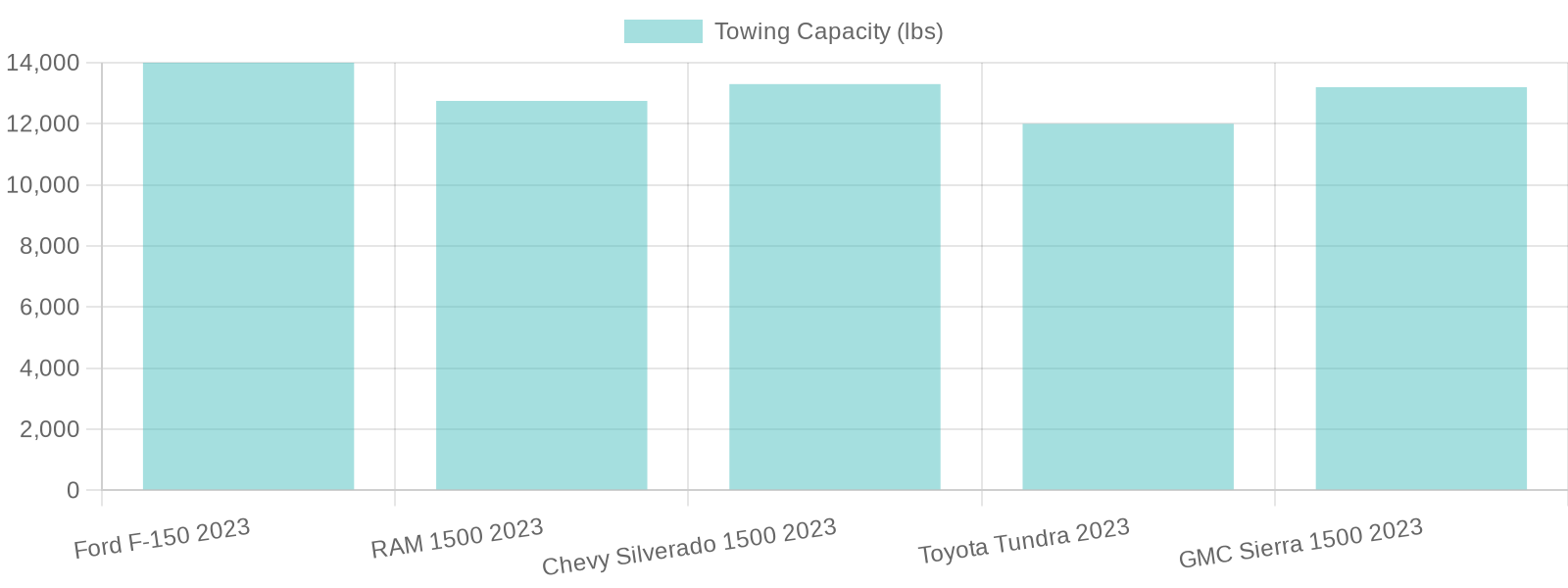
This comparison guide is essential when considering which truck to invest in for your towing needs. For more information on how we can assist you, learn more about our towing services or contact us today.
The Consequences of Exceeding Towing Capacity
When business owners rely on trucks for towing, understanding the vehicle’s towing capacity is critical. Exceeding this capacity can lead to serious safety risks and significant legal liabilities.
Safety Risks Associated with Over-Towing
Towing beyond a truck’s capacity can cause numerous safety issues:
- Brake Failure: One of the most significant risks is brake failure due to excessive weight. When towing heavy loads, the brakes have to work harder, increasing wear and potentially leading to overheating and complete failure.
- Loss of Steering Control: Overloading can affect vehicle stability. Heavy loads can shift during transit, making steering control difficult and increasing the chances of losing control of the vehicle, particularly during turns or emergency maneuvers.
- Increased Stopping Distances: The heavier the load, the longer it takes for a vehicle to come to a stop. This factor significantly raises the risk of collisions, especially in emergency situations.
- Damage to Vehicle Components: Excessive weight can lead to various mechanical failures, including damage to the suspension system, tires, and transmission. Studies have indicated that operational issues resulting from exceeding towing limits can lead to severe long-term damage to the vehicle (source: Consumer Reports).
Legal Consequences of Exceeding Towing Capacity
For business owners, the legal implications of towing beyond capacity can be severe:
- Fines and Penalties: Commercial vehicles that exceed their towing capacities can face substantial fines. Federal regulations, such as those outlined by the Federal Motor Carrier Safety Administration, specifically prohibit such practices and impose penalties for violations.
- Insurance Liability: If an accident occurs while towing a load that exceeds capacity, insurance companies may deny claims. This lack of coverage can lead to immense financial liability for business owners, as they could be held responsible for damages and injuries arising from the incident.
- Operational Suspensions: In cases of gross negligence, businesses may face sanctions that could include the suspension of operations until compliance is achieved.
- Civil Lawsuits: If another party is injured or suffers property damage due to an overloaded vehicle, the business owner might face civil lawsuits. Such legal actions can become financially draining and damage the company’s reputation.
Implications for Business Owners
For business owners, adhering to towing capacity is not just a safety concern; it’s a crucial aspect of legal compliance that protects their assets and ensures ongoing operations. Failure to understand and respect towing limits can jeopardize both employee safety and business viability, leading to profound consequences.
To avoid falling into the trap of over-towing and the associated risks, business owners should:
- Regularly train employees on safe towing practices and vehicle limits.
- Conduct routine vehicle inspections to ensure they are in good condition for towing.
- Maintain detailed records of towing capacities and educate their teams on proper load management.
In conclusion, the implications of exceeding towing capacity extend beyond mechanical failures and safety issues. They encompass legal considerations that could place a business at significant risk. It’s essential for business owners to prioritize understanding their vehicles’ limitations and operate within those parameters to protect themselves legally and ensure operational success.
“If you exceed your vehicle’s towing capacity, you risk catastrophic failure of the brakes, suspension, transmission, and even the chassis. It’s not just about pulling the trailer-it’s about maintaining control and stopping safely under all conditions.”
- James Reed, Towing Expert (source)
Understanding towing capacity is crucial for business owners who rely on trucks for transporting goods. Overloading a vehicle can lead to severe safety hazards and potentially costly damages to both the vehicle and the cargo.
In conclusion, understanding the towing capacity of your truck is paramount for business owners involved in transportation and logistics. As highlighted in various resources, knowing this capacity can prevent legal issues, mechanical failures, and increased operational costs stemming from overloading. Taking the time to ensure that the vehicle’s capabilities align with your specific hauling needs not only enhances safety but also boosts productivity and fosters customer satisfaction. For more insights, you can read about understanding truck towing capacity and the implications of ignoring these limits in your operations on FleetOwner.
Moreover, establishing a reliable line of communication with a towing company can provide the support necessary for your fleet’s challenges. At ACE Towing, we are here to assist you whenever you need us. Don’t wait – contact us today to discuss your needs, request a quote, or learn more about how we can support your mission.
Tips for Safely Towing Loads
As a business owner, when it comes to towing loads, ensuring safety should be your top priority. This includes meticulous planning, proper equipment, and adherence to safety practices. Here’s a comprehensive guide to help you manage towing operations safely and effectively.
1. Understand Your Truck’s Towing Capacity
Before towing anything, it’s crucial to know your vehicle’s towing capacity. This information can usually be found in the owner’s manual. Remember, exceeding this limit can lead to mechanical failure or accidents. Ensure you verify your vehicle’s Gross Vehicle Weight Rating (GVWR) and Gross Combined Weight Rating (GCWR).
2. Conduct Pre-Trip Inspections
Before any towing operation, perform a thorough inspection of your vehicle and trailer:
- Tires: Check tire pressure and tread depths to ensure they are in good condition.
- Brakes and Lights: Ensure all brake lights, turn signals, and emergency lights are functional.
- Hitch and Coupling: Confirm the hitch is properly secured and rated for the weight you’ll be towing.
- Load Securement: All cargo should be firmly secured and not exceed the trailer’s carrying capacity.
3. Proper Weight Distribution
Correct weight distribution is critical for safe towing. Aim to have roughly 60% of the load’s weight over the trailer’s axles. This helps stabilize the trailer and reduces the risk of swaying. Utilizing load-leveling hitches can also aid in achieving balance and precision in towing.
4. Use Appropriate Towing Equipment
Having the right equipment can significantly enhance safety during towing:
- Certified Tow Hitch: Use a hitch designed for your vehicle and towing requirements.
- Safety Chains: Always attach safety chains for added security; these help if the coupler fails.
- Reflective Gear: Ensure that your trailer has working brake lights and reflective markers.
- Emergency Equipment: Pack essential emergency gear such as first-aid kits, fire extinguishers, and warning triangles. These items provide additional safety should you encounter an emergency while on the road.
5. Training and Communication
For businesses that rely on multiple drivers, providing training on safe towing practices is essential. Educate your drivers on:
- Driving Techniques: Handling turns, stops, and reversing with a trailer.
- Proper Following Distances: The increased stopping distance when towing larger loads requires a greater distance from the vehicle in front.
6. Utilize Enhanced Safety Technologies
Modern tow trucks come equipped with advanced safety features such as automatic emergency braking and lane departure warnings. Investing in vehicles equipped with these technologies can improve towing safety significantly. For more insights, refer to the American Trucking Associations for their recommended standards and best practices in towing operations.
7. Stay Informed About Regulations
Comply with all relevant regulations regarding towing in your area. The Federal Motor Carrier Safety Administration (FMCSA) offers strict equipment standards and requires regular inspections. This not only ensures your operations comply with legal standards but also enhances safety.
By implementing these safe towing practices, business owners can ensure that their towing operations are efficient, compliant with regulations, and most importantly, safe for all road users. Never underestimate the value of proper load management and safety precautions in your towing strategy.