
As a business owner in the towing industry, understanding the requirements for Commercial Driver’s Licenses (CDLs) is crucial. This knowledge not only ensures compliance with regulations but also enhances the safety and efficiency of your operations. The CDL requirements can vary based on the weight of vehicles towed, the nature of the towing work, and regional regulations. In the subsequent chapters, we will delve into the general CDL requirements for tow truck drivers and explore state-specific regulations that could impact your business operations. By the end of this article, you will be well-equipped to navigate the complexities of CDL requirements in your towing operations.
Weight Thresholds and Road-Wise Licensing: A Practical Guide to CDL Rules for Tow Truck Operators
Tow truck operations often trigger questions about CDL requirements. The answer depends on weight, risk, and how the job is structured. For many pulls and recoveries, a standard, non-commercial license will suffice if the operation stays within specific weight limits and basic driving and towing rules apply. The rule of thumb is simple: if the combined weight involved stays under a defined threshold, a CDL is not required. In many states this threshold is around 10,000 pounds for the towed load. Practically, if towing a small sedan or light pickup, the vehicle doing the pulling might require a regular Class C license while the towed load remains under the cap. The distinction between what is being towed and the act of towing matters because the CDL framework is designed around the hazards and dynamics that arise when heavier loads or more complex towing configurations are involved.
The landscape is not a single universal rule. The weight cited above commonly refers to the GVWR of the towed vehicle, or, when the tow vehicle is included, the GCVWR or gross combination weight. If the payload crosses about 10,000 pounds, many jurisdictions require a CDL or at least a higher class. The moment the operation crosses that threshold, the license framework shifts from standard driving to commercial vehicle operation, which carries more stringent testing, medical qualifications, inspections, and periodic retesting. A tow operator who tows heavier equipment, buses, or large trucks will most likely need a CDL appropriate to the weight and type of vehicle moved, plus endorsements and safety training.
Beyond weight, other factors influence CDL applicability. Some loads carry hazardous materials or require special handling. Hazmat endorsements may be required, and larger or more complex tasks – such as school buses, transit buses, heavy construction equipment, or highway recoveries – raise the bar to CDL levels with more testing and ongoing compliance. Private, light-duty roadside towing in city traffic often stays in the non-CDL space, especially when duties are limited to simple recoveries without hazardous materials exposure or highway-scale movement. Still, state and local rules vary, and job site specifics can tilt the balance.
Because rules vary, drivers and employers should be proactive about licensing. An employer may require a CDL not only to comply with the law but to align with risk policies and insurance. Drivers who navigate on ramps, exits, and multi-vehicle scenes must consider higher standards of training and regulatory compliance that accompany commercial driving. In some regions, highway shoulder work during peak traffic may require not only a CDL but also special endorsements to handle abrupt stops and complex maneuvers in coordination with other agencies.
California provides a clear example. In California, the path to a CDL tow operator starts with a permit, followed by training, practical experience, and then the written and skills tests for the appropriate heavy-duty endorsement. The framework emphasizes safety and competency, with a deliberate progression from learner to licensed professional. DMV guidance and employer policies define the current requirements, so drivers should verify steps and updates with official sources.
In practice, licensing is a dynamic decision tied to the scope of duties and the work environment. If a shop mainly handles light-duty city recoveries, a non-CDL approach may suffice. If a shop regularly moves heavy trucks, buses, or large equipment, the CDL becomes central to hiring, insurance, and risk management. Individuals weighing CDL pursuit should consider costs, time, and potential mobility and safety benefits. The bottom line: licensing reflects the job scope, not just the vehicle weight.
For jurisdiction-specific guidance, consult the state department of transportation and your employer’s licensing policy. The California DMV offers a model example, while other states provide their own variants. Always cross-check with official resources to confirm current thresholds, endorsements, and testing requirements. This approach helps ensure compliance, safety, and reliability in towing operations.
External reference: https://www.dmv.ca.gov
Tow Truck CDL Thresholds Across the States: What It Means for Operators and Employers
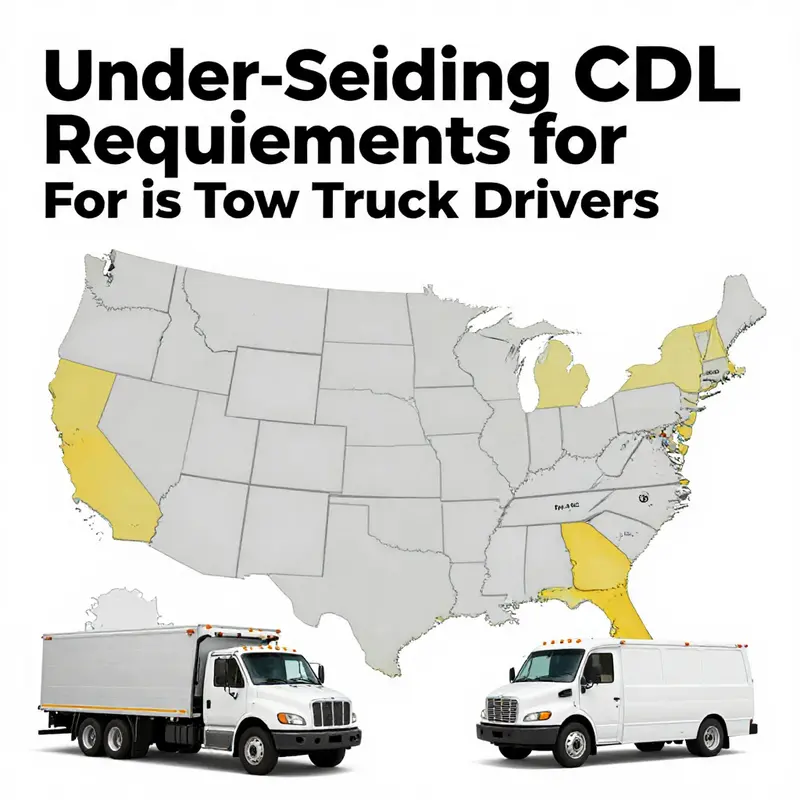
When people ask whether tow truck drivers need a Commercial Driver’s License, the simple answer rarely holds. The federal framework sets some broad boundaries, but the real map is drawn by state regulations that weigh vehicle type, load, and the exact nature of the towing work. The result is a patchwork in which a driver can move from one state to another and find the licensing requirements shift just enough to matter. This is not a modern, one-size-fits-all rule. It is a layered system where a tow operator’s licensing hinges on the gross weight of the vehicle and the load, the kind of service rendered, and even the environment in which the work takes place. In practice, that means many tow truck operators work on non-CDL licenses for routine, light tows, while others carry a CDL because their heavy tows or specialized duties push the weight or risk into CDL territory. To understand this, we need to examine how the rules differ by state and why those differences matter for day-to-day operations, for safety compliance, and for the career planning of drivers and fleet managers alike. The conversation, at its core, is about weight thresholds, endorsements, and the fine print that sometimes only shows up when a driver needs to move a heavy load on a highway or shoulder a hazardous-material shipment through a metro corridor. The question of CDL necessity is thus a hinge rather than a destination, and the answer swings with jurisdiction and the particulars of the job at hand. For the curious student of the industry, a practical way to approach this is to start with the weight threshold and then follow the thread through endorsements, training, and the operational realities of the job. A tow operator who regularly handles light passenger vehicles may never need a CDL in many states, but the moment that towed load or the tow vehicle crosses a defined weight, the license becomes a legal requirement. In some markets, even the act of performing roadside assistance on a high-speed roadway can elevate the licensing bar due to safety and traffic control concerns. To see how this plays out across the country, consider a driver who specializes in light-duty wins with small cars and light trucks. In such cases, many jurisdictions would permit operation with a standard non-commercial license, provided the combined weight of the tow vehicle and the load does not cross a state-defined ceiling. Yet the ceiling is not universal. Some states have adopted a stricter standard that places a visible line at 26,001 pounds gross vehicle weight rating (GVWR), and that threshold triggers a CDL requirement for the vehicle itself or for the operation when the towed load crosses a related limit. The discrepancy between “10,000 pounds” cited in some general summaries and “26,001 pounds” observed in others is not accidental. It reflects the fact that states sometimes publish different benchmarks for what constitutes a heavy tow. In regions where the law uses much lower thresholds, a driver could find themselves CDL-bound when the fleet’s usual vehicle-to-load dynamic changes. This is not merely a theoretical exercise. It affects the bottom line for fleets that rely on cost-effective, flexible staffing, and it directly affects a driver’s eligibility to work certain shifts, particularly on busy urban corridors or during emergency response operations. All of this underscores the importance of looking beyond a generic rule and instead consulting the local DMV or transportation department to confirm whether a CDL is needed for a given vehicle and a given task. The best practice is simple: verify the exact GVWR (and GCWR, if relevant) for the tow truck and the loaded combination, and verify whether the state requires any CDL class, endorsements, or testing for that configuration. It is also essential to review any end‑use restrictions—hazardous materials, passenger transport, or specialized equipment—that may require endorsements beyond the standard CDL itself. The practical implications for a fleet are immediate. If a company operates in a state that requires a CDL for tows above 26,001 pounds GVWR, the fleet must recruit or train drivers accordingly, or adjust its service profile to stay within non-CDL limits. If a heavy-duty tow operator is moving large vehicles—buses, trucks, construction equipment—under a heavy-duty exemption or a state-mandated CDL standard, that operator must carry the appropriate license and maintain the documented endorsements that attest to training in safety procedures, equipment handling, and road-safety protocol. In doing so, the driver not only remains compliant but also strengthens trust with clients who rely on predictable, professional service in high-stakes settings. This is why state-specific regulations matter so profoundly. California, for instance, imposes a clear line: any tow truck that exceeds 26,001 pounds gross vehicle weight rating requires a CDL, regardless of whether the operation is private or commercial. The state also requires endorsements if the vehicle carries hazardous materials or a larger passenger load. The logic is safety-driven and aligned with California’s complex traffic environment where heavy tows share lanes with dense commuter traffic and busy freight corridors. In Texas, the system presents a slightly different geometry. A Class C license suffices for tow trucks under 26,001 pounds GVWR, and a CDL is required if the weight threshold is crossed. But Texas introduces a specialized “T” endorsement that reflects the unique knowledge base needed to operate tow trucks safely. This endorsement is earned through a targeted knowledge test that covers towing procedures, weight distribution, and the crew’s safety protocol. The practical upshot is that a Texas operator who handles mid-weight tows may still function with a non-CDL license, while any routine over 26,001 pounds or more would necessitate a CDL with the appropriate endorsements. New York follows a similar threshold approach, applying the 26,001-pound rule and enforcing rigorous training and testing standards for all tow operators, especially those handling heavier-duty equipment. The aim in New York is to ensure operators are not only licensed but also well-versed in the specialized safety aspects of heavy towing, including vehicle recovery, stability control, and road positioning in congested urban environments. Florida presents a parallel, with the 26,001-pound threshold guiding CDL requirements in most scenarios. The state also carves out a narrow exception for government-issued emergency towing vehicles used in non-commercial ways. In those cases, a CDL may not be required, but the vehicle’s emergency use and the absence of commercial activity still demand strict adherence to safety rules, training, and coordination with public safety or law enforcement. These examples illuminate a core truth: state-by-state differences matter not only for licensing, but for how fleets structure training, insurance, and maintenance. A driver cannot rely on a single rule to cover all contingencies; rather, the driver and employer must map the work profile to the regulatory landscape. The practical path is to examine, for each vehicle in service or planned for purchase, the GVWR or GCWR, the intended use, and the environment in which the vehicle will operate. For a local or regional operator near Arlington or Washington, DC, the decision to pursue a CDL may hinge on the specific weights and the scope of operations. A fleet already using lightweight tows might operate under a non-CDL framework, yet when orders call for heavier recovery work or highway towing, the shift to a CDL-ready posture becomes prudent. A good rule of thumb is to adopt a conservative approach: if there is any doubt about whether the mix of tow vehicle and load could cross state thresholds in your area, plan for CDL readiness. This approach fosters flexibility and minimizes downtime when shifts change or when a crew is dispatched to a different jurisdiction. For operators who want to ensure they align with regional practice, a practical step is to review the DMV’s official language and to talk with the employer about the safest and most compliant staffing model. The industry’s best practice is to document the interpretation of weight limits in writing and to store vehicle specifications, including GVWR and GCWR, within the company’s fleet management system. The goal is not to trap talent with red tape but to empower it—enabling drivers to perform necessary work without the friction and risk of mismatched licensing. It also helps managers design recruitment and training pipelines that are responsive to evolving regulations. When drivers understand the exact reasons behind CDL requirements—whether it’s the combination of heavy tows, hazardous loads, or passenger transport—they can advocate for the right licensing level and stay safer on the streets. In communities where a local fleet interacts with municipal or emergency services, clear communication about licensing expectations can prevent last-minute changes that disrupt service or raise liability concerns. For readers navigating this topic, one useful anchor can be found in routes and services around Arlington, where local fleets commonly balance light and heavier tows and encounter a spectrum of licensing rules across neighboring jurisdictions. See how one local fleet communicates its licensing posture and service offerings here: Tow Truck Arlington VA. This kind of practical example helps frame the broader regulatory landscape and gives operators a concrete reference point as they assess their licensing needs. In sum, whether a tow truck driver needs a CDL is not a universal yes or no; it depends on the state, the vehicle’s weight classification, the nature of the load, and the work environment. The most reliable path is to check the specific DMV regulations for the state(s) in which the vehicle will operate, verify the GVWR/GCWR of the tow truck and the loaded combination, and align licensing plans with the intended scope of operation. As rules shift and as fleets expand into new markets, staying informed is not just prudent—it is essential for safety, compliance, and the continued ability to deliver timely, professional tow services. External reference: California DMV Tow Truck Requirements. https://www.dmv.ca.gov/portal/dmv/detail/vr/cdl/towtruckrequirements
Final thoughts
In summary, while most tow truck drivers do not need a Commercial Driver’s License, understanding the nuances of regional and operational regulations is critical for business owners. Varying state laws and the weight of vehicles being towed can significantly impact licensing requirements. By ensuring compliance with these regulations, not only does your business operate within legal boundaries, but it also enhances safety and reliability in your services. Always consult your state’s regulations and consider the nature of your towing operations to determine if a CDL is necessary.