
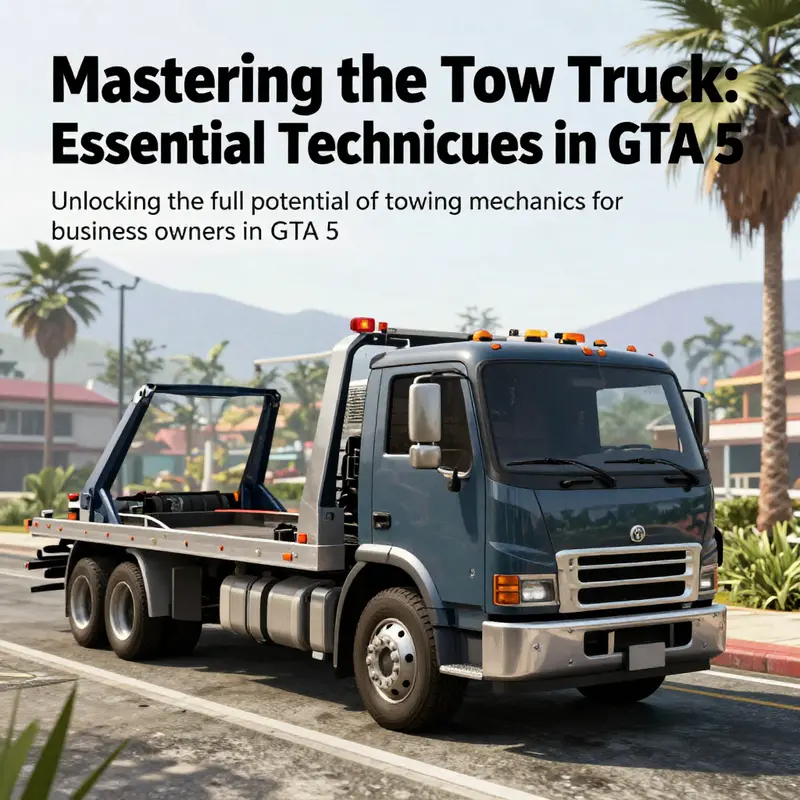
Understanding how to effectively use a tow truck in GTA 5 is crucial for players looking to streamline their missions or enhance their gameplay experience. This article provides a comprehensive guide that will equip business owners with the operational knowledge to navigate towing mechanics seamlessly. In Chapter 1, we will delve into the step-by-step operation of a tow truck, ensuring you have the practical skills to link up and manage vehicle towing effortlessly. In Chapter 2, we will explore valuable tips and tricks for effective towing, aimed at helping you maximize efficiency and minimize mishaps while on the job. By the end of this guide, readers will be prepared to utilize tow trucks skillfully within the game, enhancing their gameplay and service capabilities.
Tow Truck Mastery in GTA 5: A Step-by-Step, Real-Time Crane Operation for Los Santos
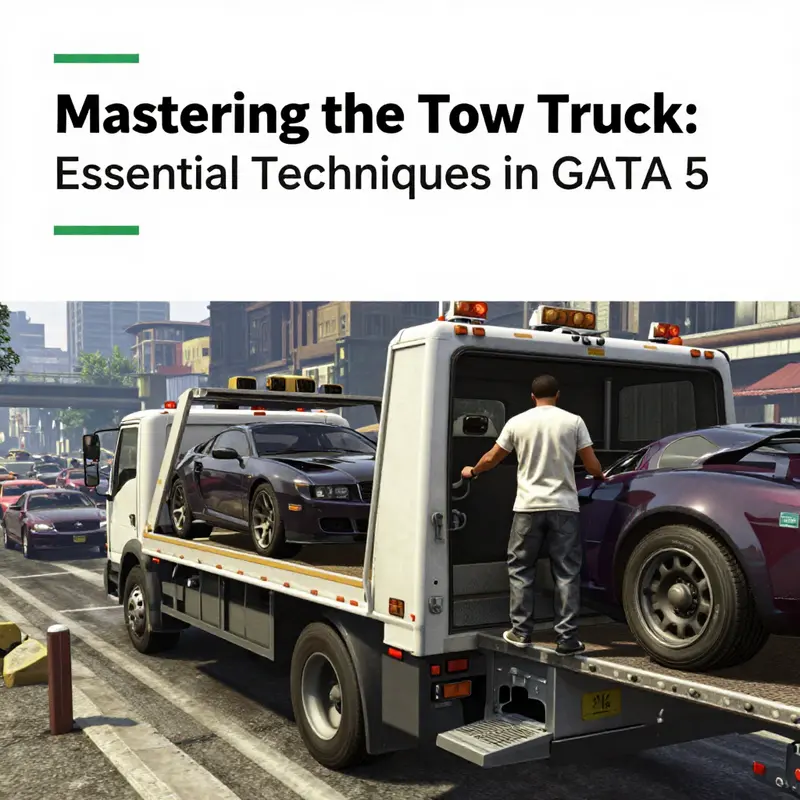
The glow of neon signs spills across the wet streets of Los Santos as night settles in, and the tow truck sits in the dim glow of a streetlamp, ready to perform a job that blends precise control with a hint of mechanical ballet. In GTA 5, operating a tow crane is less about brute force and more about timing, patience, and the subtle feel of the vehicle responding to your inputs. The crane becomes an extension of your will, lowering toward a stranded car, latching onto its front bumper, and then lifting it away with a careful, measured motion. It’s a small choreography, but when you pull it off smoothly, the game rewards you with a clear sense of mastery rather than a quick victory or a clumsy mishap. The experience is grounded in the same physics engine that makes every chase or heist in Los Santos feel grounded in reality, and it invites you to think ahead just as you would in a real towing scenario, even though you are navigating virtual streets and fictional consequences.
To begin, you must first locate a tow truck and enter the driver’s seat. Tow trucks with a rear-mounted crane are common sights in story missions and in GTA Online, where players often use them for a variety of tasks. Once you’re aboard, the crane is not yet ready for duty; it has to be deployed. The controls are straightforward but require attention to detail. On PC, you lower the crane by pressing the Ctrl key, and you watch the arm descend toward the ground with a slow, deliberate motion. On consoles, you use the L2 trigger on PlayStation or the LB trigger on Xbox to accomplish the same task. The moment the arm reaches the right height, you can begin looking for the vehicle you intend to tow. The hook is designed to latch automatically onto the front bumper, so the alignment matters more than you might expect. You’ll hear a distinctive clunk when the hook catches, a small, satisfying sound that confirms you’ve connected with the target vehicle.
The next phase is positioning. The tow truck must be aligned so that the crane’s hook travels in a direct line to the front of the car you want to tow. It sounds simple, yet it demands precise driving and careful control of your speed. Move slowly, especially near curbs or other vehicles, to avoid collisions that could misalign the hook or cause the targeted car to slip free. The closer you get, the better your odds of a clean latch. When the hook engages, you’ll notice the vehicle gently tug forward as the coupling becomes secure. This moment is crucial: if the alignment is off, you’ll find the tow is unstable or the hook may fail to hold in the first place. With the latch confirmed, the vehicle is effectively bound to your truck, and you’re ready to lift.
Lifting is where the crane truly earns its reputation for patience and control. Press the same control you used to lower the arm, but this time you should either use the Shift key on PC or the R2 button on PlayStation and the RB on Xbox to raise the crane arm. The target vehicle rises off the ground, suspended behind the tow truck, and you feel the added weight change the balance of the truck as you accelerate. The towed car doesn’t just ride passively; it remains attached, so every turn, every bump, and every acceleration test your line of sight and your grip on the wheel. It’s not a racecar maneuver, and that deliberate speed adds a layer of tension to each navigation choice. When you’ve raised the hook enough to clear the car from the street, you can begin maneuvering through traffic, using the extra height to avoid low obstacles while maintaining a straight path. The hitch will hold the vehicle’s front end in place, but you must keep a careful eye on the tow line as it curves around corners. The geometry is forgiving, but it isn’t endless; the swaying and potential for a misstep grow as you push through sharper turns or tighter alleyways.
If you need to detach, the process is reversed and similarly simple. While driving, press the same lower-control to drop the hook again. The crane lowers, the towed vehicle comes back to earth, and you can continue driving away from the dropped asset. The system in GTA 5 is designed to be intuitive, but it rewards deliberate execution. The rule of thumb is simple: keep the crane lowered when you’re trying to hook, and raise it only when you’re ready to move with the attached vehicle. This is especially important on uneven terrain or near obstacles; raising the arm too soon can amplify the vehicle’s sway and destabilize the towed car, turning a routine pickup into a tricky rescue mission of your own making.
The practical reality of towing in the game hinges on a few fundamental limitations. The crane must be lowered before anything can be hooked, and the hook attaches only to the front of vehicles. This restricts your targets and dictates your approach: you need to line up for a front-facing grab rather than trying to hook from the side or rear, which would fail by design. The moment you hear the clunk and feel the tug, you know you’ve achieved a secure connection. From that moment, your job is to maintain steady control. Turning with a towed vehicle invites a pendulum effect, especially in crowded city streets or during quick lane changes. The towed payload adds weight and reduces your maneuverability, so you’ll often need to plan longer routes that avoid tight squeezes and crowded intersections. It’s a small difference, but one that matters when you’re balancing speed with safety, as even a minor miscalculation can send you into a wall or spark a collision if not tempered by careful steering and patient throttle.
The beauty of this mechanic lies in its integration with the game’s broader mission structure and its online counterpart. In story missions that feature salvage yards or salvage operations, tow trucks aren’t just tools; they become part of the mission’s rhythm, a way to stage and reposition assets, or to extract a vehicle that hides in a difficult location. In GTA Online, players frequently employ tow trucks for more creative purposes, from reorganizing the city’s car lineup to staging escapes and planful maneuvers. The equipment’s limitations—namely, the front-hook attachment and the necessity of lowering the crane before engagement—are offset by the satisfaction of a successful hook and the smoothness of a well-executed lift. The sense of mastery comes from anticipating the vehicle’s path as you drive, counting the beats between crane deployment and hook engagement, and then smoothing the lift so the race of the city around you does not overwhelm the quiet, controlled action of your crane arm.
For readers who crave a real-world reference to complement this in-game practice, there is value in examining how professional tow operators coordinate crane operation in a controlled environment. A practical real-world reference can be explored on dedicated pages that discuss the work of tow specialists in major metropolitan areas. If you want a quick pointer to a resource that mirrors the focus on real-world crane operation in the context of towing, you can visit the page titled tow-truck-washington-dc. It anchors the real-world understanding of how tow cranes are positioned, deployed, and manipulated to engage a vehicle with care and precision. This link provides a grounded contrast to the game’s abstractions and helps you appreciate the discipline behind every deliberate move you make in Los Santos. tow-truck-washington-dc
As you continue to practice, a few steady habits emerge that enhance your flow. First, always verify the alignment before you engage. The more you practice, the easier it becomes to anticipate the exact moment the hook will latch. Second, when possible, approach from the vehicle’s rear, then slide the truck forward so the hook lines up with the bumper precisely. The closer you are, the more confident you can be that the latch will hold, minimizing the risk of a late engagement that could leave your target car dangling or cause a failed hook in a busy intersection. Third, anticipate the need to raise and lower the crane in response to terrain. A rise can help clear the pulled car over a curb, while a lower reach may be necessary to avoid scraping the ground or snagging debris on rough pavement. The chain of actions—lower, hook, lift, drive, lower to release—becomes a small, repeatable ritual that can be executed with a calm rhythm, even as the city’s lights flash and the sound of engines blends into the night.
In the larger arc of GTA 5’s gameplay design, the tow truck mechanic is more than a gimmick. It reinforces the game’s emphasis on careful planning, spatial awareness, and the reward of precise execution. It invites players to treat the vehicle not as a disposable tool but as an extension of their strategy, a mobile mechanism that must be managed with attention to weight, angle, and momentum. The feedback loop—hook engagement, lift, sway, stabilization, and release—becomes a microcosm of the game’s broader ethos: success comes from patience, practiced hands, and an eye for the subtle cues the environment offers. And when the operation goes smoothly, the sense of accomplishment is not tied to a dramatic explosion or a flashy outcome. It is the quiet satisfaction of a front-hook catch, a steady lift, and a clean departure with a towed vehicle safely in tow.
Externally, for those who want a broader panorama of how tow mechanics function in virtual worlds, a deeper dive into practical shooting and towing techniques can be found in the GTA 5 Wiki’s Tow Truck entry. That resource provides a concise reference to the vehicle’s behavior, hook logic, and interaction with other objects in the game’s physics system, complementing the hands-on experience outlined here. External resource: https://gta.fandom.com/wiki/Tow_Truck
Tow Lines and Second Lives: Mastering GTA 5’s Tow Truck for Precision, Missions, and Mayhem
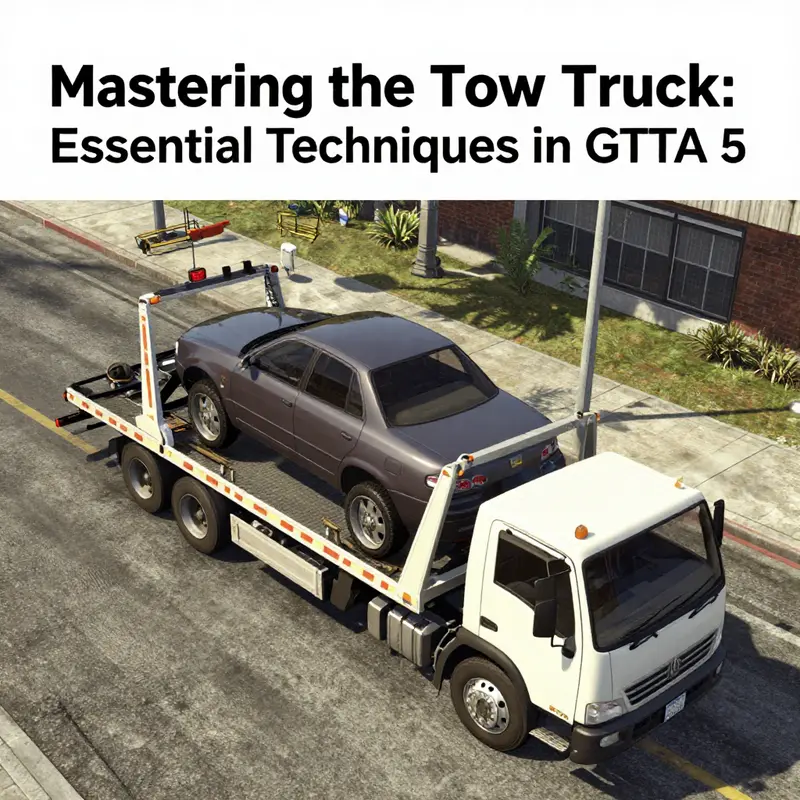
In the world of Grand Theft Auto V, the tow truck is more than a utility vehicle; it is a tool that can define how you approach missions, salvage operations, and even the free-form chaos that players love to unleash. The crane and hook are not just a gimmick. They are a crafted mechanic that rewards patient positioning, deliberate timing, and a steady hand. You’ll find tow trucks in the story mode at places like garages, construction sites, and along busy stretches of road, and in GTA Online they become a more productive asset, often tied to special events or missions that hinge on moving damaged or stolen cars from one location to another. The key is not simply to yank objects from the road; it is to choreograph a careful dance between tow vehicle and target, a choreography that minimizes damage, preserves the tow, and keeps you moving toward your objective with the maximum possible efficiency.\n\nThe first moment you pull up to a vehicle the tow truck will feel almost hesitant, as if listening for a signal from you. You line up the rear end with the bumper of the car you intend to tow, inching forward until the gap closes and you’re close enough to ensure a firm latch. The crane’s hydraulic arm is the critical component, and its operation is defined by a simple sequence that rewards repetition and restraint. On PC, you push the Ctrl key to lower the crane arm. On consoles, you’ll tap the L2 button on PlayStation or the LB button on Xbox to accomplish the same task. The moment the hook engages—an audible, satisfying clunk—your vehicle is effectively attached. The hook’s design is straightforward: it latches to the front of the target, not to its rear or sides, which means your approach must be direct and precise. This constraint mirrors real-world tow mechanics in that it forces you to plan rather than improvise, especially when space is tight and traffic is heavy. With the hook secured, the next step is to lift, and this is where the tow truck proves its value as a tool of momentum rather than brute force.\n\nRaising the crane arm is the moment when your plan begins to take shape. For PC players, the action is triggered with the Shift key; for PlayStation and Xbox users, R2 or RB performs the same operation. Lift carefully, because the moment you raise the front end of the target vehicle, it becomes an extension of your own vehicle’s steering and balance. A good tow is smooth, almost graceful; a reckless lift can send the car into an awkward arc, spinning wheels that can’t gain traction and threatening the towed vehicle with unwanted damage or, worse, your own crash. The general rule laid out by the game’s mechanics is simple but essential: never bite off more than you can tow in a single, controlled sweep. You’ll quickly learn how much you can lift before the attached vehicle begins to sway, and how far you can traverse at a steady, moderate pace without inducing dangerous oscillations.\n\nAs you gain confidence, you’ll discover that speed must be tempered with caution. The tow truck’s crane is a powerful extension of your control, but it is not a tank; the towed vehicle will respond to your steering input with a lag that feels almost cinematic. The moment you decide to move, you must anticipate how the dragged car will react around corners, over bumps, and through traffic. A tight right-hander with a heavy front end swinging outward is the kind of situation that tests your nerve as much as your timing. The best practice is to treat the entire maneuver as a single, fluid motion: approach, hook, lift, and move with a measured pace. The moment you line up for a turn, you should be thinking not just about your own chassis, but about the alignment of the towed car, the road’s surface, and the traffic around you. In practice, slow and deliberate wins the day, especially when the mission you’re supporting demands that the towed vehicle arrive intact and on schedule.\n\nThe mechanics you learn in story missions translate well into the broader GTA Online playground too. In the Salvage Yard missions, for instance, the objective frequently involves retrieving wrecked or abandoned vehicles and delivering them to a specified site. In these scenarios, the skill of precise hooking and careful lifting becomes a hidden asset, one that can shave minutes off each run and reduce the chance of reputational penalties from damaged cars. The more you understand the crane’s range, the quicker you become at aligning the tow with the target without smearing paint or bending panels. The game rewards patience here as much as speed, because a clean hook followed by a controlled lift keeps the mission objective in clear view and reduces the risk of failing an objective due to a damaged vehicle. And in a broader sense, the towing mechanic mirrors a larger game design principle: tools become valuable when players learn their limits and their best use cases, rather than simply pressing buttons in a sequence.\n\nFor players who lean into the tactical side of GTA 5, tow-truck operations reveal a surprising depth. The hook’s attachment to the vehicle’s front bumper means you must be mindful of angles and approach paths. If you ram straight on with too much force, you risk bending the bumper or, worse, snapping the hook free and wasting an entire run. The crane’s lift is not a knight’s move on a chessboard; it is a carefully measured action that translates a static vehicle into a mobile prize you can maneuver to your target like a computed chess piece that never blunders into an obstacle. This is why many veteran players reserve tow-truck operations for moments when precision matters: when you’re moving a car into a tight yard, delivering it under a time limit, or crossing through a congested area where a miscalculation could derail an entire mission. The mental model is simple: the crane lowers, the hook latches, the arm rises, and then you drive with the towed vehicle in tow. The rest is nuance—anticipation, road texture, vehicle dynamics, and a measured tempo that keeps the combination intact.\n\nAnd while the core skills are universal, the game’s design invites you to explore variations in approach. If you need to retrieve a larger or heavier target, you may find yourself relying on broader, slower movements rather than high-speed bursts. This is not about brute strength but about preserving the integrity of both vehicles while achieving your objective. When you are releasing a vehicle, the process is simply reversed: you lower the hook again by pressing Ctrl on PC or L2/LB on consoles, and then you carefully pull away so the vehicle settles at the designated point without unintended bounce. Releasing requires a similar balance; if you’re moving too quickly, the released vehicle can bounce, slide, or slip off the ramp, wasting precious seconds and perhaps forcing a reload of the scene. The cycle—hook, lift, tow, release—becomes a rhythm anyone can master with practice and a calm hand.\n\nIn addition to skill, the practical side of tow-truck utilization in GTA 5 involves situational awareness and route selection. The salvage and heist communities in the game often reward players who choose the right route to avoid heavy traffic, avoid civilian hazards, and maintain a stable tow on rough terrain. This is not a gadget-based shortcut; it’s strategic planning. When you practice, start in a quiet area to learn the tactile feedback of the hook, the crane’s reach, and how the towed vehicle behaves through turns and on inclines. A useful mid-game exercise is to pick up a decently sized target and drive a loop around a block or two to get a feel for how the system handles a turn with weight, then escalate to more challenging routes. The more you practice, the less the system will feel like a series of tutorial prompts and more like an extension of your own driving persona.\n\nIf you want a practical reference to mirror the in-game experience with a real-world flavor, you can explore resources that illustrate the fundamentals of tow operations in similar contexts. A real-world perspective can help you calibrate your expectations for speed, force, and precision. For internal practice and broader understanding, this Washington DC tow truck reference offers a compact primer on approaches and constraints that echo the GTA 5 workflow, translated into a real-world mindset: Washington DC tow truck. As you grow more confident, you can weave these insights back into the game, letting the tow truck become less of a tool and more of an extension of your own strategic thinking. The journey from cautious learning to confident execution is incremental, and the payoff is a smoother, faster, and more reliable towing experience across missions, races, and spontaneous mayhem alike.\n\nFor players seeking a structured, up-to-date reference on the mechanics, the game’s own documentation and community guides offer aligned summaries of the crane controls, hook behavior, and release sequence. A comprehensive later-generation resource that consolidates these mechanics is the IGN guide to Tow Trucks in GTA 5, which provides current strategies and mission walkthroughs. This external reference complements the hands-on practice described here and can serve as a bridge to more advanced setups and mission-specific tactics: https://www.ign.com/wikis/gta-5/Tow_Truck
Final thoughts
Navigating the world of towing in GTA 5 opens up a plethora of opportunities for players to enhance their gameplay experience. By mastering the step-by-step operation of the tow truck and employing strategic tips and tricks, business owners can ensure effective towing practices. This not only contributes to mission success but also to greater enjoyment of the vast GTA 5 environment. Embrace the skills you’ve learned and engage with every towing challenge that comes your way in the game!