
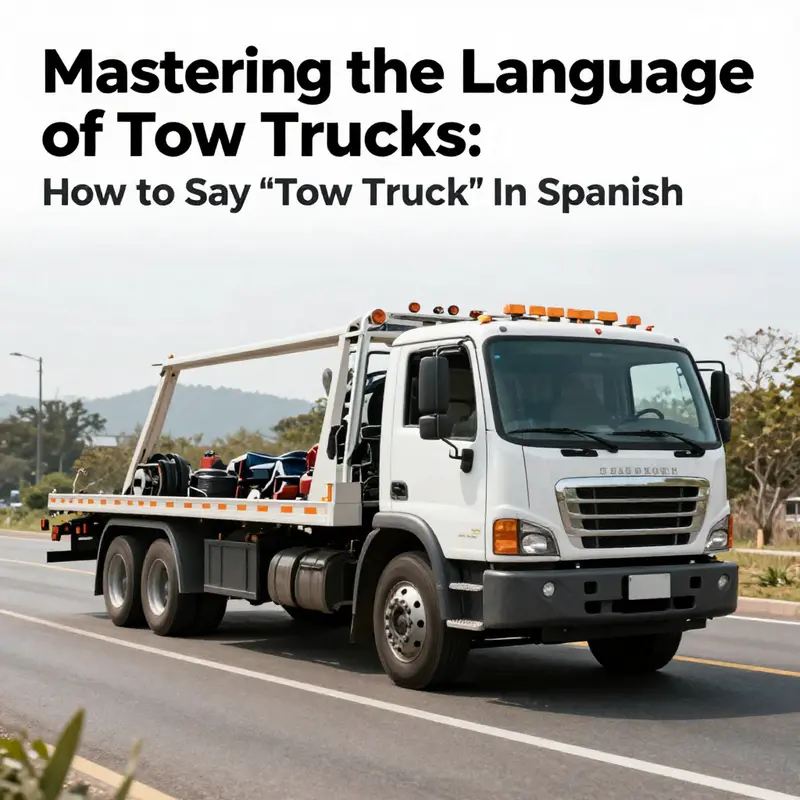
Navigating the world of vehicle towing often introduces business owners to new terminology, especially in multilingual markets. The term ‘tow truck’ is one such phrase that presents both translation challenges and opportunities. In Spanish, the most accurate and widely recognized translations for ‘tow truck’ are ‘camioneta de remolque’ and ‘grúa.’ Understanding these terms not only aids in effective communication during towing services but also enhances customer interactions in diverse environments. This article will explore these key terms, their usage in everyday conversations, and regional variations across Spanish-speaking countries. Each section is designed to provide you with a comprehensive understanding that can aid in smoother operations within your business.
From Grúa to Camioneta de Remolque: A Deep Dive into Spanish for Tow Trucks
From Grúa to Camioneta de Remolque: A Deep Dive into Spanish for Tow Trucks
Comparing what to call the tow truck in Spanish begins with understanding a core truth: the language favors simplicity in everyday speech. The single word grúa has grown into the standard way to name the vehicle used to tow a disabled car. The longer phrase camioneta de remolque is not incorrect, but it is more literal and descriptive, and in daily conversation it tends to sit on the page or in manuals rather than in street chatter. This distinction matters when you’re learning, translating, or trying to explain roadside help in a tense moment. The simple, versatile term grúa carries with it years of usage across many Spanish-speaking regions, while the longer camioneta de remolque serves as a clarifier when the context calls for explicit function rather than a generic vehicle class.
Across Latin America and beyond, grúa is the pocket dictionary favorite, the word you hear at service stations, on the news, and in casual talk when a car stops and a tow is needed. The word also extends to the person who operates the machine—the gruero, or gruista—the driver who positions the crane, winch, or hook and coordinates the tow. In some contexts, speakers might emphasize the equipment by using la grúa de remolque or simply la grúa, and listeners understand immediately that the conversation is about moving a car rather than, say, lifting a load in a factory. The broader applicability of grúa is part of why it feels so natural; it is not tied to a single size or type of tow, but signals the entire process of recovery and transport.
Examples help make the idea concrete. La grúa llegó para remolcar el coche. The tow truck arrived to tow the car, and a listener recognizes the emergency or breakdown as soon as the verb remolcar appears. Necesito una grúa para sacar mi coche de la cuneta, or Necesito una grúa porque mi coche se averió, show how the same word shifts from a statement of need to a description of the event. In a more technical moment, you might see una grúa industrial or una grúa de taller in manuals, but those phrases sit at the margin of everyday speech. In practice, the driver’s job title—gruero—becomes a natural shorthand when people discuss que se ha roto el coche y cuándo llegará la grúa. In everyday service calls, the phrase la grúa is enough to convey both the vehicle and the act, and no extra words are required to be understood.
On the other hand, camioneta de remolque remains a useful, literal tool in the translator’s kit. It is precise: a truck designed to tow, with a structure that clearly indicates function. Yet in colloquial Spanish, you will hear it less often than grúa, especially among speakers who want to keep the conversation brisk and universal. The phrase might appear in workshops, insurance documents, or technical descriptions where you want to avoid ambiguity about size or role. It can also help when you are describing a fleet or a particular type of vehicle in a brochure or a guide that aims to be explicit about equipment. This is the kind of nuance that helps learners move from translating words to translating intent, a skill that matters when the goal is clear, fast comprehension during a roadside crisis.
As learners or travelers, how do we decide which term to deploy? The first guidepost is audience: if you are speaking with someone from Spain, Mexico, or Argentina, the word grúa will likely be understood instantly. If you are writing a manual, catalog, or insurance form, camioneta de remolque can prevent misinterpretation by foregrounding the machine’s function. You can also consider the driver’s perspective: gruero or gruista communicates the human element, the operator who points the vehicle toward the stalled car and executes the tow with the appropriate chain of checks. The language tips you carry out of the classroom, or the phrase you memorize for a demanding moment on the highway, should reflect the setting, the urgency, and the audience.
For learners who want to build language confidence around vehicle repair or roadside assistance, a simple rule can help: go with grúa for everyday speech; bring in camioneta de remolque when you want to emphasize the mechanism. If you are curious about regional habits, you can explore localized usage, such as the Washington DC towing context, which offers a practical snapshot of how locals reference the towing vehicle in daily life. This cross-regional perspective is valuable because it reminds us that language is living, shaped by practical needs and local habits. The core takeaway remains consistent: grúa is the default, efficient choice in most Spanish-speaking communities, while camioneta de remolque provides nuance in formal or technical settings. The result is a flexible vocabulary that can adapt to a wide range of conversations—from a quick roadside report to a detailed, step‑by‑step manual.
In practice, regional usage is documented in regional pages like the Washington DC towing page. Washington DC towing.
For learners, this blend of simplicity and specificity is the heart of mastering how to say tow truck in Spanish. And for anyone who wants to extend the knowledge to related equipment or operations—from cranes to wreckers—the terms form a compact toolkit that travels well across countries and contexts. In conversation, the choice between grúa and camioneta de remolque will almost always default to the shorter, more fluid option, but knowing both options expands your ability to communicate clearly when the situation demands it.
External resource: https://www.wordreference.com/translation.asp?tranword=tow%20truck
From Grúa to Camión Grúa: Navigating How to Say Tow Truck in Spanish in Real-Life Conversations
When you find yourself stranded or helping a friend on the side of the road, the words you choose can matter as much as the service you request. In Spanish, talking about a tow truck is a practical test of how a language maps a concrete object—something most drivers hope never to need—onto a flexible set of terms that vary by country, region, and everyday habit. The core idea the language settlers lean on is clear: a tow truck is a vehicle that hauls a broken or incapacitated car to safety or repair. But the way people say it shifts with context, and that shift is what makes mastering the phrase more than a memorized translation. The most reliable general approach is to think in two lines: the simple noun “grúa” for the concept, and the more descriptive compound forms that pin down what kind of vehicle we mean and how formal the register should be. In many Spanish-speaking communities, the single word grúa is so familiar that it can stand on its own in casual talk, yet it carries enough ambiguity to require a little extra color when you want to be precise about a roadside emergency.
The most widely understood term for a tow truck in everyday speech is camión grúa, a compact phrase that immediately signals a tow-capable vehicle without sounding exotic. This form appears across Spain and Latin America, and speakers appreciate its clarity: camión indicates a large work truck, while grúa specifies the towing function. In practice, when someone says camión grúa, listeners picture the heavy vehicle that arrives to tow a car to the nearest workshop or to a safe location. Even more common in casual dialogue, however, is simply grúa, especially when the context is already clear. For instance, a driver who has already mentioned the accident or breakdown may say, “Llevaron la grúa al lugar,” and everyone understands the rest of the story.
But that is not the only path. If you want to be explicit or formal, or if you are dealing with official guidance, you might hear camión de remolque or camión remolcador. These variants highlight the act of remolcar—removing or towing a vehicle—without ambiguity. Camión de remolque is more technical and formal, often found in roadside assistance documentation or professional dispatch. In some regions, especially where traffic codes or service catalogs skew toward descriptive naming, camioneta de remolque can appear. Camioneta usually suggests a smaller truck or van in everyday usage, so campaña de remolque might be a more regionally nuanced choice. There is also the awkward but occasionally heard coche de remolque, which people sometimes use in informal speech, though it risks ambiguity since coche can refer to a car in a more generic sense rather than to the towing apparatus itself.
An important note for learners is the way the feminine noun grúa interacts with the accompanying article. Grúa, with its distinctive tilde on the ú, is feminine: la grúa. Yet when you pair grúa with camión to signal a vehicle designed to tow, you obtain camión grúa, a construction that blends the towing function with the transport platform. In practice, this pairing helps avoid the crane-reading sense that grúa can take in isolation. In regions accustomed to bilingual or English-influenced signage, you may also encounter the borrowed, more stilted Camión de Remolque in formal contexts, but the everyday speaker tends toward camión grúa or simply grúa depending on the moment and the crowd.
Examples anchor the nuances in memory. “Necesito una grúa para sacar el coche del pozo” paints a scene of a car stuck in a ditch, with the speaker invoking a tow truck in a straightforward demand. “El camión grúa llegó en menos de diez minutos” signals not only the arrival of a tow vehicle but also the efficiency of the response. If a regional listener wants to emphasize the operator’s specialization, they might choose camión de remolque to convey a more professional, technical tone. When the context is news or a formal report, the longer form helps avoid misinterpretation: camión remolcador would be understood as a truck whose purpose is to tow. These variations give you a robust toolbox you can draw from in any Spanish-speaking setting.
The regional tapestry matters, too. Spain and several Latin American countries share a broad understanding of grúa, with camión grúa functioning as the explicit version when needed. In some markets, the casual speaker might drop the camión and just say grúa, while a dispatcher or mechanic will reserve camión grúa to reinforce that a tow vehicle, not a crane, is involved. The same careful distinction appears in written guidance and in dictionaries. The Collins Dictionary, for instance, listsTow Truck as camión grúa, underscoring the practical pairing that most speakers rely on to avoid confusion with cranes. For learners building their mental map, this dual approach—grúa as the core idea, camión grúa as the precise vehicle—serves as a dependable anchor across regions.
As language users practice, they also weave in phrases that ease a real-world request. If you’re calling for roadside assistance, you might say simplemente: “Necesito una grúa.” If you want to indicate you need a specific kind of tow vehicle, you can add: “Necesito un camión grúa” or “Necesito un camión de remolque.” And if you want to sound succinct on the phone or in a roadside chat with a dispatcher, you might opt for the mode that the local service understands best—often camión grúa—followed by your location and the nature of the issue. For travelers or bilingual speakers, a quick internal reference is useful: in some contexts, you’ll hear a local operator phrasing it as “la grúa” when the scene is already established, or “el camión grúa” when the operator is identifying the vehicle they will send.
For readers seeking a bit more formal grounding or regional nuance, a practical reference paints a picture of where the language sits in the field. If you want to explore a localized example of tow-truck services in a specific area, you can look up related regional pages such as the local dispatch or towing provider’s site. This kind of linking helps illustrate how the same words travel with different freight or service models. tow-truck-washington-dc offers a context where the everyday term grúa is paired with a regional identifier, clarifying how people talk about tow services in urban American settings without losing the Spanish nuance.
In sum, saying tow truck in Spanish revolves around two dependable anchors: use grúa for the general idea, and pair it with camión or camión de remolque when you need precision or formality. The two-word construction camión grúa is the most common, widely understood choice in daily conversations across Spain and Latin America. The language rewards learners who listen for context and tailor their phrase to the situation; a short, confident “Necesito una grúa” can be equally effective in a casual roadside moment, while a more formal dispatch might lean on camión de remolque. For verification and further reading on standard usage, consult reliable language references such as Collins Dictionary, which confirms the core pairing of camión grúa for tow trucks. And, when you want to practice or reinforce these terms, you can explore related local pages that mirror the everyday situations described here, including practical examples that map directly to the phrases spoken on the street.
Tow Trucks Across the Spanish-Speaking World: Regional Voices, Shared Clarity, and Everyday Language
Cuando empiezas a hablar de una grúa para remolcar, descubres que una sola palabra no basta en todos los contextos. En México, Argentina, España o Estados Unidos hispanohablante, los términos varían con gusto regional, historia y necesidad práctica. Grúa es la etiqueta más ampliamente comprendida y funciona como columna vertebral del vocabulario de remolque. Sin embargo, el habla cotidiana revela preferencias regionales que pueden colorear el significado, la urgencia y hasta la profesionalidad cuando necesitas ayuda en la autopista o en una calle a las dos de la mañana. Este capítulo reúne esas diferencias para ofrecer una visión clara sin negar la especificidad local. En la vida real el lenguaje es una herramienta de comunicación rápida y precisa, no un museo de etiquetas perfectas.\n\nPara entender por qué predomina grúa, hay que fijarse en su función en el léxico. Grúa se refiere al vehículo diseñado para remolcar, levantar y transportar un coche que no puede conducir. Simplifica la idea de servicio como lo hace una caja de herramientas para un mecánico. En el uso diario, muchas personas dicen la frase la grúa llegó para remolcar el coche, que suena natural y exacta en muchos países. Por eso grúa se vuelve el término por defecto cuando alguien pregunta por ayuda en la carretera o cuando una grúa se presenta a un llamante preocupado. En contextos más técnicos o formales puede aparecer la expresión camioneta de remolque o grúa de remolque, que aporta claridad sobre las capacidades del vehículo.\n\nLas diferencias regionales se notan más en países concretos. En México grúa sigue siendo estándar, pero remolque se usa a veces de forma informal y puede sonar más formal o técnico; existe el riesgo de que se interprete como algo distinto de la grúa misma en el habla casual. En Argentina se ven con frecuencia camión de remolque o grúa de remolque para enfatizar la función de remolcar; estas fórmulas pueden expresar la mecánica y la acción remolque de forma más explícita. En Colombia grúa sigue siendo dominante, pero camión de remolque o vehículo de remolque aparecen en contextos más técnicos o profesionales. En España también la mayoría dice grúa, destacando el vehículo más que la acción, alineado con la tendencia de un español cómodo y directo en lo cotidiano.\n\n¿Qué significan estas variaciones para quien aprende español o para quien necesita traducir en una situación de urgencia? La guía práctica es preferir grúa para una comunicación rápida y comprensible en cualquier lugar. Si el contexto es técnico, logístico o formal, por ejemplo al inspeccionar un coche o al detallar el equipo en un taller o para un reclamo de seguro, camioneta de remolque o grúa de remolque ayudan a expresar información con más precisión. La intuición muestra que cuanto más descriptivas sean las expresiones, mejor se puede visualizar el vehículo y la operación, lo que reduce la confusión en una situación de estrés. En un país donde se usan mayormente remolque u otras formas regionales, usar la versión más descriptiva puede ayudar a cerrar brechas dialectales y demostrar atención al habla local.\n\nTraducir entre inglés y español en el contexto de remolque no es solo cambiar una palabra por otra. Es afinar el oído para escuchar cómo conductores, despachadores y agentes de seguros enuncian una solicitud de ayuda. En términos prácticos, podrías oír necesito una grúa, una solicitud directa que funciona en la mayoría de las situaciones. Si hablas con un despachador que necesita asignar el vehículo adecuado, puedes decir necesito una grúa de remolque para un coche atascado, que añade el matiz de que es una operación de remolque y no solo un remolque sencillo. Para la comunicación escrita, respalda tu mensaje con el término que mejor coincida con el servicio esperado, e incluye la ubicación, el tipo de vehículo y la severidad de la situación.\n\nLas referencias señalan la consistencia. Si quieres comprensión universal, usa grúa y después añade la función cuando haga falta. En contextos oficiales o técnicos, camión de remolque y grúa de remolque permiten una descripción precisa para evitar ambigüedades. Para aprendices, observar el uso regional en medios o con conductores locales puede ser valioso. La idea es no perseguir una traducción perfecta, sino reconocer el terreno semántico compartido y respetar los matices regionales cuando la situación lo requiera.\n\nAl pasar de la teoría a la práctica, una referencia local puede iluminar cómo se habla en distintos lugares. Por ejemplo, en la zona metropolitana de Washington, es común escuchar una mezcla de términos y grúa como núcleo de la mayor parte de las llamadas, con camión de remolque apareciendo en interacciones más formales o en documentos. Para explorar una perspectiva local concreta, se pueden consultar recursos de proveedores regionales que explican estas diferencias en tiempo real. En una referencia internacional, consultar un diccionario reconocido ayuda a capturar usos regionales. Un recurso como Collins puede ofrecer una comparación rápida de equivalentes inglés–español y señalar cuándo se prefiere cada término en el habla cotidiana o en contextos técnicos.\n\nEn resumen, grúa es la palabra que atraviesa la mayoría de barrios hispanohablantes, pero las variaciones camión de remolque o grúa de remolque ofrecen matices útiles para contextos específicos. La lengua de la asistencia en carretera es práctica y orientada a la acción, y la comunicación más eficaz proviene de elegir la etiqueta que coincida con la audiencia y la situación. Mantener esa flexibilidad facilita pedir ayuda con claridad, entender instrucciones y avanzar hacia una solución segura cuando te encuentres con una avería en un país de habla hispana. Para viajeros, estudiantes o profesionales, escuchar las voces regionales detrás del habla de las grúas hará que las conversaciones fluyan, ya sea en una autopista de México, una calle de Madrid o el giro de un suburbio de EE. UU.
Final thoughts
Embracing the nuances of language enhances business interactions and customer satisfaction. By understanding how to say ‘tow truck’ in Spanish, whether as ‘camioneta de remolque’ or simply ‘grúa,’ business owners can improve their communication strategies and better serve their diverse clientele. These insights contribute not only to operational efficiency but also foster stronger connections within multicultural environments. As the economy continues to globalize, ensuring clarity in language serves to protect your reputation and reliability in the towing industry.