
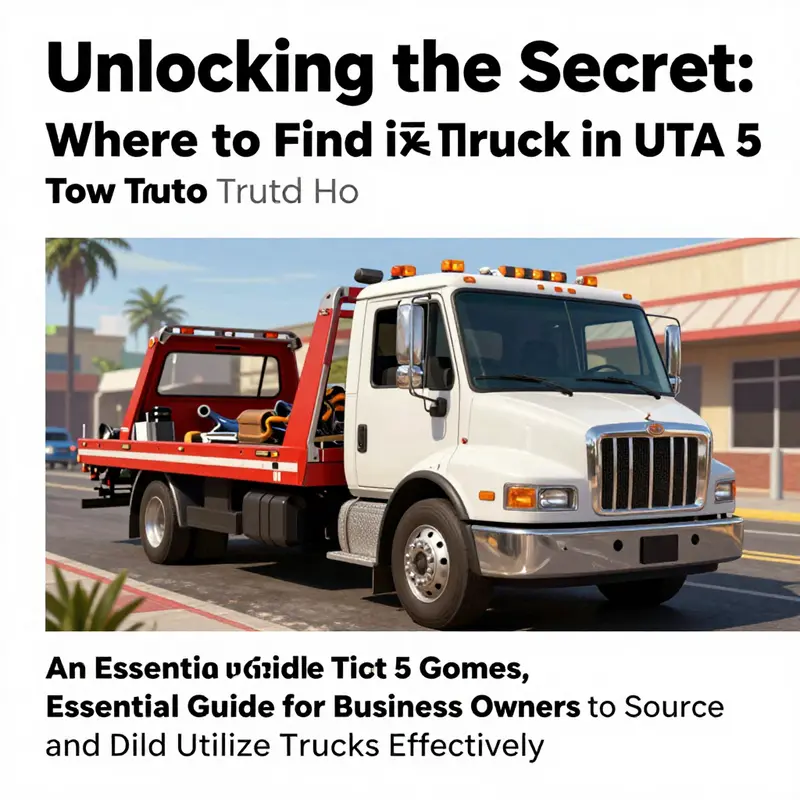
Navigating the world of GTA 5 isn’t just about racing and missions; for in-game business owners, the tow truck is a strategic asset that can streamline vehicle management, boost efficiency, and unlock new gameplay opportunities. This guide reveals key locations to locate the tow truck, with a focus on the FIB lot, and explains practical ways to leverage its features to enhance your operations.
Tow Lines and Hidden Shelters: Tracing GTA V’s Tow Truck from the FIB Lot to the Modded Frontier
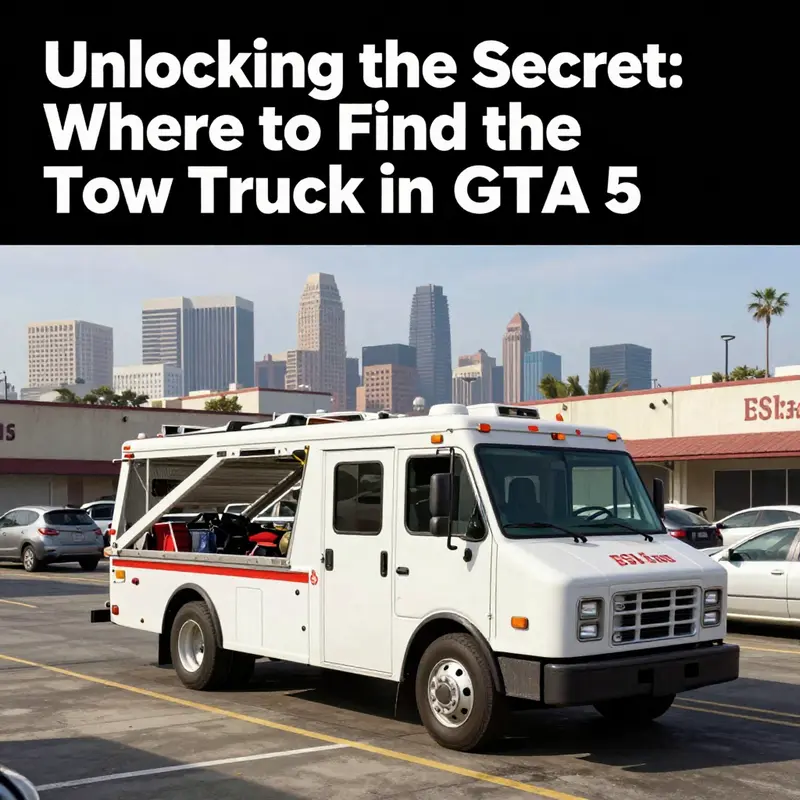
In the sprawling cityscape of Los Santos, some vehicles carry more than a chrome shine or a thunderous engine note. The Tow Truck in GTA V is one of those utilitarian icons that players chase for both function and mood. It isn’t a vehicle you stumble upon by wandering the boulevard like a typical ride. More often, it appears through a web of mission design, developer space, and, for many players, the creative possibilities sparked by community mods. The chase becomes part scavenger hunt, part mechanical puzzle, and part immersion into a city that rewards unconventional usage of its most humble workhorse. This chapter stitches together what players have come to know about the tow truck’s whereabouts, while also acknowledging the ways the game’s structure nudges you toward particular encounters and the modded avenues that widen that horizon.
If you peer at the map with the kind of attention usually reserved for high-speed chases, you’ll notice that the Tow Truck’s most talked-about perch sits in the northern reaches of Los Santos, near the edge of the Grand Senora Desert. The FIB lot, a security-forward complex tied to federal operations within the game’s lore, becomes a focal point for those who want a tow vehicle as their own or as a temporary asset for a heist-heavy run. The route to this location is not arbitrary; it hinges on geography and a practical approach that makes good use of the city’s layered topology. The hillside near the FIB building serves as a subtle shortcut, offering a quicker line onto the freeway without bulldozing through the main entrance’s guarded traffic. This is a detail that players who love to optimize itineraries will recognize as a small but meaningful tension between exploration and efficiency.
To get there, you can follow a core pattern that many players have found reliable. Start by orienting yourself toward the FIB building, which is marked on most in-game maps. From there, the practical move is to locate the hillside path just before the main gate. This path is not flashy; it’s a modest, almost stealthy lane that dumps you onto the freeway with a smooth exit rather than a slog through a controlled entrance. The payoff of this shortcut is not just speed; it’s the chance to observe the city’s micro-geography in a way that feels legitimately tactical. As you climb the hill, the city’s low-slung skyline recedes, and the desert’s pale horizon bleaches into the distance. When you crest the hill and roll onto the freeway, you’re threading a seam in the city’s fabric, a seam that leads you toward the FIB lot and, crucially, toward the Tow Truck itself. The vehicle is often, though not always, parked in a predictable spot on the lot, making the reconnaissance part of the quest as important as the actual steal or procurement.
What you’ll find in practice is a blend of reality and game design that reminds players why GTA V has endured: it encourages purposeful movement, not random trespass. The Tow Truck is not just a free-floating asset you can pull off any street corner. In the base game, it tends to appear through specific story-driven moments or through the inventive catalogs of the modding community. Community knowledge across the years has settled on the idea that the tow vehicle’s most reliable access points aren’t the ordinary street corners but a combination of mission unlocks and dedicated workspaces that players create for themselves. In short, the vanilla GTA V experience does not dump a tow truck into the middle of a random intersection with perfect, predictable timing. Instead, it carves pathways—through missions, side quests, or user-made garages—that allow you to claim a tow truck for your own purposes.
Among the official routes to a tow truck, Trevor Philips’s side quests stand out as the most famous. In the broader lore of the game, Trevor’s world is messy and improvisational, and his associated tasks reward players with operational tools that feel earned. One particular line of play involves a mission type known colloquially as the tow truck business. Completing this arc not only gives you control of a tow vehicle but also opens up a small but meaningful economy around towing damaged or impounded cars for profit. The sense of ownership that comes from completing these tasks is both practical and satisfying: you’re not simply borrowing a vehicle; you’re building a tiny operational network that uses the tow truck as a core asset. This dynamic aligns with the idea that the Tow Truck is less a casual find and more a fixture of a broader gameplay loop centered on salvage, repurposing gear, and resource management.
If you shift your gaze toward the edges of the city or into the realm of user-created content, you’ll encounter a different, equally compelling truth. A substantial portion of the GTA V Tow Truck experience has migrated into the modding ecosystem. A popular mod set, often curated on community sites, adds a dedicated Tow Truck Garage—an in-game space where you can store, service, and deploy tow trucks with new systems for managing salvage and dispatch. In this modded context, the Tow Truck becomes a working asset almost by design: you have your garage, your crews, and your planned routes, along with auction-style flows for salvaged cars. The mod’s presentation mirrors real-world salvage business logic—minus the legal paperwork and insurance—while offering a sandbox in which the player can test different strategies, such as fleet optimization, route planning, and even low-stakes auctions for players who want to add an element of commerce to the game’s rough-and-tumble economy. The experience can feel almost documentary in its attention to workflow, turning a simple vehicle into the centerpiece of a small, player-driven enterprise.
Of course, the lure of the FIB lot and the hill shortcut remains one of the most concrete, in-game touchpoints for those who want a Tow Truck without installing anything additional. It’s the sense that there is a deliberate, navigable path toward a vehicle that nonetheless carries the aura of a prize and a tool in one. Even if the tow truck’s default spawn is inconsistent in the base game, the combination of location cues, mission-driven access, and the possibility of mod-enhanced play provides a coherent framework. Players who want to explore deeply can invest time in mapping the routes between the FIB complex and the desert’s edge, test different approaches under varying lighting and weather, and then compare the experience with what others report online. The result is not a single guaranteed spawn, but a set of dependable patterns that players can calibrate to their own play style.
An often underappreciated facet of this topic is the way the community translates scattered game data into practical knowledge. The FIB lot’s reputation as a tow-truck hotspot is reinforced by videos, guide posts, and forum discussions that document precise routes, parking quirks, and the best times to move unseen when that is necessary for a mission. The idea that the Tow Truck will be waiting in the FIB’s parking area is a shorthand for many players’ trials and experiments: it’s the shared memory of a shared cityscape. And while the game’s complexity makes such a memory inherently contingent—subject to mission states, player choices, and even online players’ mods—it remains a lighthouse in a fog of possible spawns. This is where the interplay between official design choices and community experimentation becomes a narrative about GTA V itself: a city that feels alive because players contribute to its ongoing, evolving map of possibilities.
There is a second layer to this narrative, one that contextualizes why the Tow Truck remains a sought-after asset even for players who are not chasing a strict mission objective. The Tow Truck’s operational utility—in towing, recovering, and even transporting vehicles across significant distances—gives it an edge over more ordinary cars for players who want to complete tasks that require heavier capacity or specialized handling. In operational terms, a tow vehicle can be a practical workhorse for a long, multi-stop heist or a sprawling chase sequence where vehicle control matters more than top speed. This practical utility seeds the in-game lore with a sense of realism: if a city runs on traffic, law enforcement, and logistics, then a tow truck makes sense as a strategic instrument. The result is that finding a tow truck or crafting a path to one is not merely a quest for a unique car; it’s a doorway into a more deliberate, resource-aware style of play that can feel almost documentary in its attention to workflow and contingency.
Within this broader frame, it’s worth acknowledging a realistic caution for players who want to rely on a single, guaranteed spawning point. Because GTA V’s engine and mission scripting can be verbose and sometimes inconsistent across different platforms or game builds, the actual presence of a Tow Truck at the FIB lot can vary. The FIB lot scenario is still a robust anchor for a real-world playthrough, but you should be prepared for the possibility that the vehicle might not be there in every session. The advantage of this reality is that it invites players to engage with the city’s geography more deeply. If you know the hillside shortcut, you know a way onto the freeway that saves time in case the tow truck isn’t parked on the lot at a given moment. If you’ve installed a Tow Truck Garage mod, your odds improve dramatically because you’re removing the unpredictability from the equation by design. In either scenario, the City of Los Santos rewards those who invest time in learning the lay of the land, whether through official game logic or through the creative expansion of community-made content.
For readers who want a quick reference to real-world parallels while staying within the game’s frame, consider this: even if the exact vehicle and its spawn reflect a virtual universe, the pattern of seeking and leveraging a dedicated service vehicle mirrors how players treat specialized tools in many open-world games. The Tow Truck, in its various manifestations, becomes a focal point for problem-solving—whether transporting damaged vehicles after a high-speed crash, pulling a caravan of loot for an auction, or simply providing a sturdy workhorse for a long, roleplay-inspired mission. The experience is less about the thrill of the chase and more about the satisfaction of applying a practical solution to a problem that the city occasionally heaves into view with such stubborn realism that it feels like a microcosm of real-life logistics.
If you’re curious to learn more about the broader GTA V Tow Truck lore and to cross-check the live patterns reported by players and guides, a reliable starting point is the official guides that document vehicle availability and mission-linked unlocks. While the city’s sprawl invites experimentation, these guides help anchor expectations and provide a framework for future exploration. For a more visual and community-driven account of tow truck locations, the community resources and mod pages offer a complementary view of how players adapt the city to their own needs. As you chart routes between the FIB lot, the desert horizons, and the industrial districts, you’ll begin to see how a single vehicle can anchor a flexible, adaptive play style that makes GTA V feel less like a set of quests and more like a living, programmable playground.
For those who want a quick path to further reading, a trusted community guide exists that compiles the known locations and unlocks for the Tow Truck. It frames the experience not as a single location but as a set of actionable routes that players can test and customize. And for readers who crave a broader sense of how tow vehicles operate in more immersive, business-like contexts, a real-world reference point offers a practical lens on the mechanics of recovery and transport. For a real-world reference on tow trucks in major cities, see Tow Truck Washington DC.
External resource: For additional in-depth details about GTA V Tow Truck mechanics and guidance beyond the core game, you can consult the official GTA V Tow Truck guide: https://www.ign.com/wikis/gtav/Tow_Truck
Tow Line Tactics: Finding the GTA 5 Tow Truck and Unleashing Its Freight-Delivery Power
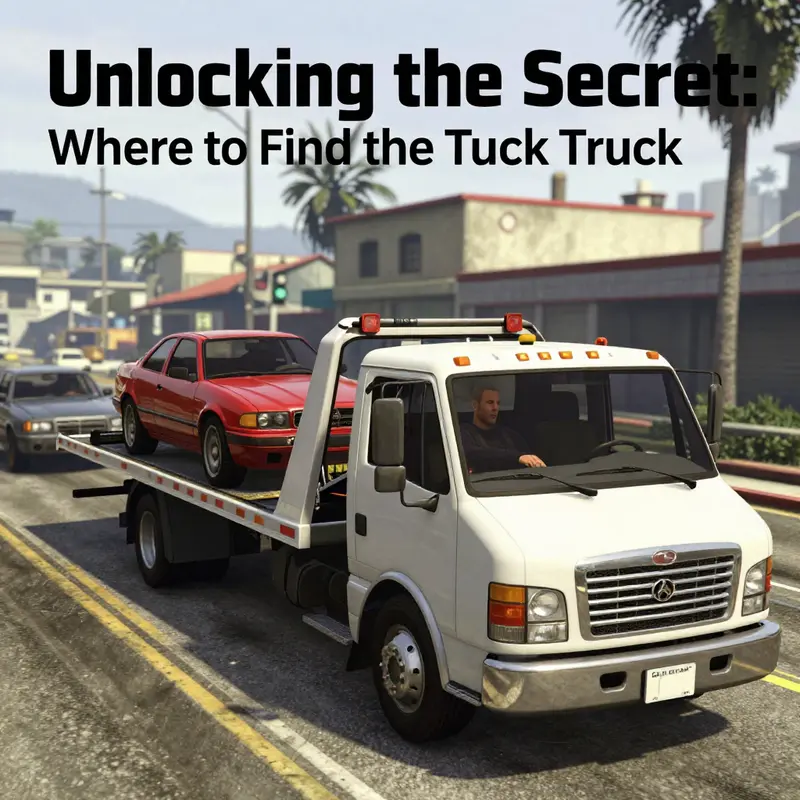
The Tow Truck in GTA Online stands out not as a mere helper vessel but as a purpose-built workhorse that can redefine how you approach cargo delivery in the expansive world of Los Santos and beyond. Its rugged silhouette, reinforced chassis, and heavy-duty design tell a story of durability and purpose, a vehicle whose true value emerges only when you push it through the tight passes of the highway network and the heavier payloads of freight contracts. In the online arena especially, where teamwork and precision decide outcomes, the Tow Truck becomes a strategic asset—a mobile depot, a stabilizing force on chaotic runs, and a surprisingly fast option when properly tuned. The fascination begins, as most players discover, with where to lay eyes on it in the game world. For those seeking a concrete starting point, the Tow Truck has a notable home base in the northern reaches of Los Santos, near the desolate sprawl of the Grand Senora Desert and not far from the intersection of Highway 110 and the I-405. This is the FIB lot—a location that, in the hustle of online heists and freight contracts, becomes a reliable anchor for players who want to test the vehicle’s mettle without waiting for a random respawn or a mission reward. The approach to this lot is almost as telling as the vehicle itself: you’ll find a hillside shortcut just before the FIB building’s main entrance that cuts up toward the freeway, a shortcut that rewards a careful driver with a quicker arc into the heart of the lot. It’s not just a matter of finding a parked truck; it’s a moment of tactical entry, where speed and positioning allow you to claim a machine that is often among the more in-demand tools for high-stakes cargo runs. The sense of discovery is part of the appeal, yet the practical why behind the Tow Truck’s design becomes clearer once you start loading up and heading out toward the work at hand.
Yet the story of the Tow Truck extends beyond this single spawn point. In the core GTA Online experience, this vehicle is not automatically waiting for players the moment they load into a mission or a free roam session. It has to be earned or acquired. Some players obtain it through the progression of cargo contracts and related missions within the Cargo series, while others may purchase it through the in-game vehicle dealership as a standard option in their growing stable of tools for delivery work. Once you unlock and purchase the Tow Truck, you can store it in your personal garage or access it through the Vehicle Locker system, ensuring that the moment a freight run is assigned, you’re not scrambling to borrow a friend’s ride or chase a random spawn. In some limited-time events or special offers, the Tow Truck can appear as part of a rotational lineup or as a reward for completing specific contracts, so keeping an eye on announcements and event pages remains a smart practice for those who want to optimize their fleet.
What makes the Tow Truck a standout choice for freight missions is not just its rugged aesthetic or its role in towing and recovery. It’s the combination of durability, upgrade potential, and tailored performance that makes it a surprisingly efficient platform for high-volume cargo work. The vehicle’s high durability and stability are more than marketing words: in practical terms, it’s built to haul large containers without the steady drumbeat of tire blowouts or chassis flex that can derail a run. When you couple that with the right modifications, the Tow Truck blossoms into a fast, responsive option whose acceleration and handling can outpace some traditional freight options when you’re properly equipped and well planned. The gains aren’t merely numerical—though the numbers do tell a compelling story. With the right under-the-hood upgrades, the Tow Truck can sprint to 0–100 km/h in a brisk 6.2 seconds under full load. That kind of acceleration shifts freight missions from a cautious crawl to a results-driven sprint, especially when facing the long corridors and sharp curves that define the map’s highways. It’s not just about raw speed; it’s about maintaining stability and control as you reel in the payload and navigate through traffic, wind, and the occasional enemy skirmish. The reinforced chassis, for example, is designed to minimize the risk of structural failure under heavy loads, while anti-explosion tires reduce the danger of tire blowouts during high-speed runs or volatile confrontations. In other words, this is a vehicle built not for flashy exhibitions but for dependable, repeatable deliveries where consistent performance matters more than a flashy pause on the curb.
To maximize the Tow Truck’s potential, players will want to lean into specific upgrades that align with the demands of cargo missions. A turbocharger is essential for rapid acceleration, giving you a decisive edge when you’re merging into fast-moving corridors or pulling away from threats while still loaded. Racing suspension directly enhances cornering stability, a critical feature when you’re negotiating tight turns with a heavy container in tow. Anti-explosion tires increase resilience, a safety net that matters most in those nerve-wracking moments when a pursuit or collision threatens to compromise the entire run. Finally, a reinforced chassis acts as a safeguard against the kind of mechanical stress that can derail an entire convoy or a convoy-like delivery in a crowded online session. Together, these upgrades don’t just boost speed; they elevate control, safety, and the confidence to push a freight mission to its conclusion. The practical effect of these enhancements is a vehicle that feels capable of handling fast routes across the city and desert outskirts alike, reducing the likelihood of container displacement or derailment during even the most aggressive maneuvers.
The strategic value of the Tow Truck in cargo operations is further amplified when you think about planning and teamwork. Cargo missions in GTA Online are rarely solo endeavors that end cleanly with a simple delivery. They demand route awareness, timing, and often a split of responsibilities among teammates: one driver handling the vehicle’s pace and steering through crowded lanes, another coordinating the loading and securing of cargo, and a third offering cover or escape in case of a challenge along the route. The Tow Truck’s performance characteristics, particularly with the suggested upgrades, support this collaborative approach. Its speed allows it to act as a lead vehicle on a fast highway stretch, while its payload-holding capacity and stability help avoid the chaos that can come with a partially loaded container. When your team enjoys strong communication and agreed-upon routes, the Tow Truck becomes more than a vehicle; it becomes a central instrument for reliable and repeatable cargo throughput, turning potentially lengthy, risky runs into a series of controlled, efficient deliveries. If you’re coordinating routes with teammates, consider pairing the Tow Truck with other specialized units that can handle escort duties, or with a plan that routes you through safer corridors that minimize the probability of sudden ambushes or traffic snarls. This is not just about getting from point A to point B; it’s about shaping the entire rhythm of your freight business in the game, where every run yields a little more experience, a little more reputation, and a little more cash.
As players chase opportunities to refine this setup, be mindful that the Tow Truck’s appearance in the game can also be tied to event-driven incentives. Special events or limited-Time offers can briefly elevate its visibility in the world, making it easier to see and more likely to appear in certain spawns or contracts. The dynamic of limited timing adds another layer to strategy: if you’re chasing efficiency, you might wait for an event to maximize your chances of acquiring the vehicle while still applying the upgrade strategy that suits cargo missions. In the broader GTA Online ecosystem, the Tow Truck’s longevity as a freight-focused tool hinges on a blend of access, unlocks, and ongoing optimization. It’s a vehicle that rewards patient accumulation of unlocks and careful investment in performance parts, while still offering a practical, real-world sense of purpose as a dedicated cargo machine that keeps large shipments moving with confidence.
For readers who want a practical starting point that blends world navigation with a snapshot of how the Tow Truck can be integrated into your GTA Online toolkit, the simplest approach is to locate it near the FIB lot and then commit to the kind of upgrade path that supports dependable freight work. With turbocharged acceleration, racing suspension for stability, anti-explosion tires for survivability, and a reinforced chassis for durability, you’ll discover that this isn’t merely a utilitarian vehicle but a capable, versatile platform that can carry you through the most demanding cargo missions with poise and speed. As you become more familiar with its handling, you’ll also find ways to optimize your routes, coordinate with teammates, and anticipate the moments when a well-timed dash through a busy freeway or a controlled, careful approach through a dense interchange will determine success rather than luck alone.
If you’re curious to explore further reading that aligns with the GTA Online optimization mindset, a detailed guide from IGN outlines strategy and builds for the Tow Truck, presenting a broader view of its capabilities within the online ecosystem. This resource offers a careful examination of how players approach cargo missions, what upgrades matter most, and how to balance speed with safety on some of the game’s busiest corridors. For additional real-world context that might inspire how you think about vehicle performance and reliability, you can explore related content linked here: tow-truck-washington-dc. As you map out your own freight routes in Los Santos and beyond, use these insights as a guide to shaping a robust, repeatable delivery workflow. External reference: https://www.ign.com/wikis/grand-theft-auto-v/Tow_Truck
Final thoughts
The strategic acquisition and efficient use of a tow truck in GTA 5 can significantly enhance a player’s business operations within the game. By knowing where to locate this valuable vehicle, particularly at the FIB lot, players can streamline their gameplay and ensure smooth vehicle management. As your virtual enterprises expand, leveraging the features of the tow truck, like transporting other vehicles or completing challenges, will provide a competitive edge in the dynamic world of Los Santos. Equip yourself with the knowledge to find and utilize the tow truck, and watch your in-game ventures thrive.