
For business owners navigating the vast realm of GTA V, understanding where to find a tow truck can be pivotal for both gameplay and operational efficiency. Tow trucks not only help in transporting vehicles but also play a significant role in various missions and tasks throughout the game. In the following chapters, we will delve into specific locations across Los Santos where you can locate these valuable trucks, the accessibility features that facilitate their use, and the purchasing and renting options available within GTA Online. This comprehensive overview will equip you with the knowledge you need to integrate towing capabilities into your GTA business strategy.
Hauling Through Los Santos: Tow Trucks in GTA V – A Practical Walkthrough
The city of Los Santos hums with a thousand little rituals, and one of the most useful, almost ceremonial rites for any player who spends time behind the wheel, is finding a tow truck when you need one. A tow truck in GTA V isn’t just a big truck with a hook; it’s a moving toolset, a portable workbench that can reshape how you approach missions, contracts, and the odd vehicular obstacle that blocks your path. The thrill comes not from stumbling on a single fixed point but from understanding how the city itself manages its resources, how the map’s appetite for work shifts with your whereabouts, and how you can align your own tactics with those shifts. In practical terms, that means knowing where tow trucks tend to cluster, and how to sift through the game’s channels to summon one when you want it.
The most reliable way to locate a tow truck in the current GTA V environment, especially within GTA Online, starts with something as simple as your character’s phone. The in-game device is more than a gadget; it’s a dynamic compass for vehicle availability. Open the phone, head to Jobs, and you’ll often find a Tow Truck option that reveals a rolling list of current locations. The listing itself is a map of the city’s pulse, updating as you move, so a spot that’s hot at one moment can cool at the next if you chase it too zealously. This is a feature you can rely on in the moment, rather than memorizing a dozen fixed spawn points you might not encounter during your session. It’s a smart, player-centric approach that keeps you aligned with the city’s cadence rather than chasing a rumor or a static waypoint.
When you start to map the physical geography of tow-truck spawns, a few neighborhoods become intuitive anchors. Ganton and La Mesa are traditional magnets for service vehicles, and you’ll often find a tow truck lounging near a garage that caters to the kinds of jobs you’re chasing. Rockford Hills and Davis offer their own clusters as you move across the map, each with a slightly different flavor of nearby activity. The idea isn’t to memorize a dozen fixed coordinates but to understand where these trucks tend to congregate as you move through these districts. If you’re in the Downtown area, for instance, glances toward Lester’s Garage or Los Santos Customs can yield a tow truck’s silhouette idling in the vicinity, ready for a quick hook-up and a swift departure. In more industrial zones, the back-door lanes around abandoned lots can also host a tow truck when the city’s day-to-day logistics tilt toward maintenance, accident response, or freight movements that players simulate in various contracts.
The city’s structural layout means a tow truck isn’t always just a spawn away from your current path; sometimes it requires a small detour. A practical approach is to think about your next objective and then scan the surrounding blocks for that ever-present taillight glow that signals a vehicle is ready for use. If you’re pursuing a mission that demands moving a vehicle from point A to point B or you’re coordinating with crew members who need a durable hauler, a tow truck can become a strategic asset rather than a mere utility. In those moments, the dynamic nature of the in-game map shines. The app’s location list, which responds to where you are in Los Santos, becomes not just a tool but a partner, guiding you toward the right bay, yard, or service station at the right time.
Beyond the city’s everyday layout, there are specific access points worth noting. The FIB lot, tucked toward the western edge of Los Santos near the Santa Maria Mountains and just south of the San Andreas Freeway, has earned a reputation as a reliable, if slightly less common, anchor point for tow trucks. Access to this area can be straightforward or a little circuitous depending on where you’re coming from and which entrances you choose. The main FIB Office entrance is a clear landmark, a large building with a distinctive presence that makes it easy to recognize on a late-night cruise. There’s also a secondary option—the parking area behind the building—where tow trucks are typically stationed when the inventory is in a lull or when the map’s current events leave the trucks parked rather than patrolling. For players who enjoy a little strategic exploration, the FIB lot offers a different flavor of urgency. It’s a reminder that tow trucks exist not only to tow but to relocate, to move between their usual nests and your own evolving plans.
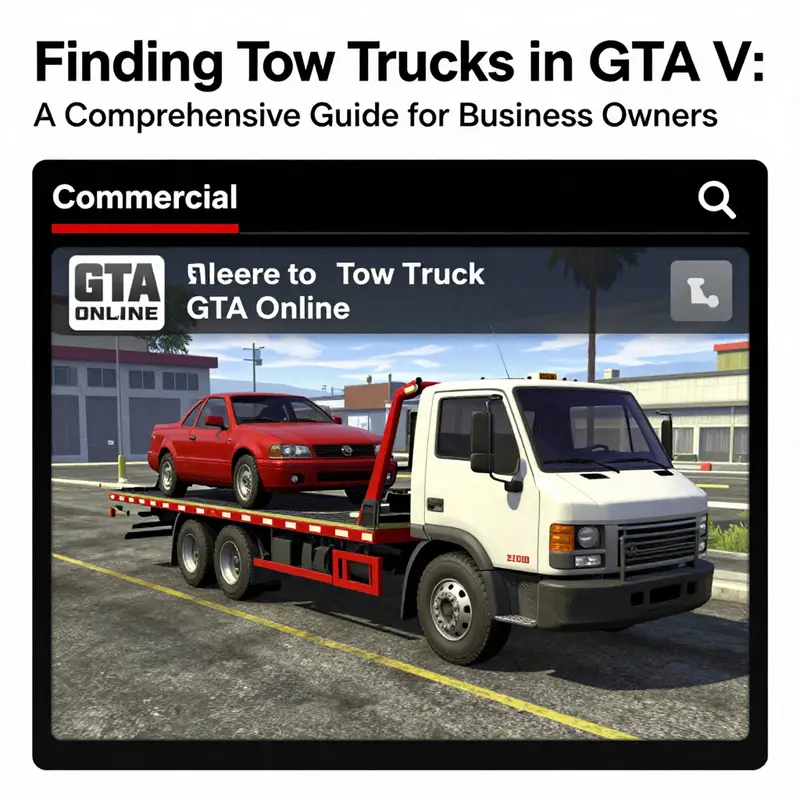
If you want to bring a tow truck into your own operations on a more permanent basis, you can actually acquire one through the game’s menu. In GTA Online, the LSPD / FIB dealership option under the Vehicles category—specifically the Commercial section—lists Tow Trucks for purchase or rent. This is a meaningful option when you want predictable access, a vehicle you can count on in any session, and the peace of mind that comes with a dedicated piece of equipment ready at a moment’s notice. The practical benefit is not only having a tow truck but also being able to tailor it for specific tasks, from hauling cargo in contract modes to moving other vehicles during a mission. It’s a small investment that pays off through the countless times a tow truck proves its worth during late-night operations, high-stakes heist setups, or more straightforward courier runs where efficiency matters.
To enrich your knowledge of tow truck spawns and to stay current with community-tested routes and tips, the GTA community remains an invaluable resource. Fan forums, discussion boards, and subreddits teem with posts about precise spawn locations, frequent hotspots, and even maps that players have painstakingly compiled and shared. These spaces are not simply nostalgia lanes but practical repositories of collective experience. They offer pin-point cues about where the city’s trucks might appear as you navigate different time cycles, weather conditions, or mission arcs. The game’s ecosystem rewards curiosity and shared exploration, especially when you’re trying to train your eye to spot a tow truck in a busy intersection, a dimly lit back alley, or a bustling industrial complex.
In terms of reliable, up-to-date references, many players turn to well-maintained guides and fan-built resources that map spawn points, along with tips on maximizing yield from a tow truck during various job types. The approach to using these resources is pragmatic: treat them as supplementary, not gospel. Use the in-game app to locate a tow truck in real time, cross-check with community posts for a possible hotspot, and then decide whether you want to pursue a spawn you know is reliable or venture toward a nearby cluster that might be more productive at that moment. This balance between live data and community-tested insights keeps you nimble and ready to respond to Los Santos’s shifting rhythms.
As you move through this city’s continuum of activity, you begin to understand that a tow truck is more than a tool for moving wreckage or assisting in a gridded contract. It is a conduit for resourceful play, a way to choreograph your own mobility, and a catalyst for creative problem solving on the fly. Whether you’re chasing the quiet efficiency of a mission that requires a well-placed tow hook or you’re simply adding a reliable hauler to your arsenal for future jobs, the city’s landscape rewards those who learn to read the map’s subtle signals—the slight glint of a vehicle’s chrome, the way headlights slice through a narrow alley, the soft glow of a station’s sign in the late hours. In the end, locating a tow truck in Los Santos becomes less about chasing a single point and more about learning the city’s tempo and letting your instincts, enhanced by the game’s tools, guide you toward the truck you need for the moment you need it.
External resource: https://www.ign.com/wikis/gta-5/Tow_Truck
Locating the Hauler: An Immersive Guide to Finding and Using Tow Trucks in GTA V
In GTA V, the tow truck is more than a tool of necessity; it’s a mobile workshop, a strategic platform, and sometimes the hinge that holds an entire mission together. The city of Los Santos rewards foresight and resourcefulness, and the tow truck, with its sturdy hitch and reliable grip, becomes an extension of your team’s coordination. It is a vehicle built for control, not just power, and that distinction matters when you’re threading a plan through crowded streets, tight loading zones, or the high-stakes tempo of a crew job. The search for this asset begins with a practical anchor near the western edge of Los Santos—the FIB lot. This location sits against the backdrop of the Santa Maria Mountains and just south of the San Andreas Freeway, a corridor that channels traffic and suspense in equal measure. Access is straightforward: you can approach through the FIB Office entrance, the angular structure marked by its red-and-gold sign, or you can drive directly into the parking area behind the building where tow trucks are typically parked and ready for action. The layout is designed to reward players who move with purpose. In GTA Online, ownership or rental of a tow truck is not left to chance. The path to procurement runs through the LSPD / FIB vehicle dealership option in the game’s menu—Vehicles → Commercial → Tow Trucks. This is more than a convenience; it’s a reliable way to ensure that you have a tow capable of meeting the demands of a mission, even when the map forces you into tight alleyways or long-haul operations where timing matters as much as horsepower. Once in your hands, the tow truck expands your operational envelope in visible, practical ways. It becomes a multiplier for efficiency in contracts like Freight Cargo, where moving containers to staging zones can be the difference between success and a stalemate. It also shines in crew jobs, where you might need to re-locate vehicles to clear a path, reposition a car that’s blocking a route, or simply extract a compromised asset from a tricky scenario. The actual act of towing is intentionally straightforward, designed so you can focus on strategy rather than wrestling with controls. Approach the target vehicle and align your hitch with the car you intend to tow. The interaction key—E on PC, the corresponding button on consoles—engages the towing mode, secures the vehicle, and allows you to haul it away. In the heat of a heist or a sprint through a high-pressure contract, this simplicity becomes your advantage. You can move a car to a safer location, reposition a vehicle for a better getaway line, or relocate a stolen ride without drawing unnecessary attention. The tow truck’s straightforward mechanics also support a more nuanced approach to mission design. Rather than a blunt instrument for brute force, it becomes a precise tool for managing space, controlling the flow of vehicles, and creating space for your teammates to maneuver. This is particularly valuable in crowded urban segments where space is at a premium and every second counts. The game’s dynamic nature means you shouldn’t rely on a single spawn point for your tow truck. The FIB lot is the most dependable anchor—consistent enough to form the backbone of your planning—but other spawn points drift into view as session dynamics shift. Some players report that tow trucks appear near industrial yards or construction zones that skirt the edges of Los Santos, places where heavy equipment routinely parks and where the game’s traffic design mirrors real-world logistics pressures. The knowledge that spawn points can rotate invites a patient, observant approach: check back after completing a run, and keep an eye on the map for a hint of a tow truck’s silhouette in a back lot or a service area. Beyond the city’s core, the lore around tow trucks in this virtual world hints at a broader ecosystem—one where dealerships, yards, and repair facilities intermittently host operators ready to lend a tow. While the FIB lot remains the most stable anchor, the Maze Bank area and downtown fringe scenes have become part of players’ collective memory, especially for those who run long, multi-point operations across the map. This broader awareness matters because, in GTA V, the right vehicle at the right moment can multiply your crew’s effectiveness. When you’re ready to deploy, the tow truck’s utility extends beyond mere vehicle transport. You can use it to reposition stubborn cars, clear paths for a material drop, or secure a vehicle as a temporary asset during a hold or a staged exchange. The equipment’s abilities align well with the game’s emphasis on planning and precision: you study the terrain, position your tow, and then execute with a calm efficiency that keeps your team in sync. The real-world echoes of this approach can be instructive. Understanding how tow trucks function in the real world—types, loading strategies, and safety considerations—gives you a more robust mental model for the game’s physics and physics-like constraints. A reputable resource on towing practices lays out the fundamentals of when to use different configurations and how to handle diverse vehicle profiles, offering a helpful bridge between the digital and the real. For players who want a quick, practical bridge between GTA V’s tow service mechanics and real-world know-how, many will also find value in exploring related resources that discuss towing services and best practices in real life. As you refine your in-game technique, you may find yourself drawing parallels to the way real-world haulers approach loading, securing, and transporting vehicles across varying terrains. If you want to explore these real-world insights further, you can follow a trusted external guide that discusses tow trucks and their applications in greater depth. It can provide a broader perspective on how different vehicle types influence towing strategy, a concept that translates neatly into your approach to in-game tasks and mission planning. Finally, one practical tip ties everything together: keep an eye on mission briefs and crew instructions, then map your tow truck’s path to avoid bottlenecks. The city’s rhythm rewards a measured pace, thoughtful positioning, and the ability to adapt your plan as on-screen conditions change. In the end, locating and using a tow truck in GTA V isn’t just about having a vehicle you can hook to another car. It’s about integrating a reliable, flexible tool into your strategic play—one that enables you to move, manage, and maneuver with confidence. The FIB lot remains the most dependable anchor for getting a tow truck when every second counts; the GTA Online menu’s commercial pathway gives you control over ownership or rental, ensuring you’re never left stranded by a failed pickup; and the broader map hints at additional opportunities if you’re patient and observant. With practice, the difference between a tense, chaotic moment and a smooth, orchestrated operation often comes down to the choice to bring a tow truck into the frame and the discipline to use it with precision. For players who want to connect the digital with the tangible, consider the value of real-world perspectives on towing to sharpen your strategic instincts and improve your in-game execution. If you’re curious about a real-world resource that aligns with these ideas, you can explore this external guide for a broader context on towing practices and how they apply to varied vehicle types. And when you’re ready to broaden your in-game toolkit even further, a linked internal resource can offer practical insights that echo the same principles of accessibility and reliability described above, such as a local towing service page that aligns with the same problem-solving mindset you bring to Los Santos. The goal is simple: build a dependable workflow around the tow truck, so you’re ready to react calmly to the city’s unpredictable rhythms, move vehicles with purpose, and keep your crew coordinated as you push toward the next objective. In the larger scheme of things, your mastery of the tow truck reflects a broader competence—the ability to turn a single asset into a strategic advantage and to translate that advantage into mission success and smoother, more efficient play. External reference: IGN’s GTA 5 Guide: Tow Truck. https://www.ign.com/wikis/gta-5/Tow_Truck
null
null
Final thoughts
Understanding the ins and outs of locating, using, and acquiring tow trucks in GTA V offers business owners a strategic advantage. With the right tools at your disposal, you can enhance your gameplay, expand your operations, and tackle missions more efficiently. By leveraging the information presented, you can seamlessly incorporate towing capabilities into your business model, ensuring you are always prepared for the challenges that arise in the dynamic world of Los Santos.