
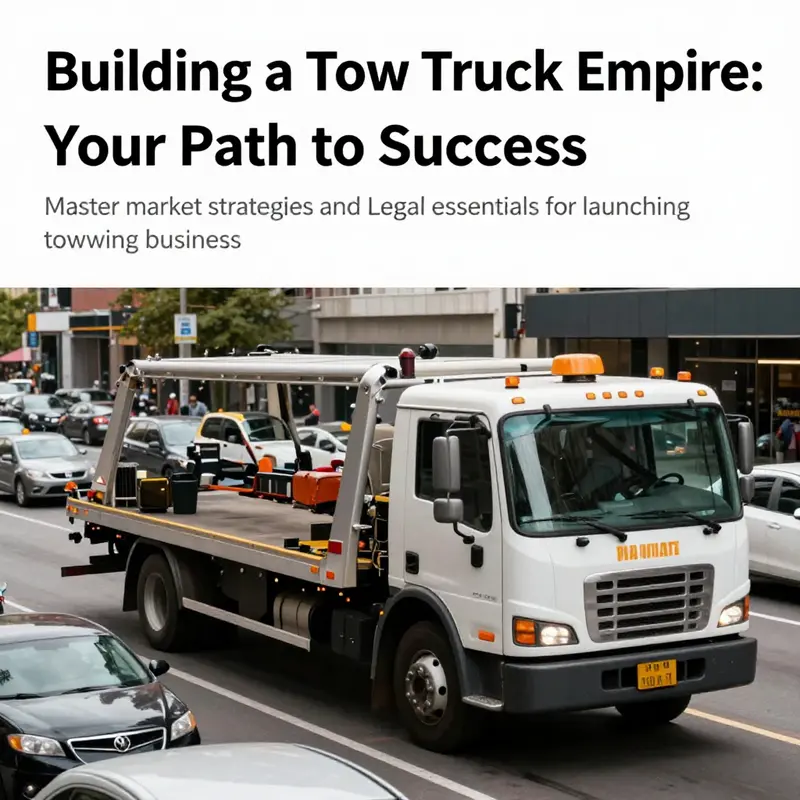
Launching a tow truck company requires a blend of strategic market analysis and compliance with legal standards. This venture is not just about towing vehicles; it’s about establishing a reputation for reliability and professionalism. Chapter one delves into market research and business planning, guiding you through identifying your target audience and crafting a comprehensive business strategy. In chapter two, we’ll address the maze of legal requirements and insurance needs crucial for protecting your investment. Navigating both aspects ensures a solid foundation for your tow truck enterprise.
Toward a Sound Start: Market Insight as the Engine Behind a Successful Tow Truck Company
Market research and planning are not mere formalities; they are the compass and the fuel for a tow truck business that lasts. The journey from idea to operation begins with listening to the market and translating what you learn into a living plan. You will not simply buy a truck and hope customers appear. You will uncover where demand lives, who pays for it, and how you can stand out without overspending. This chapter weaves market awareness into a practical blueprint, showing how to size your opportunity, shape your service mix, and write a plan that aligns with real-world constraints. The result is a road map you can follow, adjust, and defend when times get tight or when the next big opportunity arrives. Real-world markets demand precision, not wishful thinking, and that precision starts with rigorous, honest inquiry.
Market Research begins with knowing the local heartbeat of towing needs. Start by identifying the most likely high-demand zones: areas with dense populations, frequent commercial traffic, and clusters of repair shops that rely on rapid response. Look beyond your immediate street corner. Consider the proximity of collision centers, insurance partners, and fleet operators that frequently require tow services. Gather data on call frequency, typical service windows, and preferred response times. This is not just about what you can offer, but about understanding what the market already expects from a tow partner and where you can deliver a step above. The more you know about when and where people need help, the better you can plan routes, staffing, and equipment.
Within this framework, your target customers become more concrete. Auto repair shops, body shops, and insurance companies are natural anchors because they generate recurring demand. Individual drivers come into play during emergencies or roadside events, and they reward reliability and transparent pricing. By mapping these segments, you can tailor your value proposition: faster response for fleet clients, flexible scheduling for repair shops, fair pricing with clear terms for individuals. It’s important to ask if your area supports a two-tier service model—where fast, premium dispatch serves high-value accounts and a more economical, chat-based or phone-based offer covers individual calls. The aim is to design a service portfolio that fits cash flow needs while remaining competitive against incumbents. As you refine customer profiles, consider a simple model that links revenue potential to service level, geography, and seasonality. In practice, you’ll want to chart where each customer type tends to cluster and how far you have to travel to reach them, because distance translates into fuel costs, wear on vehicles, and response times that shape client satisfaction.
Another pillar of market insight is the competitive landscape. Inventory the number of tow operators within your chosen service area and categorize their offerings. Do they specialize in light-duty roadside pulls, or do they deploy heavy-duty equipment for commercial fleets? How do they price services—flat rates for basic tows, higher charges for after-hours calls, or tiered pricing by distance and vehicle weight? Read customer reviews to identify strengths you can emulate and gaps you can exploit. If several operators barely mention safety and compliance, that creates an opening to brand your business as meticulous and transparent. Conversely, if a competitor dominates a particular corridor with rapid response and predictable pricing, you may need to diversify services or optimize dispatch to compete without a race to the bottom on price. A map-intensive approach—plotting coverage, response times, and competitor footprints—helps you see unserved pockets and decide where to add trucks or subcontractors most effectively.
Understanding traffic patterns and local dynamics connects the dots between demand and your operational footprint. Urban cores may deliver frequent calls but also come with parking restrictions, higher insurance costs, and tighter regulations. Suburban corridors might require longer travel times yet offer steadier demand and lower incident rates. Weather, events, and seasonal changes shift demand predictably in many regions, so your plan should incorporate a flexible fleet model. For example, a small fleet with one or two flatbeds might cover most emergencies in a mid-sized city, while a suburban area with commercial fleets could justify a wheel-lift specialization. This is not speculation; it’s risk-aware modeling that weighs call probabilities, travel times, and the cost of idle trucks during slow periods. The more your data tells you the story of demand, the more confidently you can justify the investment in equipment and people.
A core, often overlooked, aspect is regulatory alignment. Licensing, insurance mandates, background checks, and bonding requirements are not merely hurdles; they define the operating envelope and future growth. A plan built on loose regulatory assumptions often collapses when a license renewal slips or a bond needs updating. Begin by listing the licenses and permits your jurisdiction requires for both the company and individual drivers. Map out renewal cycles and associated costs, and track any anticipated changes in rules that could alter your compliance burden. Your market research should reveal how regulators view competitors in your area, whether there are preferred practices around reporting and incident responses, and how much emphasis local authorities place on safety training and vehicle standards. When you approach licensing with clarity, you reduce the risk of sudden downtime and set a standard for your team that customers can trust.
With market insight in hand, the second act is to translate it into a plan that guides every decision. A robust business plan is more than a collection of numbers; it is a narrative that ties your market observations to concrete actions. Start with an executive overview that captures your mission, service scope, and the customer value you intend to deliver. Move into a company description that clarifies your operating model—whether you’ll own and operate your fleet, whether you’ll engage subcontractors in peak periods, and how you will scale responsibly as demand grows. The marketing plan should spell out how you reach the target customers you identified: direct outreach to local repair shops, partnerships with insurers and roadside assistance programs, and a digital presence that supports visibility and trust. The plan should also acknowledge the competition you mapped, explaining how you will differentiate through reliability, clear communication, and a transparent pricing structure.
Financial planning anchors the plan in reality. Start with startup costs: the number of tow trucks you intend to acquire or lease, the type of equipment each truck will carry, the costs of insurance and bonding, and the initial licensing expenditures. Then lay out ongoing expenses: fuel, maintenance, tires, overtime premiums, salaries, and administrative costs. Revenue forecasts should be grounded in expected call volumes, service mix, and pricing strategies that reflect your market position. Build scenarios for best, moderate, and conservative cases, noting how cash flow shifts with seasonal demand and with the onboarding of new partners. A well-crafted forecast also accounts for ramp-up time—how long it takes to reach steady state as you secure accounts and expand your service area. Contingency planning deserves a dedicated section, outlining steps to maintain operations during slow seasons, supply chain hiccups for equipment, or regulatory delays. The end goal is a plan you can share with lenders or investors, but more importantly, a plan you can live by when choosing equipment, scheduling shifts, and pursuing partnerships.
The practical value of this work becomes evident in the decisions that follow. A well-researched market basis informs which service lines to pursue first, where to stage vehicles to optimize dispatch, and how to price to win without eroding margins. It explains why you might choose a two-truck start in one neighborhood and a more incremental expansion in another. It clarifies the trade-offs between owning and leasing, the balance between full-time drivers and on-call specialists, and the required investments in safety training and software tooling. It also helps you communicate to prospective lenders or investors with credibility. When you can articulate the market dynamics you studied—the demand pockets, the customer preferences, the competitive edge, and the regulatory landscape—you replace guesswork with strategy. Your plan becomes a living document that guides hiring, equipment selection, fleet logistics, and customer acquisition. As you develop it, remember that external resources can add depth. For a practical, industry-focused framework on setting up operations, managing finances, and building teams, you might explore structured courses that tailor the fundamentals to towing. See an example of specialized guidance through this external resource: https://www.udemy.com/course/tow-power-masterclass-how-to-start-a-tow-truck-business/?couponCode=2026MARCH. And to observe grounded market realities in action, consider exploring local service profiles such as the Washington DC towing service page to understand how established operators present themselves and position value in a competitive market.
To anchor your plan in a real-world context, you can examine how a known local operator structures its outreach and service footprint. In markets with dense commercial activity and a high demand for dependable response, a well-documented approach creates trust, speeds onboarding, and lowers friction for new customers. A thoughtful plan translates market signals into disciplined actions: precise dispatch routes, predictable pricing, and transparent communications that reassure customers in stressful moments. The deeper you go into market research, the more your plan reflects lived realities rather than assumptions. In turn, this reduces risk, speeds up the path to profitability, and helps you recruit staff who share a clear understanding of the business’s service standards. The end result is not a perfect map, but a robust compass—a guide that keeps you aligned with evolving market conditions while preserving the core of your value proposition: dependable, safe, and professional towing when it matters most.
As you finalize the market research and refine the business plan, keep in mind that your documentation should speak to both the future you envision and the constraints you will inevitably encounter. The most successful tow operations balance ambition with pragmatism: they invest in the right equipment, cultivate reliable partnerships, and maintain compliance as a continuous priority. They also build processes that scale, so a growth opportunity does not overwhelm service levels or finance. If you’re seeking a practical framework as you start, remember that a structured course focused on towing operations can provide step-by-step guidance tailored to this industry. For direct learning aligned with the path you’re pursuing, you can explore resources like the Tow Power Masterclass mentioned earlier. This kind of targeted education can accelerate your readiness and help you avoid common missteps while you lay the groundwork for a sustainable, reputable tow truck company. For broader exposure to regional market dynamics and service footprint ideas, you may also study local profiles such as the Washington DC towing service page to see how successful operators communicate value and reliability on multiple channels.
In sum, market research and business planning are not box-ticking tasks; they are the work of turning observation into capability. When you know where demand lives, who pays, what competitors do well, and how regulations shape operations, you can design a service that consistently meets needs without overextending. The plan then becomes both a promise and a roadmap: a promise to customers that you will show up fast, do the job right, and be forthright about pricing; and a roadmap for you and your team that translates data into disciplined actions, predictable cash flow, and meaningful growth across the years ahead. The road from market insight to launch is not always straight, but with careful research and a clear plan, you can traverse it with confidence and clarity.
Legal Foundations on the Road: Licensing, Registration, and Insurance Essentials for Launching Your Tow Truck Company
Launching a tow truck company means more than buying a wrecker and posting a sign. It requires a disciplined understanding of the legal terrain and the financial protection that insurance provides. The road to legitimacy begins long before a first tow and continues long after the tires roll for the first real job. A solid legal and insurance framework acts as both a shield and a scaffold: it protects your business from costly disputes and creates a reliable platform for growth, partnerships, and long-term contracts with insurers, body shops, and municipal fleets. In practice, the journey rests on a few core pillars—business structure, registration and licensing, driver qualifications, and a carefully engineered insurance program—that together determine how you operate, how you price your services, and how you survive the inevitable bumps along the way.
Choosing the right business structure is more than a tax choice; it shapes liability and the way banks and potential partners view your enterprise. Most new towing operations opt for an LLC or a corporation because these structures provide a level of personal shielding from business debts and legal claims. An LLC, in particular, balances simplicity with liability protection and flexible tax options, making it a popular fit for small-to-midsize fleets. But every market is different, and the best fit depends on financial goals, risk tolerance, and growth plans. After you settle on a structure, the next step is to register your business with the state and local authorities. This process typically begins with selecting a unique business name and filing it with the state, followed by obtaining an Employer Identification Number (EIN) from the IRS. An EIN is not just a formality; it’s essential for opening a business bank account, hiring employees, and filing taxes. It also signals to suppliers and partners that you are a legitimate enterprise with distinct tax responsibilities.
Beyond registration, towing involves a mesh of local and state licenses. In many jurisdictions, a basic business license from the city or county is just the starting point. A separate towing license or permit frequently exists and may require a background check, proof of bonding, evidence of proper insurance, and sometimes a written exam on state towing laws and procedures. Some states also require specific approvals for the type of towing you will perform—flatbed, wheel-lift, recovery, or wheel removal—each with its own set of equipment standards and safety rules. You should expect a regulatory landscape that emphasizes safety, accountability, and clear consumer protection. This means keeping current with ongoing license renewals, maintaining up-to-date insurance, and ensuring your fleet meets state equipment and lighting requirements.
A commercial driver’s license (CDL) is a non-negotiable credential if your operation uses trucks that exceed certain sizes or weight limits. Depending on the truck class and configuration, operators may need CDL endorsements for towing. The licensing requirements are not just about the driver’s skill; they reflect the public’s expectation that commercial tow operators can handle large, potentially hazardous loads with care and precision. In addition to the CDL, you should consider providing ongoing training on safe towing practices, secure vehicle handling, and defensive driving. A well-trained team reduces the risk of accidental damage to customer vehicles and minimizes your liability exposure. Driver qualification isn’t only about compliance; it’s a cornerstone of customer trust. A clean driving record and documented training can become differentiators when insurers review your exposure and when you bid for contracts with insurance pools, repair shops, or municipal fleets.
The beauty—and the burden—of legal compliance is that it creates a formal framework that helps you manage risk. This is where insurance becomes more than a cost center. It becomes an operational discipline. General liability insurance protects your business from claims of property damage or bodily injury that arise from ordinary operations, such as a slip-and-fall in a customer’s driveway or a collision while en route to a call. But general liability alone does not cover the full spectrum of towing-specific risks. Your commercial auto insurance is critical because tow trucks are specialized vehicles used in demanding conditions. Regular auto policies typically exclude commercial towing activities. A tailored policy covers not only physical damage to your own equipment but also liability for damage or loss arising from towing operations, including incidents in which your truck is involved in an accident while responding to a tow or while loading a vehicle.
A pivotal, sometimes overlooked, element is bonding. A surety bond, often referred to as a towing bond, is frequently required by state or local authorities. Bonds provide a public-facing guarantee that you will operate in good faith and comply with applicable laws and regulations. In many places, the bond helps the community recoup losses or damages that result from improper or fraudulent towing practices. Failing to maintain an adequate bond can trigger serious consequences, including fines, license suspensions, or restrictions on operating grounds. By contrast, a properly structured bond can strengthen your credibility with clients such as police departments, insurance carriers, and repair shops who need reliable, accountable partners.
In the realm of insurance, the typical suite you will assemble includes general liability, commercial auto, and a bond, but the specifics don’t stop there. Tow-truck liability insurance is a specialized line that covers incidents unique to recovery operations—things like improper towing, damage to a customer’s vehicle during loading or transport, or incidents that occur during winching. For some operations, cargo insurance is essential because it protects the vehicles you are transporting from damage and loss while they are in your custody. Physical damage coverage protects your own tow trucks from damage arising from collisions, theft, vandalism, or other perils, while ensuring you meet the lender or lease requirements that often accompany financing of multiple heavy-duty units. The exact coverage levels and deductibles should reflect your risk profile, your average trip radius, and the nature of your engagements—whether you frequently handle high-value vehicles or operate in a high-traffic environment with tighter margins.
The risk calculus for a tow business is unforgiving but manageable with the right structure. When you consider the penalties for gaps in coverage, the logic becomes clear. Inadequate insurance can lead to fines, license suspensions, or even personal liability in the event of a severe accident. The economic impact can be devastating: a single uninsured claim could erode profits, jeopardize payroll, or freeze access to financing. Moreover, many clients—especially insurance adjusters, auto body shops, and fleet operators—will only contract with firms that demonstrate robust insurance coverage and a dependable compliance track record. This makes coverage not merely a protective shield but a competitive differentiator in a crowded marketplace.
The practical path to building this foundation begins with a careful, proactive approach to documentation and process. Start by mapping your licensing requirements to the places you intend to operate. If your market spans multiple jurisdictions, you may need to track several sets of rules for licenses, endorsements, and bonding. Create a centralized compliance file that includes copies of business registrations, licenses, CDL certifications, bonds, and certificates of insurance. Regular audits of your documentation can prevent small lapses from escalating into operational shutdowns. Your internal policies should clearly delineate who handles renewals, how you verify driver credentials, and how you maintain records of training and performance. This is not merely clerical discipline; it is a strategic hedge against disruption in a market where authorities enforce rules with increasing rigor.
As you implement these protections, think about how to communicate them to partners and customers. A well-documented licensing and insurance posture can simplify negotiations with insurers and fleet customers and can reassure body shops and police departments that you operate professionally and within the law. It also supports your marketing narrative. When you present your business to potential clients, you can articulate a clear boundary of responsibility, a predictable pricing model supported by comprehensive coverage, and a history of compliant operations. In markets with tight regulatory control, your reputation for compliance can become as valuable as a fast response time or a courteous driver.
To ground these considerations in real-world practice, consider looking up resources that map licensing and permit requirements by state. The U.S. Small Business Administration offers state-by-state guidance on licensing and permits, a reliable starting point for understanding how your local environment may shape your compliance journey. For those who operate in more tightly regulated markets or who plan to scale beyond a single city, this resource can help you anticipate where to invest time and money to stay ahead of changes in the regulatory landscape. External guidance like this supports the strategic decision-making that underpins your insurance strategy and licensing roadmap. See SBA Licensing and Permits for a practical overview of what to expect as you begin formalizing your plan.
In a practical sense, your chapter of compliance will be easier if you anchor your actions to a single, credible plan. In the early days, you might align with a local partner who has navigated licensing and bonding in your target area. For example, in regions where you anticipate steady demand from police departments, towing services, and insurance companies, you could reference local practice through established service pages that outline capabilities and service areas. An internal link to a local reference like a DC-area towing service page can illustrate how a credible operator presents itself to customers while you build your own robust policies. For instance, you can explore how a dedicated towing service in Washington DC communicates credentials and reliability while maintaining compliance standards. This kind of local exemplar can inform your own branding and operations without compromising your independence or regulatory obligations. tow-truck-washington-dc
As you develop, keep in mind that the regulatory landscape is not static. Laws, licensing processes, and insurance requirements can shift with market conditions, safety standards, and driver safety concerns. A proactive stance—regularly reviewing renewal dates, ensuring continuous coverage, and staying engaged with licensing authorities—will keep you from facing unexpected interruptions. You will find it valuable to establish a cadence of quarterly reviews that assess whether your licenses remain current, whether your bonds are adequate for your current scale, and whether your insurance limits align with the risks you actually face on the road. This ongoing stewardship is what separates a start-up with potential from a durable, trustworthy operator with a track record of reliable service.
For those who are just beginning, the end goal is simple to articulate: create a legally compliant, financially protected foundation that supports a dependable, professional towing operation. The legal framework—the licenses, registrations, and endorsements—establishes your authority to operate. The insurance program translates that authority into practical protection against the financial risks inherent in towing work. When both are in place, you position your business to respond quickly to calls, meet customer expectations, and partner with insurers, repair shops, and municipalities on favorable terms. The pathway requires diligence, a clear understanding of state and local requirements, and a commitment to maintaining coverage aligned with your fleet’s evolution. In this sense, legality and protection are not restrictions; they are enablers of strategy, growth, and trust in a market where every tow can carry both risk and opportunity.
External resources for broader regulatory guidance can provide a valuable complement to your in-house compliance efforts. See the U.S. Small Business Administration’s Licensing and Permits guidance for a state-by-state overview that helps you anticipate required steps before you launch. https://www.sba.gov/business-guide/launch-your-business/understand-licensing-and-permits
Final thoughts
Successfully launching a tow truck company hinges on thorough market research and understanding legal obligations. By connecting with local needs and ensuring compliance, you pave the way for a reputable and profitable business. Embrace the challenges ahead with a well-crafted plan and a commitment to quality service, and watch your tow truck company thrive in a competitive landscape.