

In the dynamic world of business, visual skills play a pivotal role in how companies present themselves and engage with their audiences. For business owners, the ability to convey ideas visually can be as important as the words spoken or written. Drawing a tow truck, for instance, may seem like a trivial skill, but it holds significance in branding and marketing strategies for towing companies and other related businesses. Not only does it help in creating memorable logos and business cards, but it also enhances the overall appeal of presentations and promotional materials. This article aims to guide business owners through the process of drawing a tow truck step by step, equipping them with the skills to boost their visual communication. Whether you are working on towing services in Burke or planning a branding initiative in Alexandria, understanding how to depict essential elements of your business can set you apart in a competitive market. Let’s explore how this simple yet effective skill can make a substantial difference in your business’s visual identity.
Materials Needed for Drawing a Tow Truck
Drawing a tow truck can be an engaging creative process, whether you’re a beginner or have some experience. Here’s a comprehensive list of materials and tools that will prepare you for the drawing process.
Traditional Drawing Tools
-
Paper Types:
-
Sketch Paper: Ideal for preliminary sketches due to its medium texture.
-
Bristol Board: Offers a smooth surface for detailed work, perfect for finalizing your drawing.
-
Construction Paper/Cardstock: Great for robust sketches, especially if creating templates or models.
-
Pencils:
-
Graphite Pencils: A range from HB to 4B is recommended for versatility in shading and outlining.
-
Colored Pencils: Useful for adding vibrant colors to your tow truck design.
-
Erasers:
-
Kneaded Eraser: Excellent for lightening pencil marks without damaging the paper.
-
Vinyl Eraser: Effective for cleaning up mistakes without tearing the paper.
Digital Drawing Tools
- Graphics Tablet: Consider a Wacom Intuos or iPad Pro for pressure-sensitive drawing.
- Drawing Software: Programs like Procreate or Adobe Fresco allow for layers and fluid strokes.
These materials will set you on the right path to creatively expressing your vision of a tow truck. For more tips on towing services, learn more about our services in Arlington.
Basic Truck Drawing Techniques
Drawing a truck, especially for beginners, may seem daunting, but with the right techniques, you can create impressive illustrations. Here’s a step-by-step guide focusing on shapes, proportions, and perspectives.
1. Start with Basic Shapes
To begin, break down the truck into simple geometric shapes:
- Cab: Draw a large rectangle to represent the truck’s main body.
- Bed: Add a slightly longer rectangle at the back for the cargo bed.
- Wheels: Use circles or ovals for the tires, ensuring they are proportionate to the truck’s body. You can refer to this useful WikiHow guide for visual examples.
2. Establish Proportions
Understanding proportions is crucial. A typical truck’s cab is around 1/3 the total length of the truck. To maintain balance:
- The truck’s wheels should be about 1/4 the height of the cabin.
- Position the wheels so that they sit under the truck’s body, aligning with the front edge of the cab and the back edge of the bed.
This will help create a visually appealing and realistic truck.
3. Add Details
Once the basic shapes are in place, it’s time to add details:
- Grilles and Headlights: Trucks often have distinctive grilles; detail these by sketching in horizontal lines. For headlights, small circles at the front end will suffice.
- Windows and Mirrors: Add rectangular shapes at the top of the cab for windows, and extend small rectangles or circles for mirrors.
- Cargo Details: If you’re drawing a tow truck, consider adding elements like chains or hooks, especially if it’s towing another vehicle. For inspiration, check the detailed drawing tutorial from Drawspace.
4. Perspective Matters
To give your truck the illusion of depth:
- One-Point Perspective: This technique is useful for side views. Draw the truck facing straight on, with vanishing points on either side.
- Two-Point Perspective: This is great for three-quarter views. Use vanishing points on the horizon line to help align the edges of the truck correctly.
5. Final Touches
After laying down the lines and details, finalize your drawing:
- Erase any unnecessary sketch lines and gently darken your final lines.
- Shading can add depth; consider where the light source is and add darker shades to areas that would be in shadow.
- You can also add some color; tow trucks often have bright colors that can make them stand out.
Practice Makes Perfect
The more you draw, the better you’ll become. Use reference images and practice regularly. For more about the towing business and its visual representation, explore our contact page for any professional needs you may have. Happy drawing!
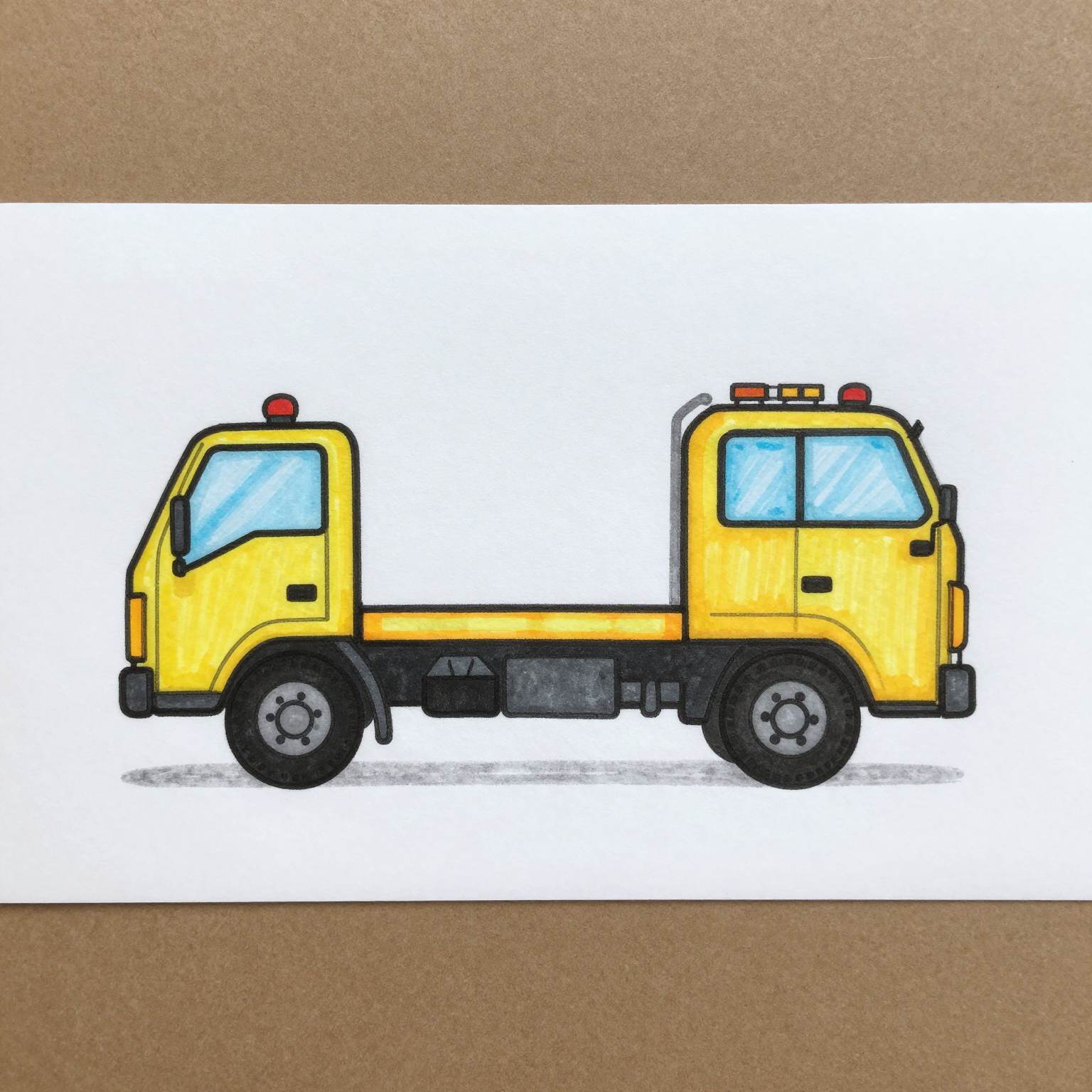
Sketching the Basic Outline of a Tow Truck
Sketching a basic outline of a tow truck is a fundamental skill for artists, especially those looking to capture intricate vehicle forms accurately. By starting with simple shapes, you can create a strong foundation that enhances your understanding of proportions and spatial relationships. This technique not only simplifies the process but also provides a clear roadmap for adding details later on.
Importance of Sketching
The significance of sketching lies in its ability to establish the backbone of your artwork. According to ArtTutor, sketching helps determine proportions, placement, and overall structure, ultimately reducing the risk of errors. This preliminary phase encourages experimentation and builds confidence as artists learn to visualize their ideas before committing to final lines.
Getting Started
To begin sketching your tow truck:
-
Start with Basic Shapes: Draw rectangles for the truck’s body and long rectangles or lines for the tow arm. Circles can represent the wheels, with smaller circles for the axles, helping to establish the overall proportions.
-
Identify Proportions: Ensure that the elements you’ve sketched are in the correct proportion to each other. A mature sketch retains realism when the size of the cab, bed, and tow arm match up visually with a reference.
-
Light Lines: Use light pencil strokes to form your initial outline. This makes it easier to erase or modify any parts that need adjustments without ruining the overall sketch.
-
Refine the Outline: Once you’re happy with your basic shape, go back over your lines to refine the outline and add details like the windows, lights, or the tow mechanism.
Due to the iterative nature of sketching, it’s crucial to practice regularly. Consistent sketching nurtures creativity and enhances technical skills, making it an indispensable practice for aspiring artists. To explore more about drawing vehicles, check out our towing services that can inspire your next sketch!
Comparison of Different Tow Truck Styles
| Tow Truck Style | Features | Common Uses | Visual Characteristics |
|---|---|---|---|
| Flatbed | – Hydraulic tilting platform – Durable steel body – Safe loading and unloading with straps |
– Transporting high-end or low-clearance vehicles – General towing of cars and trucks |
– Flat, long platform – Often has safety rails |
| Hook and Chain | – Simplicity and cost-effectiveness – Utilizes a metal hook and chain – Can damage vehicle if not careful |
– Basic towing tasks – Suitable for old models |
– A hook attached to chain – Simple, less costly design |
| Wheel Lift | – Hydraulic arms that lift the front wheels – Minimizes body contact – Suitable for lower clearance vehicles |
– Urban recovery – Repossession tasks |
– Two forks lifting the wheels – Compact design |
For further insights into the importance of choosing the right tow truck style, learn more about towing services.
Also, if you are near Alexandria, check out our specific towing services in Alexandria.
Adding Details to Your Tow Truck Drawing
Creating a realistic and visually appealing tow truck drawing requires attention to detail and thoughtful incorporation of features that enhance its authenticity. Here are some tips on how to add essential aspects like windows, wheels, and branding elements to your tow truck sketch.
1. Detailing the Windows
Windows are a crucial aspect of any vehicle drawing. When adding windows to your tow truck, consider the following:
- Shape and Size: Draw windows that are proportionate to the truck’s body. Use clear, rounded edges and slightly tinted areas to suggest glass.
- Reflection Effects: Incorporate light reflections and shading to give dimensionality. Adding highlights and darkened edges can make the glass appear more realistic.
- Interior Elements: Suggest the interior design by sketching outlines of a steering wheel and dashboard. This adds depth and places the vehicle in context, making it more engaging to the viewer.
2. Designing the Wheels
The wheels contribute significantly to the character of your tow truck. To enhance your drawing:
- Detailing the Tires: Add tread patterns and subtle shading to emulate depth and texture. Shadows underneath the wheels will give the impression of weight and realism.
- Rims and Hubs: Consider drawing detailed rims, including spokes and logos if applicable. This attention to surface detail can elevate the overall look of your drawing.
3. Branding Elements
Branding not only provides a unique identity but also adds professional appeal:
- Company Logo and Colors: Position your business logo prominently on the sides of the truck. Utilize bold colors and lettering that reflect your brand’s identity. This is particularly important for business owners looking to convey professionalism and reliability in their services.
- Contact Information: Adding phone numbers or website URLs can create a direct marketing opportunity through your drawing, especially if it’s shared online.
4. Additional Enhancements
To maximize the visual appeal of your tow truck drawing:
- Functional Features: Integrate elements like the hydraulic lift arm, winch mechanism, and lights. Drawing these can evoke the operational capacity of the vehicle and enrich the narrative of your illustration. For example, sketching the winch as a cylindrical drum, along with cable lines extending from it, will convey functionality and realism.
- Shading and Textures: Use gradients to create shadows and highlights across different materials of the truck. Irregularities in metal surfaces, such as small scratches or dents, can indicate use and give more life to your creation.
Incorporating these details not only makes your tow truck drawing more appealing but also enhances its functionality as a visual representation of your business. For more insights, learn about our towing services in Burke or explore our offerings in Alexandria.
Adding details to your tow truck drawing can significantly improve its visual appeal while communicating important aspects of your business identity. By following these tips, you’ll ensure that your depiction is not only enjoyable to look at but also a true representation of your brand.
Steps to Draw a Tow Truck
| Step | Description |
|---|---|
| 1 | Draw the base rectangle for the truck body. This forms the main chassis of the tow truck, ensuring it is slightly elongated to represent the vehicle’s length. |
| 2 | Sketch the truck cab with windows. Position the cab at the front of the rectangle, adding a sloped roof and window shapes to give it a realistic appearance. |
| 3 | Add wheels at the bottom. Draw four large tires-one at each corner of the truck body-ensuring they are evenly spaced and properly aligned. |
| 4 | Design the towing arm extending from the back. Draw a sturdy metal bar or arm that extends backward from the rear of the truck, typically angled downward for functionality. |
| 5 | Include details like headlights and a company logo. Add small circular headlights near the front of the cab and place a stylized company logo on the side of the cab or towing arm. |
| 6 | Color the truck. Apply solid colors: typically yellow or red for the body, black for the tires, and silver or gray for the towing arm and metal parts. |
Conclusion
In summary, drawing a tow truck is not just a creative exercise; it is a skill that can benefit business owners in various industries. We covered essential techniques, including understanding the truck’s structure, capturing details unique to tow trucks, and enhancing your drawing with proper shading and textures. Mastering these skills allows you to create compelling designs that can be used in marketing materials, logos, or presentations.
The importance of drawing skills for business owners cannot be overstated. In a competitive market, visually appealing representations of your services can attract more customers and leave a lasting impression. Businesses that invest in enhancing their visual communication are more likely to thrive in today’s economy.
If you are interested in making your towing service stand out, don’t hesitate to reach out for professional help. Contact our team at Ace Towing today for expert advice on how to elevate your business and engage your audience visually.
The Importance of Drawing
Drawing is a fundamental skill in the world of art and business. As Henri Matisse famously said, “Draw with your eyes first, then with your hands.” This highlights that drawing is not just a mechanical skill but a way to enhance observation and understanding of the world around us. For business owners, honing drawing skills can improve communication of ideas, making your vision clearer to clients and collaborators.
“Drawing is the honesty of the art.” – Pablo Picasso
This quote further emphasizes the authenticity and directness that drawing brings to our expressions.
To enhance your understanding of how to draw a tow truck, consider checking out these helpful resources.