
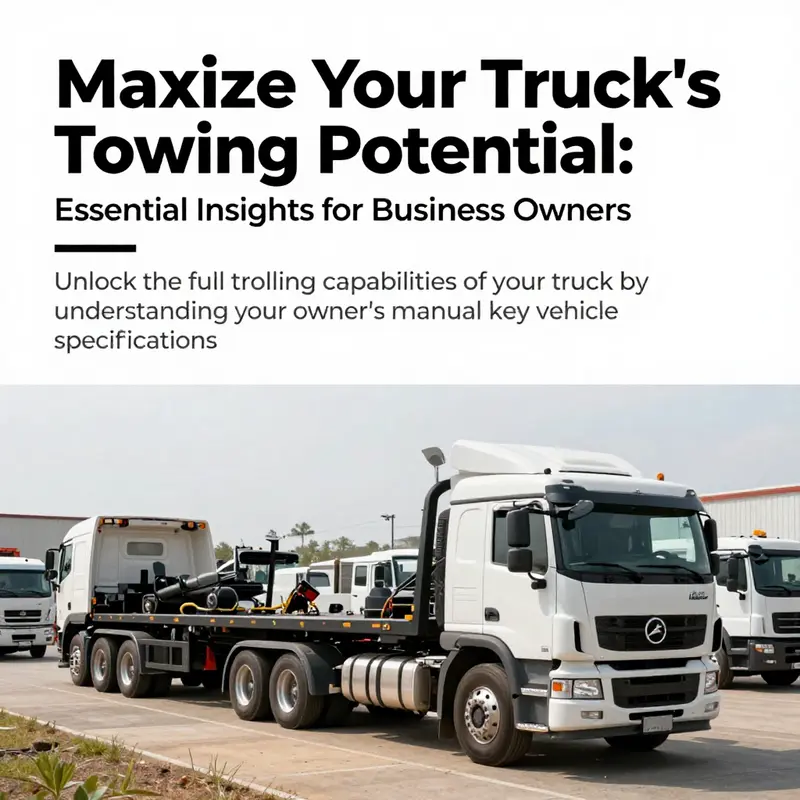
Understanding how much your truck can tow is crucial for business owners who rely on their vehicles for transporting goods. The towing capacity isn’t just a number; it impacts operational efficiency, safety, and compliance with legal standards. Two main factors will dictate your truck’s towing capabilities: the owner’s manual, which outlines specifications and recommendations, and an understanding of the Gross Combined Weight Rating (GCWR) alongside decoding the Vehicle Identification Number (VIN). The insights provided in this article will allow you to make informed decisions regarding your truck’s towing potential, helping you optimize your business logistics.
Tow Weight and Truth: Decoding Your Truck’s Tow Capacity Through the Owner’s Manual

Tow capacity isn’t a single figure; it’s a total that depends on how your truck is built and how you intend to use it. The owner’s manual translates your exact make, model, and year into a towing limit, the hitch and electrical requirements, and the recommended practices for safe operation. The maximum towing capacity is specific to your configuration, including whether the tow package is present, the hitch type, and the trailer you plan to tow. The manual also explains how to verify that your setup stays within safe limits in real‑world conditions, since passengers, cargo, and gear reduce available headroom for a trailer. The heart of safe towing is GCWR—the Gross Combined Weight Rating. This is the total weight the vehicle can handle when engine, drivetrain, the vehicle, and the trailer are weighed together. To estimate the maximum trailer weight, subtract the curb weight of the truck from the GCWR, and subtract cabin payload if applicable. The result is the safe limit for the trailer itself. The manual translates these numbers into actionable steps and cautions against assuming the trailer’s weight alone tells the whole story. If in doubt, rely on VIN‑based specifications or official manufacturer resources for the exact GCWR, curb weight, and hitch requirements. Digital manuals on manufacturer sites and the VIN lookup help tailor the data to your vehicle, ensuring you aren’t chasing generic figures. When changing equipment—hitch class, axle ratio, or wheel‑and‑tire packages—revisit the manual to confirm how the changes alter GCWR and towing limits. Before departure, perform basic checks: tire pressure for tow and tow vehicle, hitch and safety chains, trailer lights, and proper mirror adjustment for the extended length. A brake controller may be needed for trailers with their own braking system. Following these steps keeps every pull predictable and controlled. For precise data, use official vehicle documentation and VIN‑based resources from the manufacturer. If you need local assistance translating the numbers into a safe plan, a professional towing service can help verify weights, install hitches, and perform safety checks. For example, a local towing service in the DC area can assist with weight checks and on‑site equipment. Official manuals and guidance from Ford and other brands remain the authoritative references for calculating what your truck can safely tow.
Tow Truths: Mastering GCWR and VIN Decoding to Uncover Your Truck’s True Hauling Limit
Determining how much your truck can tow is less about horsepower or torque and more about weight math that publishers and manufacturers bake into the vehicle from day one. The moment you hitch a trailer, you’re entering a balance sheet of forces: the truck’s own weight and payload, the trailer’s weight, passengers, fuel, and cargo—all operating within a framework the manufacturer designed so you stay safe on the road. The chart that governs this is called the Gross Combined Weight Rating, or GCWR, and the numbers behind it are not just guidelines; they’re limits that protect braking, steering, suspension, and overall stability. Understanding GCWR isn’t just an academic exercise. It’s the difference between a confident, safe pull and a situation where control feels slippery or the vehicle tires whisper warnings about being near the edge of what the chassis can tolerate. When I talk through GCWR, I’m talking about a practical, real-world boundary—one that helps you choose a trailer, plan loads, and avoid overreaching the truck’s design envelope. In the end, the question “how much will my truck tow?” becomes a precise calculation rather than a vague hope. The GCWR is the ceiling; your actual tow figure is carved from it by the vehicle’s curb weight, the payload you carry, and the weight of the trailer you attach.
Understanding the GCWR begins with a clear definition: it is the maximum allowable combined weight of the tow vehicle (your truck) and the trailer or load it pulls. This figure must account for the truck’s own weight, fuel, passengers, cargo, and the full weight of the trailer, all added together. Exceeding the GCWR introduces safety risks that are easy to underestimate in a moment of impatience or oversight—brake performance can degrade, suspension can become overloaded, and steering control may feel less precise in an emergency maneuver. The guidance isn’t about scaring you into not towing; it’s about enabling smart, predictable towing decisions that keep you and others safe on the road.
To find your truck’s specific GCWR, you’ll want to consult the owner’s manual—the most authoritative source for your exact model and configuration. A label on the driver’s side door jamb is also a reliable quick reference. This GCWR label sits alongside other critical numbers: the GVWR, which is the maximum weight the truck can carry itself, and the GCWR, which demarcates the overall ceiling for vehicle plus trailer. It’s important to note that GCWR is not simply the sum of GVWR and the trailer’s maximum weight. It’s a pre-determined limit the manufacturer sets based on the chassis, brakes, suspension, drivetrain, and other structural components. This distinction matters; otherwise you risk miscalculating what you can safely tow.
Another tool in your kit is VIN decoding. The Vehicle Identification Number is more than a serial code; it’s a detailed configuration file for your exact truck. When you use a VIN-based lookup, either through the manufacturer’s resources or trusted automotive data services, you can retrieve precise data for your build—especially the GCWR and payload ratings that reflect your truck’s real-world configuration. VIN decoding helps you avoid generic figures that don’t apply to your specific axle ratio, engine choice, or tow package. A proper VIN check bridges the gap between a general capability and the exact capacity your truck carries in its bones.
With GCWR and VIN in hand, translating numbers into action becomes practical. A common, straightforward approach is to estimate the maximum trailer weight by subtracting the truck’s curb weight from the GCWR. This calculation mirrors the manufacturer’s own logic: GCWR is the ceiling for the entire system, and the curb weight represents the truck without any cargo or trailer. If your GCWR is, for example, 14,000 pounds and your truck’s curb weight sits at 5,000 pounds, the rough ceiling for trailer weight would be about 9,000 pounds, assuming you don’t load the cab with passengers or fuel beyond what you typically carry. Of course, this is a baseline. The real number must be tempered by payload restrictions, tongue weight, and how ballast is distributed within the trailer. Tongue weight—the portion of the trailer’s weight that presses on the hitch—also matters for steering and braking, so it’s not enough to chase the overall trailer weight alone. The distribution of weight between the trailer and the tow vehicle changes how steadily the combination will behave under acceleration, braking, and cornering.
Every towing decision should begin with the manual, then move to the GCWR label and a VIN-based confirmation. If you’re planning a specific pull, list the following: the curb weight of the truck as equipped (including fluids and typical cargo), the anticipated payload (passengers and other cargo), and the trailer’s actual weight and tongue weight when loaded. Check the trailer’s own weight rating and ensure the hitch and braking systems are compatible with the total load. This is where the practical value of GCWR shows up: it isn’t a single number you memorize; it’s a framework that keeps you within safe limits while you plan trips and loads that align with the vehicle’s engineering.
In moments when you want to know what your truck can truly haul for a given trip, consult the manufacturer’s resources or your dealership with the VIN-provided data. The VIN is the key to unlocking precise, build-specific numbers. It helps prevent the pitfall of using a generic figure that might be close but not exact for your configuration. If you want a broader explanation of GCWR concepts, you can explore expert resources like GCWR explanations on reputable towing-focused sites. For a connected, real-world take on the topic, consider practical guidance from local towing professionals who can help interpret GCWR in the context of road conditions, terrain, and your specific use case. A straightforward way to connect with reliable local guidance is through a local towing service in Washington DC, which often provides practical load calculations and safety considerations tailored to your vehicle type and towing needs: towing service Washington DC.
Ultimately, the math behind your tow comes down to respecting the numbers already built into your truck. The GCWR defines the ceiling; the curb weight and payload define the starting point. The trailer’s weight, including its contents, completes the picture. When you combine these pieces, you’ll see where your real limits lie and how far you can push them without compromising safety. Remember, the goal is predictability and control, not maximum raw capability. If you’re curious to dig deeper into the mechanics of GCWR, a detailed external resource offers a thorough breakdown of the concept and its safety implications: https://www.fifthwheelstreet.com/gcwr-explained/
Final thoughts
In conclusion, knowing how much your truck can tow is vital as a business owner. By engaging with your owner’s manual and understanding the parameters outlined, such as the Gross Combined Weight Rating and VIN specifics, you can effectively manage your vehicle’s capabilities. This knowledge not only attends to your operational needs but also fosters safety and compliance across your logistics processes. A well-informed decision on towing capacity enhances efficiency, ensuring your business’s transportation needs are met responsibly.