
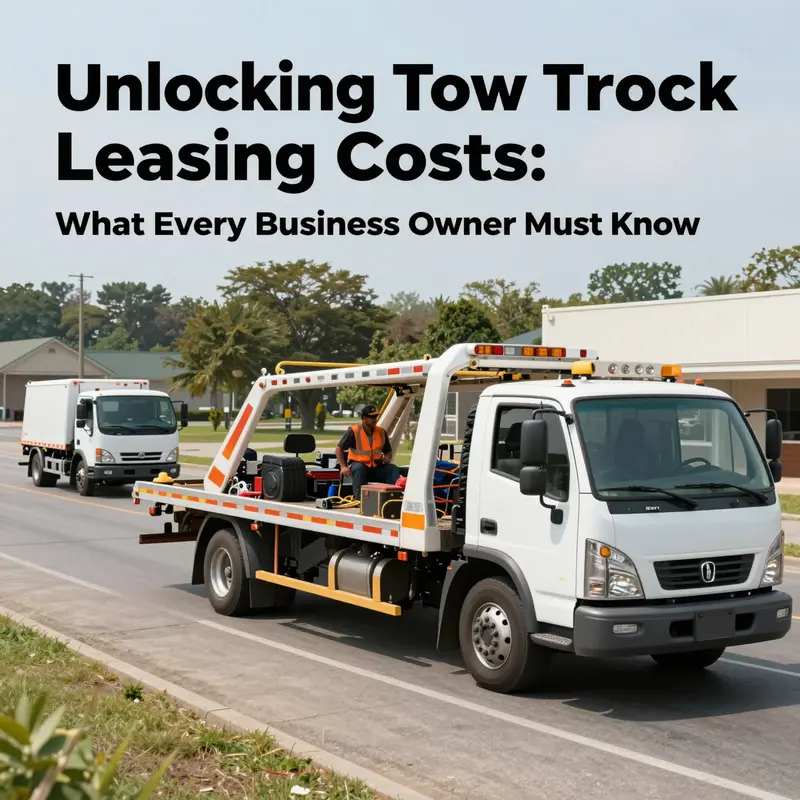
Leasing a tow truck can be a pivotal decision for business owners in the towing and roadside assistance industry. Understanding the various costs associated with leasing, the factors that impact those costs, and the comparison between leasing and purchasing is crucial for effective financial planning. This article explores each of these facets, providing insights that can guide business decisions and strategies for optimizing towing services, whether for towing cars, motorcycles, or larger vehicles.
null
null
Beyond the Sticker Price: Reading the Real Cost of Leasing a Tow Truck
Leasing a tow truck can look straightforward at first glance—a daily rate, a contract, and a vehicle ready to hit the road. But the true cost picture is more nuanced. The numbers you see on a rental quote are only part of the story. When you’re weighing whether to lease a 5‑to‑8‑ton winch truck for light to medium recoveries or a heavier, more specialized unit, you need to understand how several moving parts interact to shape the bottom line. The contrast between purchase price and lease cost matters, because the baseline you’re comparing against helps you decide if leasing is the right financial path for your operation. For a small, commonly used model, the purchase price for a new 5‑ton to 8‑ton winch tow truck might sit in the mid‑twenty thousand dollars range. That sticker price signals long-term asset value, but it does not capture how much you’ll spend month to month on a leased arrangement. Daily rental rates for such vehicles typically fall in the $300 to $600 band, a spread that reflects regional demand, the reputation of the rental provider, and the vehicle’s current condition. These numbers illustrate a fundamental truth: leasing is often less about the headline daily rate and more about the total cost of ownership over the period of the lease, including all the extras that fuel a tow truck operation. Larger or specialized wrecker trucks command significantly higher leasing costs. Their purchase prices climb, and the corresponding rental fees can rise into a much higher range, sometimes several thousand dollars per day for the most capable, heavy‑duty configurations. When you see those figures, keep in mind they are the ceiling options rather than the everyday reality for many fleets, but they do highlight how capability translates into price. The overarching message is clear: the base rental fee is just the doorway. If you want an accurate sense of monthly or yearly cost, you must add the other recurring expenses that keep a tow truck on the road and compliant with local rules. Fuel, insurance, maintenance, licensing, tolls, and driver wages are not optional line items in most operations. Fuel consumption scales with miles driven and the intensity of call volume, while maintenance costs can surprise you if you’re leasing an older unit or operating in rugged terrain. Insurance, in particular, will reflect the truck’s value, the nature of incidents you encounter, and regional insurance markets. Licensing fees, registration renewals, and periodic inspections also bite, sometimes as predictable annual charges and sometimes as variable costs tied to operation. The combination of these factors makes the true leasing price a moving target that shifts with utilization patterns, regulatory environments, and the age and condition of the equipment. From a business planning perspective, it helps to anchor conversations with prospective lessors in two core questions: What is included in the base rate, and what is excluded? Commonly, the base rental excludes fuel, insurance, maintenance, tolls, and driver wages. Clarifying coverage, mileage allowances, breakdown service, and replacement vehicle provisions can save surprises when the bill arrives. In practice, this means you should request a fully loaded quote that itemizes every component you can reasonably forecast. If your typical cycle involves long hauls, night shifts, or frequent tow calls across multiple jurisdictions, those costs accumulate quickly and can dwarf the apparent daily rate. To translate this into an actionable estimate, start by mapping your expected usage. How many miles will you drive per week? How many shifts per day require the truck to be on the road? What is the anticipated call volume and the average weight of the loads you recover? Use these questions to build a rough monthly budget, then layer in fuel burn estimates, maintenance windows, and insurance premiums. The math won’t be perfect, but it will yield a more reliable framework for decision‑making than a standalone daily rate. Location matters as well. Demand for towing services varies by market, which in turn influences leasing costs. In high‑activity regions with tight truck supply, daily rates can rise, while smaller markets with more competition may offer more favorable terms. If you operate in a dense service area like Washington, DC, you’ll likely encounter regional pricing that reflects urban traffic patterns, labor costs, and regulatory requirements. For a sense of what the local landscape looks like, you can explore options in the area and speak with providers about fleet availability and term flexibility—for example, towing service in Washington, DC to gauge how regional factors might shape your lease. The lease agreement terms themselves deserve careful scrutiny. Are you locking in a fixed monthly fee for a set term, or is there a mileage cap that triggers additional per‑mile charges? Does the contract stipulate maintenance responsibilities or a separate service plan? Are there penalties for early termination, or incentives for longer commitments? These clauses can dramatically alter the economic picture over the life of the lease. Market conditions, too, are not static. The balance of supply and demand for tow trucks shifts with new model introductions, financing conditions, and broader economic trends. A robust approach combines current quotes with a sensitivity analysis that tests how changes in utilization, fuel prices, or insurance rates would affect cash flow. The objective is not a single number but a trusted framework for ongoing cost management. For readers seeking a broader, practical financial framework beyond leasing alone, a comprehensive guide from The Balance Small Business covers many operating costs connected to tow truck ownership and ongoing operations. This external resource can complement your internal estimates as you plan capital needs and cost controls in the near term and the longer horizon. For more context, see https://www.thebalancesmb.com/understanding-tow-truck-ownership-costs-4158367. If you’re preparing a regional assessment, you might also look at local resources tied to nearby service networks and markets to compare what similar operators pay in daily rates and what inclusions accompany those quotes. In sum, the cost to lease a tow truck is shaped by a matrix of factors that extend far beyond the daily price tag. Truck specifications, location demand, lease terms, operational expenses, and broader market conditions all weave together to determine the true monthly cost. A disciplined approach—combining precise usage projections with transparent lease terms and a realistic view of ongoing costs—will yield a leasing plan that fits a fleet’s needs without overshooting the budget. And while the numbers are location‑ and configuration‑dependent, the fundamental principle holds: the more you understand the full spectrum of costs, the more accurately you can price your services and keep your tow operation financially sound. For additional regional insight into service options, you can explore related resources in your area, such as the various pages that outline local tow truck services in nearby communities. The overall guidance remains consistent: ask for complete inclusions, anticipate ancillary expenses, and compare terms across multiple providers to find the best fit for your business. https://www.thebalancesmb.com/understanding-tow-truck-ownership-costs-4158367
Leasing Versus Buying a Tow Truck: Decoding the True Cost and the Operational Flexibility
Leasing Versus Buying a Tow Truck: Decoding the True Cost and the Operational Flexibility
The choice between leasing and buying shapes not only the balance sheet but also the rhythm of daily operations. In a field where downtime directly erodes revenue, the way a tow truck is paid for affects cash flow, maintenance planning, and the pace at which a company can grow. The cost story isn’t just a price tag; it is a texture of payments, warranties, fuel efficiency, and the risk the business can tolerate.
Ownership carries an upfront investment that can strain cash flow for small to mid-sized fleets. Yet owning an asset provides long-term value, full control over how and when it is used, and the possibility of tax benefits tied to depreciation. If a truck is kept beyond the lease horizon and used heavily, the annualized cost can become favorable. But the initial hit must be weighed against the expected life of the vehicle, potential maintenance surprises, and the time value of capital.
Leasing lowers the barrier to entry. With lower initial costs and predictable monthly payments, a company can keep capital available for core operations, equipment, or hiring. A lease often includes maintenance and service agreements, which reduces surprises in repair bills and minimizes downtime. Operators can access newer models with improved fuel efficiency, safer features, and up-to-date technology without committing to a long-term purchase. In markets where technology rapidly evolves, this can translate into meaningful efficiency gains and safer performance for crews.
Flexibility matters when demand fluctuates. Roadside assistance and recovery work can swing with weather, economic cycles, and local events. Leasing terms are usually shorter than the vehicle’s expected life, so fleets can upgrade more often and stay current. However, leases carry their own risk: residual value assumptions, mileage caps, and end-of-term charges. If demand surges, a fleet tied to a fixed lease may struggle, while ownership might allow a more aggressive expansion if financing is favorable. The opposite is true if demand declines—the cost of owning a rarely used vehicle remains a sunk expense, whereas a lease provides an exit path at relatively predictable terms.
Many operators adopt a hybrid approach: lease the daily equipment needed for ongoing operations while keeping a smaller stock of older, well-maintained trucks for long-term use. The financial lens should focus on total cost of ownership (TCO), tax implications, and the company’s credit position. A robust decision framework compares annualized costs, including depreciation or lease payments, interest, insurance, maintenance, tires, and fuel, against the revenue impacts of uptime and service levels. For planning, firms can run net present value (NPV) analyses and break-even assessments to see which path delivers the lowest long-term expense given projected utilization, spare capacity, and growth.
Even in a world of precise schedules, the numbers remind operators of the practical realities. The base rental or lease fee rarely includes fuel, insurance, tolls, or driver wages. Those line items can push a month-to-month total well beyond the sticker price. In higher-demand markets, per-day rates for larger or specialized units trend upward, reflecting the specialized equipment and faster response expectations. In contrast, smaller, lighter units can be surprisingly economical on a daily basis if mileage remains modest and downtime is minimized. The overarching message is that price alone does not tell the whole story; the real value lies in how terms align with the company’s workflow, safety standards, and regulatory obligations.
For regional context and examples of how terms play out in the field, consider how Washington DC area providers structure their tow-truck usage and service arrangements. See Washington DC tow truck services for local dynamics and term variations that can influence both leasing and ownership decisions.
Beyond dollars, non-financial drivers matter as well. Crew safety, maintenance scheduling, and compliance readiness influence uptime and reputation. A newer model may offer improved telematics, diagnostics, and remote monitoring, which can reduce unscheduled downtime and speed incident response. For a deeper financial framework, the Investopedia comparison of tow truck leasing versus purchasing offers a detailed view of the math behind the decision: https://www.investopedia.com/articles/07/towtruckleasingvspurchasing.asp
Final thoughts
Understanding the costs of leasing a tow truck encompasses various interconnected factors that every business owner must consider. By evaluating the lease terms, the operational demands of your business, and the financial implications of leasing versus purchasing, you can make informed decisions that align with your business goals. A well-informed decision not only optimizes your towing services but also contributes to the overall financial health of your business.