
In today’s fast-paced business landscape, the right transportation tools can make a significant difference in operational efficiency. Half-ton trucks, known for their versatility and power, are essential assets for businesses needing to haul equipment, materials, or deliver goods. Understanding the towing capacity of these vehicles is crucial for business owners to ensure they choose the right equipment for their needs. This article presents a comprehensive overview of how much a half ton truck can tow, explores factors that influence this capability, and highlights real-world applications for businesses, empowering owners to make informed decisions.
Tow Power, Real Limits: Reading What a Modern Half-Ton Truck Can Truly Tow
The term half-ton belongs to a family of light-duty pickups that found their place in everyday work, family road trips, and weekend projects. Yet the word half-ton no longer describes a universal ceiling. In recent years, engineering advances have boosted towing capability across the board, so a modern half-ton can pull far more than the old lore suggests. The real story is not a single number but a blend of factors that work together—the engine choice, the drivetrain, the axle ratio, and the trailer equipment installed to assist with weight handling. When you add in the weight of passengers, tools, and cargo in the bed, the picture becomes even more nuanced. In short, the practical question is not “What is the truck capable of?” but “What can I safely tow given my exact setup and the trailer I’m pulling?”
Towing capacity for a current half-ton truck typically falls in a broad range, influenced by how the vehicle is equipped. In base configurations with smaller engines and rear-wheel drive, you’ll often see towing numbers in the vicinity of seven to eight thousand pounds. As you move up to models with more spirited powertrains, four-wheel drive, and a dedicated trailer tow package, the ceiling rises substantially. In the upper end, a well-configured truck can reach into the twelve-thousand to fourteen-thousand-pound zone, sometimes higher under ideal conditions with proper cooling, braking, and hitch setup. These figures represent maximum towing capacities under specific, favorable configurations and assume the trailer is properly matched to the truck’s hitch rating.
Crucially, the towing number is only part of the equation. The distinction between towing capacity and payload capacity matters a great deal. Payload is what you can carry in the bed and cab—people, gear, and cargo—whereas towing capacity is about the weight you can pull behind the truck. Exceeding either limit can compromise handling, braking performance, and overall safety. The exact numbers for a given truck are printed on the vehicle’s identification placard or listed in the owner’s manual, and the VIN carries a precise specification that you should confirm before hitching a trailer. The trailer itself contributes weight in two ways: it adds to the total load and introduces tongue weight, which is typically about 10 to 15 percent of the trailer’s gross weight. Tongue weight must be within the recommended range to keep steering responsive and to prevent trailer sway.
Beyond the numbers, there are practical realities that determine how much you can safely tow. A heavier trailer demands better cooling, reinforced brakes, and a stable hitch setup. The drivetrain and axle assembly must withstand continuous stress, especially on grades or when fighting wind resistance on open highways. If the cooling system or transmission isn’t up to the task, the truck may hit its limits long before the nominal towing capacity is reached. This is why many owners configure their half-ton trucks with enhanced cooling packages and trailer brakes, and why some routes demand more careful planning. It is also wise to reserve a margin of safety for unexpected hills, headwinds, or dynamic loading at the gooseneck.
For readers planning actual trips or projects, local resource planning can be invaluable. If you need hands-on guidance about planning and moving trailers in your area, local towing services can help assess weight, balance, and route options. For example, you can consult a nearby towing service in Washington DC to review its advice on safe loading practices and route choices, ensuring you stay within your vehicle’s limits. towing service Washington DC.
Ultimately, understanding how much a half-ton truck can tow comes down to reading the spec for your exact unit, including the VIN-derived ratings, and respecting the difference between payload and towing. The encouraging takeaway is clear: modern half-ton pickups accommodate substantial loads when configured thoughtfully, but the key is precision in matching trailer weight to vehicle capability, rather than chasing a single headline number. For a concrete reference to a specific production model’s capabilities, the official specifications pages provide the most reliable numbers to consult. External reference: https://www.ford.com/trucks/f-150/specs/
null
null
Tow Truth in Everyday Use: Real-World Limits of the Half-Ton Pickup
The label half-ton is a holdover from a simpler era. Today, a half-ton pickup is a flexible tool, built to haul cargo and to tow heavier loads than its predecessors could imagine. The name is less about a fixed payload number and more about class, capabilities, and the everyday tasks owners ask of them. In real life, you are balancing engine torque, drivetrain efficiency, frame strength, and transmission cooling as soon as you hitch a trailer. The result is a vehicle that can move surprisingly large loads when used within its design, while still offering the maneuverability and efficiency expected in a lighter-duty class. Towing capacity, then, is not a single line on a spec sheet but a range shaped by configuration, equipment, and how the trailer interacts with the road. You feel this every time you turn onto a winding road with a loaded trailer behind you or when you stow a heavy load in the bed and still expect confident re-acceleration at highway speed.
The numbers you’ll hear are a guide: most modern half-ton pickups can handle a wide span of towing tasks, typically from about 7,000 to 14,000 pounds. That range reflects a lot of variation from base to top trim, and from a simple rear-wheel-drive setup to a fully loaded four-wheel-drive configuration with a heavy-duty towing package. In practical terms, a base model with a modest engine and a straightforward drivetrain will usually tow closer to the lower end of the scale, while a well-equipped, high-torque setup with the right axle ratio and cooling systems can reach the upper limit. The math behind the capability is straightforward but crucial: more engine torque, stronger axles, and better cooling translate into steadier, safer towing under load.
To translate a number into a real-world task, you have to separate towing from payload. Payload is what the truck can carry in the bed and cab, while towing is about the trailer you pull behind. Confusing the two leads to overloading a hitch, more strain on the engine, and reduced control. The trailer itself adds weight—its own structure, contents, and even things like fuel and water—that all count toward the vehicle’s total tolerance. The safest approach is to verify the exact towing rating for your particular truck in the VIN-specific specification label on the driver’s door jamb and in the owner’s manual. This detail governs what you can tow with confidence, not just what the truck can move at a quick glance.
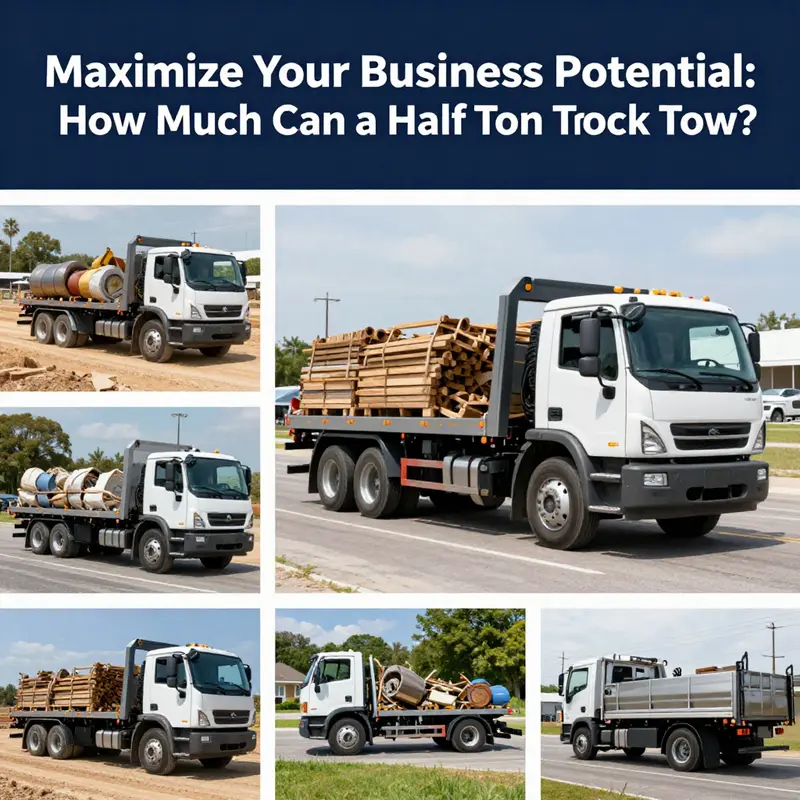
Real-world use shows the versatility of half-ton pickups across a spectrum of tasks. For recreational towing, families often attach trailers carrying lawn equipment, boats, or campers. With a well-configured setup, a 10,000-pound travel trailer can be pulled safely, provided the trailer’s weight and all contents stay within the factory limits and the trailer’s weight distribution is correct. In construction and landscaping, professionals rely on the same class of truck to tow heavy-duty trailers loaded with machinery such as skid steers or генераtors, moving large loads efficiently between job sites. Emergency response and utility crews also depend on these trucks to pull mobile repair units or generator trailers, enabling rapid deployment during outages or emergencies. Off-road and adventure communities push the envelope further, towing off-road trailers, ATVs, or compact RVs through rugged terrain, relying on features like integrated trailer brake controllers, hill descent control, and strengthened suspensions.
To stay on the right side of safety and efficiency, many owners study specifications and guidelines beyond a single chart. Modern half-ton trucks employ high-strength frames and advanced drivetrains designed to handle weight in motion with predictable braking, steering, and stability. Vehicle owners are advised to consult the manufacturer’s official guidance and their own manual for model-specific details, engine, drivetrain, and trim-dependent configurations. For practical support on the road, local resources can be a quick reference when you’re unsure about your setup—practical help you can access through a trusted towing service Washington DC. This kind of support is often the difference between a smooth, planned tow and an unplanned detour.
In sum, the half-ton class delivers a remarkable blend of everyday usability and capable towing when used within its designed envelope. The real measure of usefulness comes from understanding the distinction between payload and tow, recognizing the influence of engine and drivetrain choice, and respecting the trailer’s weight as part of the whole system. When you treat these limits with care, the half-ton pickup becomes a versatile partner for family trips, professional tasks, and outdoor adventures alike, a vehicle that bridges daily chores with confident, efficient towing. For a more technical, official look at towing specifications, see the manufacturer’s towing guidance.
External reference: official towing guide
Final thoughts
Half-ton trucks stand as indispensable vehicles for many businesses, offering considerable towing capabilities that can meet various operational needs. Understanding the specific capabilities of these trucks, influenced by numerous factors, allows owners to maximize their utility efficiently. Whether transporting equipment, goods, or providing services, knowing how much a half-ton truck can tow empowers business owners to make choices that enhance productivity and profitability.