
Understanding the necessity of a Commercial Driver’s License (CDL) for operating tow trucks is essential for business owners in the towing industry. The regulations governing CDL requirements can significantly impact the operations, safety, and compliance of your business. This guide explores the federal and state-specific regulations related to CDLs, delves into the importance of having a qualified driver behind the wheel for safety, and reinforces how compliance with these regulations can protect your business and enhance your reputation in the towing sector.
Tow Truck CDL Demystified: Weighing Rules, Endorsements, and the Road Ahead
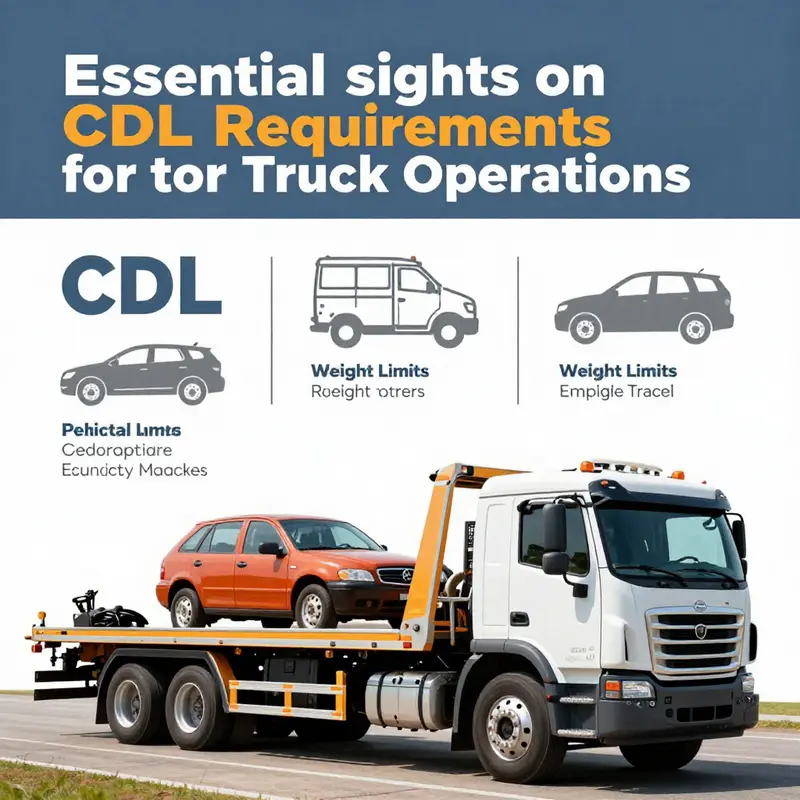
Tow trucks sit at the busy curb, catching glimpses of sirens and stalled traffic. They are tools of urgency, but they operate under a web of licensing and weight rules that can confound new drivers. For most tow operators, a Commercial Driver’s License is required when the truck itself crosses a critical weight threshold. In the United States, the commonly cited line is a Gross Vehicle Weight Rating (GVWR) over 26,001 pounds. But it’s not just the tow truck’s own weight that matters; the sticker for the combined weight with the towed vehicle matters too—the Gross Combination Weight Rating (GCWR).
Under federal standards, the GCWR threshold typically triggers CDL requirements. If the GCWR of the tow truck and its load exceeds 26,001 pounds, a Class B CDL is generally needed to operate the vehicle with its normal towing gear. If you’re regularly hauling a heavy trailer or a much heavier towed object, you could move into Class A territory, designed for the highest weight combinations. The exact class depends on the weight categories you’ll encounter and the configurations you’ll drive, which means a one-size-fits-all answer rarely applies to real-world towing.
Beyond licensing, states add their own layers of regulation. Some jurisdictions require a CDL even for lighter tow operations if the activity is commercial or if you tow on a regular basis. Additionally, most states expect drivers to hold endorsements for specialized tasks, most commonly a ‘T’ endorsement for towing. The implications extend to minimum age, typically 21 for interstate work, and to the ability to pass a clean driving record. Employers frequently insist on drug testing and background checks, and many will require DOT medical certification before you even sit for the practical driving test.
Preparing to pursue a CDL means more than enrolling in a class. You’ll need to chart a path that aligns with the intended scope of work. Decide which class you need— Class B for most medium-duty tow trucks or Class A if your operation includes heavier combinations. You will face a written knowledge test, a skill/road test, and a medical exam to obtain the DOT card. Documentation, such as proof of identity and residency, becomes part of the application package. Costs, scheduling, and the time it takes to arrange testing vary by state, but the progression is consistent: learn, test, license, and maintain.
For a sense of how this plays out in practice, consider a regional towing operation that answers dispatches across a dense corridor. Training focuses not only on maneuvering a tow truck but on securely anchoring and loading heavier vehicles, maintaining control during dynamic roadside conditions, and communicating with law enforcement and roadside assistance teams. Local operations can provide practical pathways into CDL work, and you’ll want to connect with a local service to understand the requirements for your area. For a local resource on towing operations in the region, see the tow-truck service in Washington, DC.
Once you’ve chosen the path, begin with the official channels. Contact your state department of motor vehicles or transportation office to confirm current rules, endorsements, and age requirements. Seek a certified training program that emphasizes not just the test content but the safety realities of roadside work, including load distribution, use of wheel straps and chains, and securing cargo. Assemble your documentation, complete the medical exam, and prepare for both knowledge and road tests. If you already drive professionally, your employer may sponsor training or provide guidance on the best sequence of milestones toward a CDL and any state-specific endorsements.
Finally, remember that licensing is only the start. The job of a tow driver rests on ongoing safety, professional standards, and the ability to adapt to evolving regulations. Licensing agencies emphasize continuing education, and many fleets require refresher courses every few years. Keeping up with regulations ensures the safety of drivers, passengers, and the public. For a broader industry overview, refer to the U.S. Bureau of Labor Statistics page on Tow Truck Drivers.
State-Specific Regulations on CDL for Tow Trucks
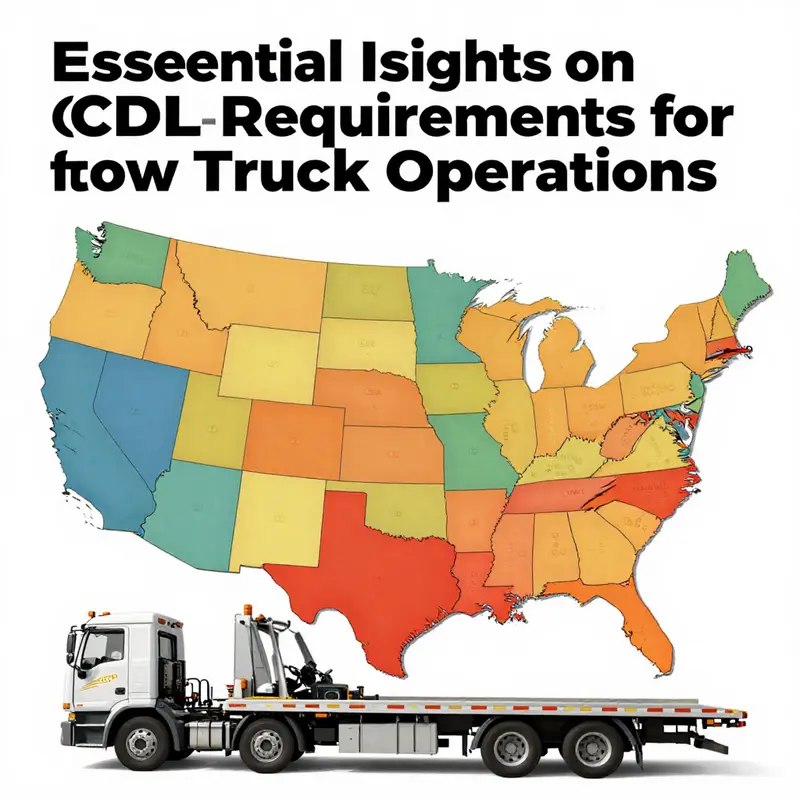
Across the United States, the question of whether a Commercial Driver’s License (CDL) is required to operate a tow truck isn’t answered by a single nationwide rule. It’s a mosaic of state standards layered on a federal baseline. Federal guidelines set general expectations for commercial operation, but states decide when a CDL must be carried, often tying the requirement to the vehicle’s Gross Vehicle Weight Rating (GVWR), towing capacity, and the specific work the vehicle performs. That means a tow operator may drive legally in one state with a lighter license, only to encounter a different threshold a few miles away that triggers a CDL requirement. The practical upshot is a regulatory landscape that rewards careful planning and strict, regionally aware compliance. For anyone who moves between states or operates a fleet with multi-state work, the rules demand a clear map of where the licenses must exist and which endorsements must ride along with them.
In California, the framework is explicit and weight-centric. A Class B CDL is required for tow trucks with a GVWR of 26,001 pounds or more, regardless of whether the operation is private or commercial. Endorsements become relevant when the job involves additional risks or activities, such as transporting passengers or performing highway recoveries. In particular, a driver may need endorsements corresponding to the vehicle’s configuration, and operators may face requirements that go beyond a basic CDL if the operation crosses into areas like hazardous materials transport or specialized towing tasks. The emphasis here is not merely on the vehicle’s mass but on the potential exposure and the complexity of the tow operation, which can change the licensing landscape quickly for fleets that service California’s dense road network.
Texas follows a similar weight-based logic but adds its own layer of operational priority. A CDL is required for any tow truck with a GVWR exceeding 26,001 pounds. Yet the Texas rule also triggers CDL necessity if the company is engaged in towing or recovering vehicles weighing over 10,000 pounds, even when the tow truck itself sits under the heavier threshold. This emphasis on the actual towing activity reflects a broader view of risk—where the weights involved in the recovery, the speeds on busy roadways, and the potential for incident dictate licensing requirements more than the vehicle’s inherent mass alone. For Texas operators, that means planning for CDL credentials not just when the truck is heavy, but when the services involve moving substantial towed loads that multiply the operational risk on the street.
New York presents a straightforward weight-based threshold with its own safety-focused nuance. A CDL is required for tow trucks with a GVWR of 26,001 pounds or more, aligning with the federal baseline in practice. However, New York also imposes a “T” endorsement for tow trucks engaged in transporting hazardous materials, reinforcing the state’s careful approach to freight and recovery work that may involve dangerous contents. This combination—weight-based licensing plus specialized endorsements for hazardous materials—highlights how a state can couple general licensing with targeted safeguards to address local traffic conditions, dense urban corridors, and industrial exposure.
Beyond these three examples, many states operate on a matrix of criteria. Some jurisdictions apply multiple weight thresholds, others regulate based on whether the operation involves passenger transport, and still others require endorsements for air brakes, combination vehicles, or other specialized capabilities. The practical takeaway is clear: the mere presence of a heavy tow truck isn’t the sole determinant of CDL eligibility. The intended use, the nature of the load, and the environment in which the vehicle is operated collectively shape the licensing equation. This is especially important for fleets that cross state lines or run on contracts spanning several regions. Operators should routinely verify their status with the state’s Department of Motor Vehicles or equivalent transportation agency, and stay tuned to any updates that reflect changes in weight limits, endorsements, or operating regimes. The federal FMCSA provides a useful baseline, but the actual licensing reality is written by state law, with enforcement practices and penalties that can vary widely. For a tangible sense of how licensing questions manifest in a local setting, a nearby tow-truck service Washington DC can illustrate how operators translate regulatory requirements into day-to-day practice across busy urban streets. In the end, the CDL question for tow trucks isn’t a one-size-fits-all decision; it is inherently state-by-state—dynamic, nuanced, and inseparable from safety and professional responsibility on the road.
External reference: For a central, state-by-state overview, see https://www.fmcsa.dot.gov/regulations/vehicle-requirements/cdl/state-by-state-cdl-information.
null
null
Final thoughts
Ensuring that your towing operations adhere to CDL regulations is not merely about compliance; it is a key component of enhancing safety and safeguarding your business. Investing in qualified drivers with proper licensure not only minimizes legal risks but also boosts your operational reputation. As the towing industry continues to evolve, staying informed about federal and state regulations will empower your business to thrive and adapt effectively.