
Navigating the world of towing requires understanding regulatory requirements, particularly when it comes to operating flatbed tow trucks. For business owners in the towing sector, the necessity of a Commercial Driver’s License (CDL) cannot be overstated. A CDL ensures that drivers meet safety standards and are trained to handle larger vehicles effectively. In this piece, we will explore two critical areas: the general CDL requirements for operating flatbed tow trucks and the state-specific variations that may impact your operations. Each chapter builds on the previous one, providing you with a comprehensive overview to ensure compliance and safety in your towing business.
Flatbed Realities: Reading the CDL Map for Tow Trucks, Weights, and Warnings on the Road
When a shop owner or an aspiring operator asks whether a CDL is required to run a flatbed tow truck, the question often sounds simple, but the answer travels through a network of weight thresholds, vehicle configurations, and state-by-state regulations. A flatbed is not just a more secure way to haul a damaged car; it is also a commercial vehicle that presses against the boundaries of licensing, testing, and endorsements. The core idea is straightforward: if the vehicle you drive and the work you perform place you into the realm of a commercial motor vehicle, a CDL becomes a practical necessity, if not a legal one. The more nuanced truth is that the specific Class of CDL and the endorsements you need hinge on how heavy the truck is, how it’s configured, and what you transport. In the everyday operations of towing, those thresholds are not abstract numbers. They shape who can behind the wheel, what training is required, and how a company plans its routes, insurance, and compliance program.
At the heart of the CDL decision is the Gross Vehicle Weight Rating, or GVWR, of the tow truck itself and the weight of the load it carries. For many flatbed tow trucks used in professional service, the GVWR pushes well past the 26,001-pound mark. That number—26,001 pounds—has become a convenient shorthand in the industry for when a vehicle crosses into CDL territory for interstate commerce. If you’re operating a single flatbed unit with a GVWR over that threshold, the general expectation is that a Class B CDL will apply. A Class B CDL covers single vehicles with high GVWR, and it typically fits the profile of many standard flatbed tow trucks that haul a vehicle on the bed without pulling a trailer at the same time. The practical implication is simple: the driver must meet CDL prerequisites, pass the appropriate knowledge and skills tests, and carry a medical certificate that verifies fitness to operate heavy commercial equipment.
The classification shifts when a flatbed is part of a combination vehicle. If the tow truck is pulling a trailer that itself has a significant GVWR, the combination may push the vehicle into Class A territory. In the world of tow trucks, that scenario is less common for everyday flatbeds than for tractor-trailer configurations, but it is a real possibility in fleets that routinely haul multiple vehicles or use heavy equipment on trailers. The result is that the driver might need a Class A CDL rather than Class B, reflecting the increased complexity of the combination vehicle. Those distinctions are not mere trivia; they determine which tests you study, which endorsements appear on your license, and how you document your medical approval to drive across state lines. They also influence the safety practices a company must implement, from the way the bed is secured to how the tow strap system is inspected before every shift.
Endorsements, too, occupy a central place in this regulatory map. The materials commonly cited for flatbed towing indicate that certain endorsements are particularly relevant to the job. An “N” endorsement is described in some sources as necessary for transporting vehicles on a flatbed, aligning with the idea that a specific credential exists for the unique task of moving vehicle cargo on a bed rather than within a standard passenger cabin. A “P” endorsement is noted for transporting passengers, a scenario that may arise if a tow operation includes crew transport or if a contractor shares rides with a crew in the course of a long shift. An “S” endorsement appears in reference to operating a school bus in some contexts, a reminder that the CDL landscape is not one-size-fits-all and can reflect broader credentialing pathways in the same licensing system. While the precise endorsement requirements can vary by state, the overarching principle holds: the endorsements you need must align with both the vehicle’s configuration and your actual duties. If the job involves transporting a heavy tow vehicle between sites, or if the operation includes moving passenger teammates as part of the service team, the endorsements may be nontrivial and must be secured before you climb behind the wheel.
It is in respect to these variables that state authorities strongly encourage drivers to consult the local DMV and the federal FMCSA guidelines. The exact requirements do not exist in a vacuum; they flow from both the physical realities of the vehicle and the responsibilities of the driver. Vehicle weight ratings, the presence of a tow hitch or trailer, the number of axles, and the bed’s load-securement features all contribute to the final licensing picture. And even when a fleet has standardized practices, the state in which you operate can still add layers of specificity. A fleet that serves urban corridors, for instance, may encounter stricter rules about intrastate versus interstate operations, hours-of-service regulations, and medical certification standards that apply differently depending on whether the work is to be performed within a single state or across multiple jurisdictions. In short, the CDL decision for a flatbed tow truck is not a fixed rule but a dynamic assessment that balances the vehicle’s weight, the load profile, the configuration of the tow unit, and the regulatory environment in which the operator travels.
Within this framework, the knowledge that the CDL landscape is both broad and granular becomes essential. A driver cannot assume that the same class applies everywhere or that endorsements carry automatically across states. A flatbed operator must be prepared to explain the GVWR of the truck, whether the vehicle is towing another unit, and what endorsements the license currently holds. The process often begins with the basics: being of legal driving age, maintaining a clean driving record, passing a background check, and completing a drug screening. These prerequisites are the stepping stones that allow the more specialized testing to occur. The knowledge test and the skills test are designed to verify competence not only in highway operation but also in the particular challenges of a flatbed, such as vehicle securement on the bed, proper hook and chain usage, proper lash-down procedures, and the ability to navigate congested urban routes while ensuring stability of the load. The physical and mental demands of this work can be high, and the licensing framework is designed to match that reality.
The question of endorsements is often the part drivers find most perplexing because it is both essential and context-dependent. The N, P, and S endorsements mentioned in the research materials are a reminder that a CDL is not a single document, but a portfolio of permissions that reflect the diversity of duties that a driver may perform. The N endorsement, in the context of flatbed towing, is framed as enabling the transport of vehicles on a flatbed. The P endorsement, relevant to passenger transport, may be invoked if crew transport becomes part of the job. The S endorsement, tied to school buses, likely comes into play only in specific districts or in roles where a driver may be required to operate that type of vehicle. The interplay of these endorsements with the base CDL class means that a prospective driver must map out their anticipated day-to-day tasks and verify that their license is equipped to cover them. In practice, this means speaking with the DMV, reviewing each state’s CDL manual, and confirming that the endorsements are current and properly recorded on the license before accepting a job that demands any of them.
Beyond the endorsements, many operators are surprised to learn that the licensing landscape may also require additional elements such as medical certification and periodic drug testing. A valid CDL for a heavy vehicle implies ongoing medical surveillance to confirm that the driver remains physically capable of operating a multi-ton machine in variable road conditions. The medical card must be maintained, renewed, and carried on every shift. The regulatory framework also requires compliance with hours-of-service rules that determine how long a driver can operate within a given period before mandatory rest. While these considerations belong to the broader CDL ecosystem, they have a direct bearing on flatter operations because a fleet must ensure that drivers are not only legally qualified at the outset but also supported by a robust compliance program that tracks the medical status and the duty cycles of its drivers. On the ground, that translates into scheduling practices that avoid fatigue, maintenance regimens that reduce the risk of mechanical failure, and a culture of safety that permeates every call. In short, how a tow operation trains, tests, and monitors its drivers aligns with the weight and configuration realities discussed above.
The practical upshot for anyone standing at the crossroads of CDL versus flatbed is to treat the licensing decision as a function of the vehicle’s weight, its configuration, and the work’s scope. If the combined gross weight of the tow truck and the vehicle on the bed falls under the 26,001-pound threshold, Class B CDL with the appropriate endorsements may suffice for many standard flatbeds. If the combination pushes beyond that threshold, or if the operation routinely includes heavier hauls or multiple vehicles, Class A becomes a more likely necessity. Given how quickly a fleet can encounter exceptions—state variations, the legal interpretation of “combination vehicle,” or the inclusion of a trailer—one cannot rely on a one-size-fits-all answer. This is why the best practice is to consult both the state DMV and, when possible, the FMCSA guidelines for the latest, official requirements. The landscape may evolve with updates to weight definitions, changes to endorsement scopes, or new rules for certain vehicle types. Staying informed is not only about getting the right license; it is about maintaining the license you need as your work evolves.
For operators looking to anchor this understanding in local realities, it can be helpful to examine how a nearby service area translates these rules into everyday practice. In metropolitan or regional fleets, managers often devise a licensing matrix that aligns with the typical fleet composition and the most common job orders. The matrix might specify that a driver with a Class B CDL handles most single flatbed tasks, while a Class A license is reserved for the subset of operations that involve tandem or combination configurations. In this scenario, the company’s training program mirrors the licensing map, ensuring that newer drivers move through progressive certifications that match the equipment they will operate and the routes they will service. This approach reduces the risk of misclassification, helps avoid regulatory penalties, and reinforces a culture of safety from the moment a driver straps down the first load. It is a reminder that licensing is not merely a credential to collect, but a living framework that governs how and where a flatbed tow truck can be used. The clarity of this framework supports fleet planning, driver recruitment, and even insurance considerations, because carriers and clients alike prefer partners who demonstrate up-to-date qualifications and a disciplined approach to risk management.
For readers who want to ground these insights in a concrete, local context, consider examining a regional resource that outlines how a typical towing operation navigates the CDL landscape in a specific market. Tow Truck Service Washington DC offers a window into how a professional service aligns its fleet capabilities with licensing requirements, training, and operational procedures. While no single page can capture every state’s nuance, such resources illustrate the practical alignment between vehicle configuration, licensing, and service delivery. They also underscore the need to confirm details with the DMV and FMCSA before relying on any generalized rule. In parallel, it is wise to consult official guidance from the Federal Motor Carrier Safety Administration, which maintains the framework that govern CDL classes, endorsements, and safety rules across the United States. The tension between general principles and local variation is the reason why a diligent operator treats licensing as an ongoing conversation with regulatory authorities rather than a one-time checkbox.
As this chapter builds toward a practical synthesis, the underlying idea remains clear. The flatbed tow truck operates at the intersection of weight, configuration, and duties. The CDL and its endorsements are not mere abstractions; they are the enabling tools that ensure a driver can perform today’s demanding, safety-critical work within the legal framework that governs highway travel. The driver’s journey—from obtaining the appropriate class to maintaining medical certification and endorsments—reflects a path of continuous compliance. Each call, each securement check, and each mile traveled under a properly documented license reinforces the trust that clients place in towing professionals. The road socks this work with accountability, and the licensing system, with its classes and endorsements, is the map that keeps that accountability legible across states and across the hours in a driver’s day. In a sense, the question, Do you need a CDL for a flatbed tow truck? becomes less about a binary answer and more about embracing a licensing framework that matches the equipment, the loads, and the responsibilities that define professional towing in a modern, regulated environment. The result is a more predictable, safer, and legally compliant operation that can adapt as the work grows or shifts—whether the next job involves simply delivering a vehicle on a flatbed or coordinating a multivehicle haul across intercity routes.
External references and ongoing guidance are essential components of this map. For authoritative guidance, see the regulatory framework provided by the FMCSA at https://www.fmcsa.dot.gov. And for more practical, region-specific context that illustrates how these rules are translated into day-to-day operations, you can explore local resources that describe tow-truck service and scheduling in major markets. The alignment between licensing, endorsements, and real-world duties is a dynamic conversation, not a static declaration, and it is through that ongoing dialogue that drivers and fleets stay compliant while delivering reliable service to the communities they serve.
Weight, Jurisdiction, and the Road: Navigating State Variations in CDL Rules for Flatbed Tow Trucks
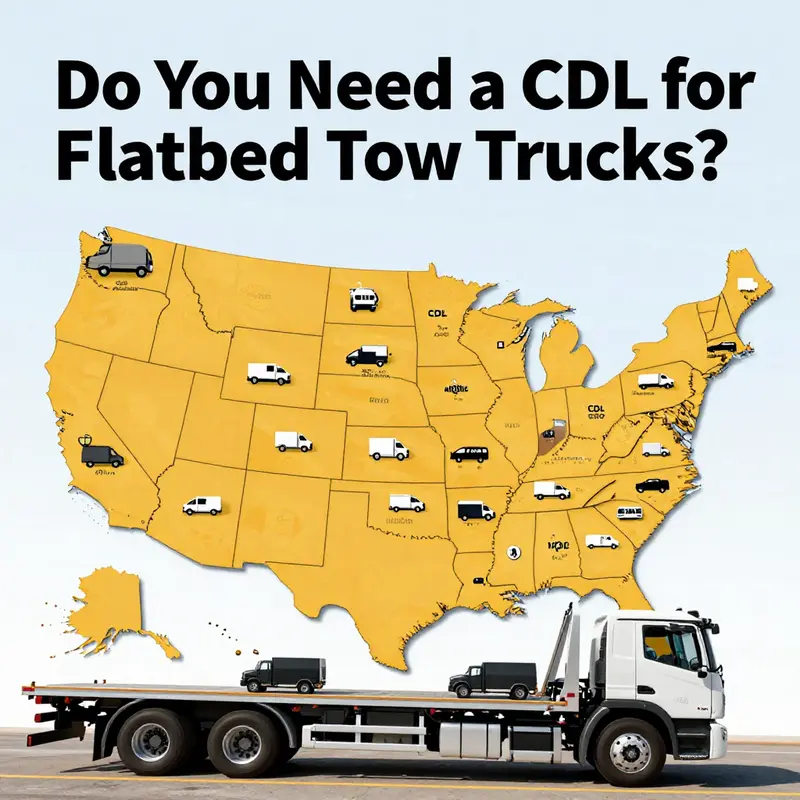
The question of whether you need a CDL to operate a flatbed tow truck is rarely answered once and for all by a single law. Rather, it unfolds as a map of requirements that shifts with the state you’re in, the job you’re doing, and the exact configuration of the truck you’re driving. For someone starting a towing business or expanding an existing fleet, this is less a static checklist and more a careful negotiation with weight limits, vehicle configuration, and the commercial purpose behind each trip. What binds these elements together is a simple but powerful idea: federal guidelines provide a baseline, but the states wield the scalpel. They carve out exemptions, impose stricter thresholds, and tailor endorsements to reflect local concerns. That interplay—federal baseline plus state nuance—defines the practical reality of operating flatbed tow trucks across the country. Below the surface of the general rule, a driver will find a tapestry of thresholds, conditions, and endorsements that can determine whether a CDL is needed, what class it must be, and what additional credentials or restrictions must accompany that license.
At the core of state variations is the GVWR, the gross vehicle weight rating, which acts as the most visible line in the sand. For many flatbed tow trucks used in professional services, the vehicle itself often carries a GVWR well above 26,000 pounds. Crossing that line frequently triggers a Class A CDL under many state rules, especially when the truck operates as a standalone commercial vehicle or when it tows a trailer with a GVWR that pushes the total over 26,000 pounds. But the picture is more complex than a single threshold. In some jurisdictions, the threshold is different, and in others the combination of vehicle and towed load makes the required license even more stringent. A handful of states apply stricter rules for specific uses or for certain types of cargo, while others maintain broader exemptions for private, non-commercial towing scenarios. These distinctions matter. They can turn a once-quiet career into a charged regulatory landscape overnight, depending on whether you’re working for a private individual to move your own vehicle or running a commercial operation that answers to a dispatcher, fleet manager, or roadside assistance network.
Consider how this plays out in practice. The most common situation you’ll encounter is straightforward: a flatbed tow truck with a GVWR above 26,000 pounds that is actively engaged in a commercial operation—responding to calls, loading and transporting disabled vehicles, or recovering a vehicle from a location. In this scenario, a CDL is typically required, and most operators will seek what is commonly known as a Class A CDL, which covers combinations and vehicles with high gross weights. However, state rules do not always align perfectly with the baseline. Some states impose lower GVWR thresholds for CDL eligibility when the vehicle is used for towing operations, especially if the towed vehicle adds substantial weight to the combined total. Others may focus on the towed vehicle’s own GVWR as a factor, meaning the same flatbed could require different licensing depending on whether it’s hauling a heavy load or a lighter car. This variability reflects a broader truth: the industry’s regulatory fabric is woven from many threads, including vehicle weight, configuration, and how the vehicle is used commercially.
Endorsements are another layer of variation that can complicate a straightforward answer. An operator who holds a CDL might still face state-specific endorsements that are essential for certain towing tasks. The most common endorsement in this space is the “N” endorsement, which specifically authorizes the transport of vehicles on a flatbed. Without the N endorsement, even a driver with a CDL might be restricted from loading and transporting a vehicle on the flatbed, which is the core function of many tow operations. Other endorsements, such as the “P” endorsement for passenger transport or the “S” endorsement for operating a school bus, may be relevant in particular contexts but are less common for a typical flatbed tow operation. Some states also require additional endorsements for hazardous materials if the towed vehicle could, in any scenario, be carrying hazmat cargo. The cascade of endorsements means a CDL holder may need a combination of core license types and supplemental endorsements to legally perform the full range of towing duties offered by a business. A prudent operator therefore plans for not just the base license class, but also the endorsements that align with the fleet’s everyday activities.
An equally important facet concerns exemptions and exceptions. The regulatory line between personal towing and commercial towing can be fine indeed. A person who uses a tow truck only to move a private vehicle on weekends, or an operator who provides service strictly for personal or family use, might encounter exemptions that would not apply to a professional, fleet-based operation. In many states, these exemptions are narrow and typically do not cover businesses that routinely present in roadside or fleet recovery scenarios. The practical takeaway is that a company’s business model—private, commercial, fleet-based, or emergency services—can determine whether a CDL is required at all, and if so, which class and endorsements must accompany it. This is why states often publish caveats that emphasize the difference between “non-CDL” use and “CDL-required commercial use.” A driver who crosses the line from personal to commercial operation will likely need to upgrade to a CDL and to ensure that their endorsements align with the most common towing activities, including flatbed loading, securement, and vehicle transport.
Training and testing standards are the other cardinal pieces in this mosaic. Federal guidelines establish a core floor for CDL training and testing, including knowledge tests, practical driving examinations, and behind-the-wheel skill tests. Yet the specifics—how long the training lasts, what portions are emphasized, and how state knowledge tests are structured—vary from one state to the next. Some states require additional state-administered exams that address local road rules or unique vehicle inspection procedures, while others lean heavily on the federal framework with only minor modifications. This means that even if a driver holds a CDL from one state, moving to another can require additional testing or documentation to reflect the new jurisdiction’s standards. For operators whose work spans multiple states, this can translate into a planning exercise that maps out licensing requirements by region and aligns fleet scheduling with the time needed to complete any state-specific requirements for drivers and endorsements.
The practical implications of state variation reach into the day-to-day operations and the strategic planning of a towing business. First, the weight thresholds and towed-vehicle considerations call for precise knowledge of the GVWR of both the tow truck and any vehicle it may haul. Operators must know whether a given load, in combination with the flatbed and equipment carried on the truck, could push the total weight into the CDL territory in one state while allowing a non-CDL designation in another. This has consequences for insurance, regulatory compliance audits, and even business decisions around which service areas a fleet will cover and which types of calls it will be equipped to handle. Second, endorsements should be anticipated as part of a fleet’s standard operating procedures. If a business frequently hauls vehicles with a flatbed, the N endorsement is practically non-negotiable in most jurisdictions. If hazardous materials are a possibility—whether the towed vehicle itself contains hazmat or is carrying hazardous materials in its cargo—then HazMat training and endorsement requirements must be integrated into the licensing strategy, with the understanding that hazmat rules add another layer of compliance and cost.
Third, the state-specific exemptions reinforce the importance of tailoring licensing strategies to actual use. A fleet that markets itself as a private-tow or non-commercial mover might be able to duck certain CDL requirements, but once a business accepts commercial contracts or roadside assistance work, those exemptions commonly evaporate. In other words, the business model not only shapes marketing and service delivery; it also defines the kind of license a driver must hold. This link between business activity and licensing underscores the value of a proactive licensing plan: before purchasing a fleet, a company should map out which states will be involved in its operations and confirm the exact license class, endorsements, and testing that will be required for each jurisdiction. The aim is not only legal compliance but also optimization of crew certification and training costs over the lifetime of the fleet.
To support this planning, operators should regularly consult state DMV websites and the FMCSA framework for clarifications on where federal baseline standards end and state innovations begin. They should also keep a detailed inventory of their equipment, noting GVWRs for each vehicle, the combined weight when loaded for typical towing operations, and whether any call would involve towing beyond a single jurisdiction. The process also involves a careful assessment of the towed vehicle’s weight and the potential for exceeding thresholds when combined with the tow truck’s GVWR. If the fleet’s typical operations include heavy vehicles or heavier tows, the likelihood of needing a Class A CDL with the N endorsement rises. Conversely, work that remains within lower weight limits or that is confined to non-commercial or intrastate operations could be eligible for narrower licensing—though the boundary lines can shift by state and by how the operation is branded and conducted.
For operators who have already earned a CDL and want to ensure continued compliance across multiple states, a practical approach is to maintain a centralized licensing file that tracks each driver’s qualifications by state. This file should include the driver’s CDL class, all endorsements, any state-specific testing requirements, expiration dates, and documentation for any exemptions claimed by the business. Regular internal audits—perhaps tied to fleet inspections or annual safety reviews—can catch mismatches between the licenses carried and the work being performed. Such discipline is not merely bureaucratic; it protects workers, the company, and the public by ensuring that everyone on the road is properly trained and authorized for the specific tasks they perform.
The nuanced rules also suggest a larger frame for decisions about training investments, equipment choices, and service area planning. If a company aims to operate a flatbed fleet across several states with varying requirements, it is prudent to pursue a uniform baseline in driver certification, with state-specific add-ons as needed. This approach helps avoid repeated training bursts and reduces the risk of non-compliance that could arise from ad hoc licensing changes when a job takes crews across state lines. It also positions the business to respond quickly to regulatory updates. When a state tightens its CDL thresholds or adds an endorsement for flatbed operations, the fleet’s licensing strategy can be adjusted with less disruption if a consistent core of CDL knowledge and endorsements is already in place.
In navigating these issues, it is useful to remember the practical guidance many operators find most helpful: always verify current, state-specific requirements before operating a flatbed tow truck commercially. The exact rules are not static; they evolve with safety priorities, traffic patterns, and enforcement strategies. The best path to staying compliant is a disciplined, proactive approach that combines an understanding of the weight-based thresholds with a clear picture of how a truck will be used across jurisdictions. This means recognizing when a particular state’s rules are stricter than federal baselines, and planning driver qualifications, training timelines, and fleet deployment around that reality. It also means engaging with local DMV offices or licensing authorities to confirm interpretations of the rules as they apply to a given vehicle and a given operation. In brief, the CDL decision for a flatbed tow truck is less about a single number and more about a dynamic calculus that uses weight, use, and endorsements to determine the right licensing pathway for a safe, compliant, and efficient business.
For readers seeking a concrete example of how a local jurisdiction frames these questions, a practical touchstone is the way a regional service area interprets the Washington, DC metro’s rules for tow operations. See how a local operator describes the licensing pathway in that market here: Tow Truck Washington DC. This particular example helps illustrate how a driver who might be licensed for a flatbed in one state could still need adjustments—whether in endorsements or class—for another state’s requirements when the job scales up in weight or crosses borders.
If you want to explore the federal side of the regulatory landscape in more depth, the Federal Motor Carrier Safety Administration (FMCSA) provides the national framework that underpins these state rules. Their resources outline the core CDL classifications, endorsements, and testing standards that form the baseline for every state’s adaptations. Access to the FMCSA guidelines is a reliable starting point when assessing how state variations align with or diverge from federal expectations. See the FMCSA site for authoritative guidance: https://www.fmcsa.dot.gov
The variations across states in CDL regulations for flatbed tow trucks reflect a field that is as much about safety culture and utility as it is about weight and paperwork. A flatbed operator who understands the weight thresholds, the probable endorsements, and the likely state-specific nuances can structure a business that remains flexible across markets while staying firmly within the law. The conversation about CDL requirements is not a dry registry of numbers; it is a practical discipline that shapes hiring, training, vehicle selection, and dispatch planning. It affects everything from how a truck is loaded to how drivers are tested, and from the insurance coverage that accompanies a tow to the speed with which a fleet can respond to a critical roadside scenario. The overarching aim is clear: to enable reliable, efficient, and safe vehicle transport while ensuring that the licensing status of every driver aligns with the responsibilities they undertake on the road. In that sense, state variations are not impediments but navigable routes that, when understood, can help a towing business grow responsibly and sustainably across a changing regulatory landscape.
Final thoughts
Understanding whether a Commercial Driver’s License (CDL) is needed for operating a flatbed tow truck is essential for business owners in the towing industry. The necessity varies based on the truck’s weight and configuration, as well as state-specific laws that could impact your operations. By familiarizing yourself with these requirements, you position your business for safety compliance and can navigate the regulatory landscape with confidence. As you evaluate your towing services, of utmost importance is ensuring that you and your drivers are adequately licensed and trained to operate safely and efficiently.