
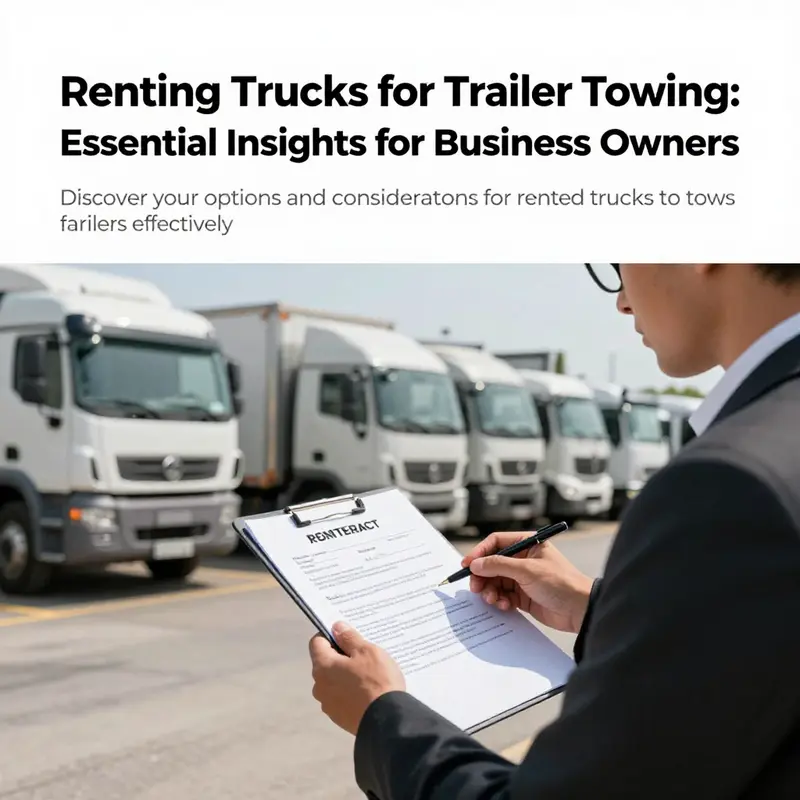
As a business owner with logistical needs, renting a truck to tow a trailer can be a critical solution for transporting goods, equipment, or vehicles. With numerous rental companies available, it’s important to assess the best choices suited to your specific towing requirements. This guide aims to illuminate the options for renting vehicles that can handle trailers and the key factors to consider during the process. The first chapter will explore various rental options to help you identify potential truck rentals, while the second chapter outlines important considerations that ensure safety and compliance when towing a trailer.
Tow Ready: How to Select and Rent a Truck for Towing a Trailer with Confidence
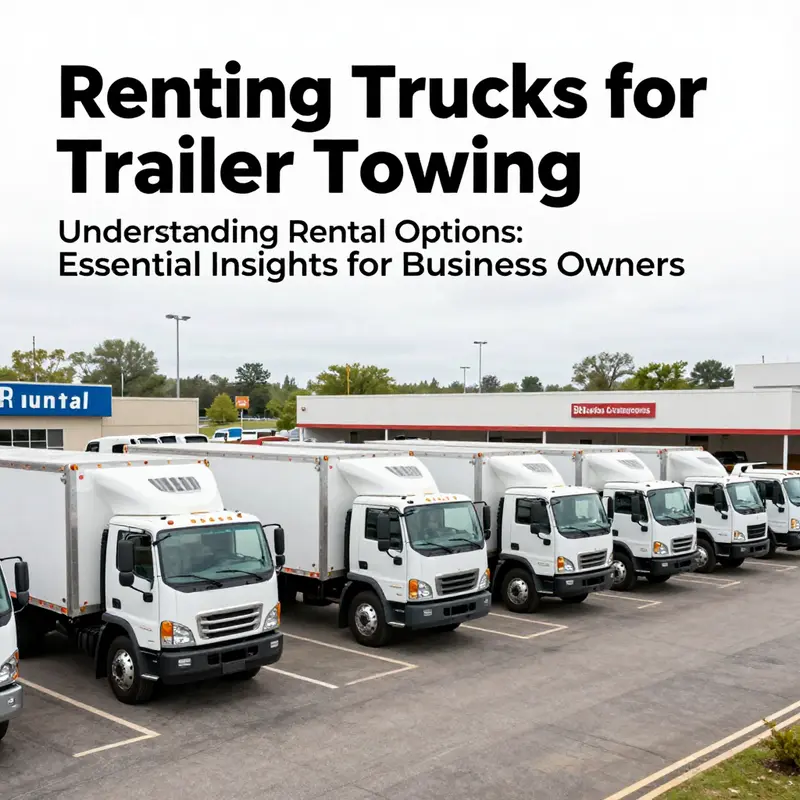
When you need to move a trailer, from a household load to equipment or recreational gear, the right truck can make the job safer, simpler, and more economical than other options. Renting a truck to tow a trailer is a common solution, but it works best when you approach the choice as a careful match between trailer weight, truck capability, and the rental terms. The goal is not just to borrow a larger vehicle, but to secure a truck whose towing capacity, hitch setup, and support services align with the job at hand. The core idea is straightforward: know the weight you’ll be pulling, verify the truck’s capabilities, and confirm the rental terms before you sign. In practice, this means translating the numbers on the trailer’s plate and the truck’s specifications into a practical plan for loading, hitching, and driving with a trailer in tow.
The first step is to measure what you intend to move and understand how weight translates into towing ability. Trailers and their cargo come with a total weight that includes the trailer’s own weight plus the load inside it. This is commonly described as the gross trailer weight. The truck you rent must be able to handle that weight safely. It helps to think in terms of weight distribution, not just total mass. A trailer can present a heavy tongue load that sits at the hitch, and a vehicle’s payload capacity—the amount of weight the truck can carry in the bed, cab, and hitch area—affects how much weight can be transferred to the trailer without compromising control. In the context of rental decisions, you’ll want a truck class that leaves a comfortable margin between its stated towing capacity and the trailer’s gross weight. If you’re unsure, the rental agent can explain the relevant figures and help you compare models, but you should come prepared with your own calculations. A practical rule of thumb is to identify a truck whose towing rating is well above the trailer’s weight, and whose payload capacity can handle any additional gear, fuel, or passengers you’ll carry in the truck itself.
The range of trucks available for towing from major rental providers generally includes full-size pickups in several configurations, with four-wheel drive available for challenging road conditions and better control on hilly or uneven terrain. These trucks are designed with towing in mind, featuring sturdy frames, enhanced cooling systems for sustained pulls, and transmissions tuned for heavy loads. The hitch setup matters just as much as the engine and chassis. For most mid- to heavy-duty trailers, a weight-distributing hitch with sway control helps manage the dynamic forces that occur when a trailer follows behind a moving vehicle. If your trailer requires a gooseneck or a fifth-wheel connection, you’ll need to verify whether the rental agency provides such hitching options or requires you to supply them. In many cases, the standard hitch on a rental pickup will be a good starting point, but the safety and performance of your tow depend on ensuring the hitch is compatible with the trailer’s drawbar and the weight distribution system you plan to use.
As you scan available trucks, keep in mind that the towing rating is a ceiling, not a guarantee. Real-world performance depends on factors like tire condition, brake capacity, and how you distribute weight across the trailer and truck. The trailer itself may have braking requirements that exceed what a basic tow vehicle can safely manage, particularly on longer drives or in hilly or mountainous terrain. If the trailer has its own brake system, you may still need a braking controller installed in the tow vehicle to ensure smooth, proportional braking. If not, you’ll want to discuss options with the rental provider about brake compatibility and any necessary equipment to maintain safe control. The emphasis should be on a cohesive system: engine torque, transmission gearing, braking capacity, hitch integrity, weight distribution, and stability control all working in concert.
Choosing the right truck also means understanding the practical logistics of the rental. Availability can fluctuate with peak moving seasons or demand for heavy-duty equipment, so booking in advance is wise. When you reserve, confirm not only the model and its class but also what’s included in the rental package. Some providers include basic towing equipment, while others may assess extra charges for hitch adapters, sway controls, or brake controllers. Insurance coverage is another area where clarity pays off. Towing increases risk, so you’ll want to know what the insurance covers, what it costs, and what portions you’d be responsible for in the event of damage or an accident. Roadside assistance is another important consideration. If you encounter a tire issue, a mechanical failure, or a hitch problem on the road, having access to reliable support can be a real safeguard during a tow.
To translate these considerations into a practical plan, begin with a precise inventory. List the trailer’s gross weight rating and estimate your cargo weight for the trip. Then identify several truck options that clearly state a towing capacity higher than the trailer’s weight and a payload capacity that accommodates your load plus passengers and gear in the cab. When you speak with a rental agent, be prepared to share these figures and ask how the truck’s configuration affects towing performance. You’ll often hear about differences between two-wheel-drive and four-wheel-drive models, as well as between gasoline and diesel engines. In many situations, a diesel-powered one-ton or near one-ton pickup offers a robust combination of torque, fuel economy, and stability for extended towing. If you will be traversing uneven ground or adverse weather, four-wheel drive can provide additional traction and control, especially when starting from a stop and when descending grades. However, four-wheel drive may add weight and cost, so factor these trade-offs into your decision.
The social and logistical landscape around rental trucks also matters. Most rental agreements require a valid driver’s license and may impose minimum age restrictions or other eligibility criteria. Some locations may also require an additional driver to undergo basic training on hitching and load distribution, particularly for customers new to towing. The rental contract may outline mileage limitations, daily rates, and any charges for adding equipment such as a ball mount, hitch ball, sway control device, or a brake controller. There can also be policy nuances related to fuel, return condition, and penalties for early return. Reading these details before you sign helps avoid surprise costs and ensures you have the right tools and terms to complete your tow safely.
As you plan, consider how you’ll handle the trip. Knowing your route and the loading plan reduces the risk of overloading either the trailer or the truck. It also helps determine whether you’ll need to practice backing up with a trailer in a safe space before you head out on the road. If this is your first towing experience, you may want to practice with a lighter load at a nearby open area. The goal is to build confidence in maneuvering the combination, especially when turning, stopping, and parking, where misjudging weight distribution can lead to trailer sway or loss of control. If you’re towing in an urban area like the nation’s capital or its surrounding suburbs, you’ll encounter tighter streets and more complex intersections. Having a plan for parking and for on-the-fly hitch adjustments can spare you time and stress. For readers in specific locales who want local guidance, there are regional towing resources that can assist with safe routing, parking options, and route-specific advice. For readers in the DC area, you can explore local guidance and service options here: towing-service-washington-dc.
In the end, renting a truck to tow a trailer is about aligning capability with need. It’s not just about having a bigger vehicle; it’s about matching a truck’s power, braking, and weight handling with the trailer’s mass and the load you’ll carry. A careful calculation upfront, clear questions to the rental provider, and a practical test drive with the trailer attached can save time, money, and risk down the road. The aim is a smooth journey where the tow feels controlled, the load remains secure, and the vehicle behaves predictably through every turn and grade. When done thoughtfully, the process helps you see rental trucks not simply as a means to an end but as a tailored tool that enables you to transport weight safely, efficiently, and with confidence.
External resource:
https://www.penske.com/
null
null
Final thoughts
Renting a truck to tow a trailer offers logistical flexibility for business owners, allowing for the efficient movement of goods and equipment. Understanding the various rental options available helps you make an informed choice that aligns with your specific towing needs. Additionally, being aware of key considerations such as towing capacity, rental agreements, and safety regulations ensures that the process is smooth and compliant. By focusing on these aspects, you can effectively utilize truck rentals to enhance your business operations.