
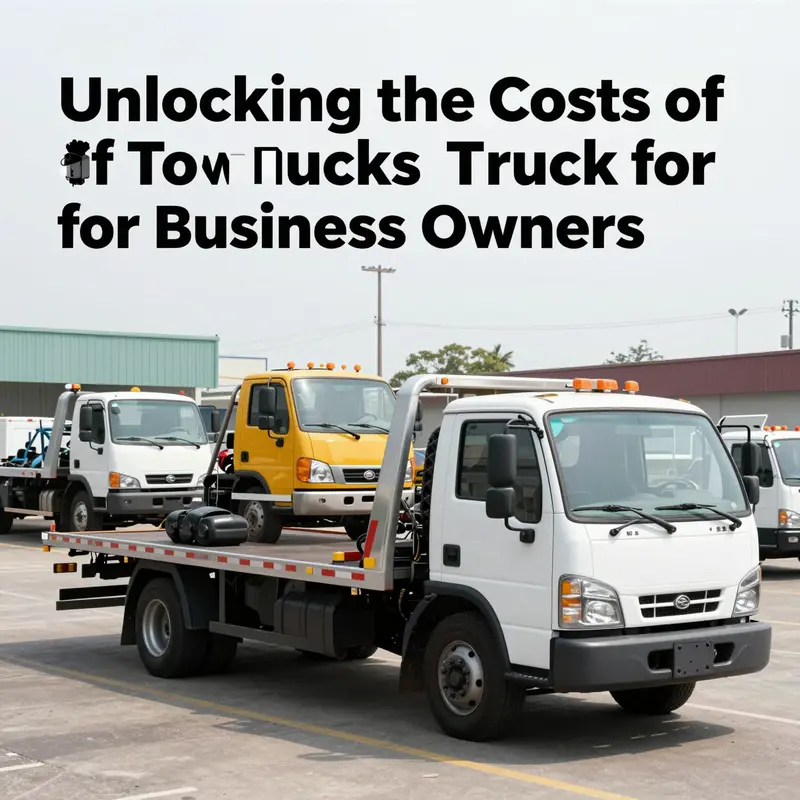
Understanding the costs associated with tow trucks is essential for business owners involved in transportation, logistics, or roadside assistance. From different pricing models to the operational expenses that come after the purchase, the factors influencing these costs can vary widely. This article delves deep into the key elements affecting tow truck prices, starting with specific pricing structures and moving towards the operational factors that impact your overall investments. By the end, business owners will possess a comprehensive understanding to make informed decisions regarding towing equipment that aligns with their operational needs.
Tow Truck Price Demystified: How Purchase Costs, Fleet Choices, and Tow Fees Shape Your Bottom Line
When people ask how much a tow truck costs, they are often really asking two intertwined questions: what is the upfront price to own or equip a tow truck, and what will it cost to hire one when you need it. The landscape is not a single number but a spectrum shaped by truck type, capacity, equipment, and how the vehicle will be used. In 2026 market terms, the range is wide enough to cover every need from a small local operation to a large emergency-response fleet. The simplest way to frame it is to separate the cost of acquiring a tow vehicle from the cost of using one. But those two threads are connected by the same core economics: capital investment, depreciation, fuel and maintenance, and the ever-present pressure of time and demand that push service prices higher when you need them most.
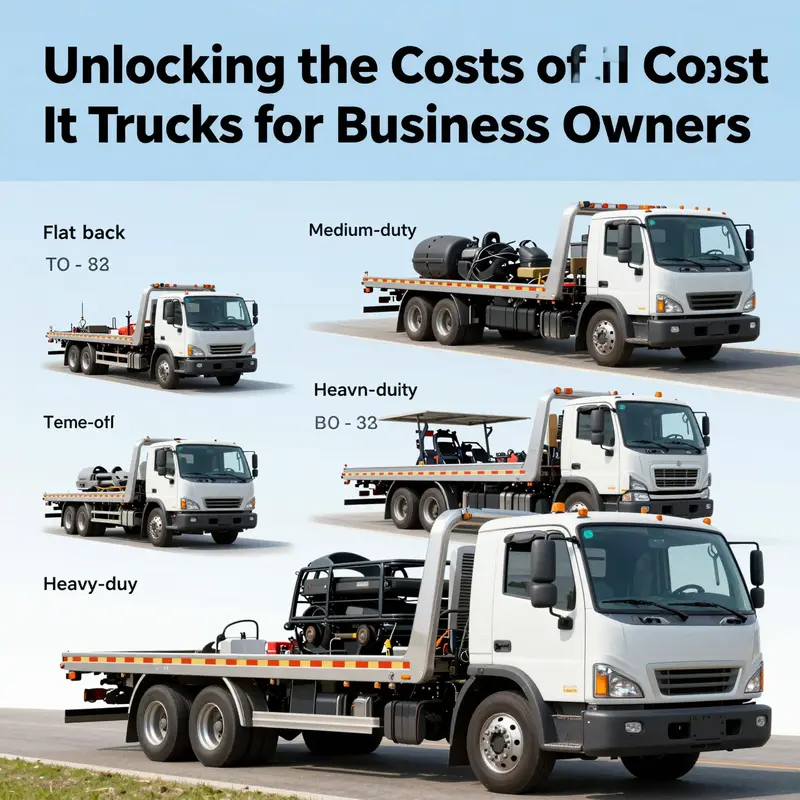
To build a practical picture, consider first the purchase side. Basic flatbed tow trucks, which typically carry light to medium loads and are favored for cars with drivetrain damage or delicate frames, begin in the roughly twelve-thousand-dollar range and can climb to nearly forty thousand dollars when new and equipped for more demanding duties. The mid-range workhorses—medium-duty wreckers with a six-by-four chassis and substantial lifting capacity—tend to sit in the low to mid-thirties thousands. These machines are designed for road-side recoveries, small to mid-size fleets, and everyday towing tasks that require reliable hydraulics, a sturdy bed, and an efficient winch system. Then there are the heavy-duty rotators—the most capable and the costliest—whose price bands typically start around one hundred fifty thousand dollars and can push well beyond three hundred thousand for industry-leading configurations with 360-degree booms and advanced stabilization. Rotators are built for complex recoveries, overturned vehicles, and emergency response, and they demand specialized training and higher ongoing operating costs, including fuel and regular maintenance on a more complex hydraulic system.
Even within those tiers, there is a parallel story about rollback flatbeds, sometimes described as inexpensive options for quick deployment over short distances and lighter jobs. These can be the most budget-friendly entry point, still offering the reliability of a flatbed—the preferred platform for many professionals when drivetrain integrity matters or when precious cargo is involved. Across all categories, the purchase price is influenced not just by the basic chassis but by the array of equipment that can accompany it: winches with higher lift capacities, tilting beds, fully rotating booms, and safety and communications packages that ensure visibility and coordination on crowded urban streets or during late-night operations. The opportunity to customize a tow truck is a mirror of the broader equipment market: you pay more for more capability, and you pay more for reliability, which translates into less downtime and more jobs completed each shift.
Brand and origin enter the conversation as well, though they should be weighed carefully against the total cost of ownership. In general terms, there are market forces at play where price differentials reflect production location, export duties, and warranty terms. International manufacturers may offer competitive base prices, but shipping, freight, and import duties can add a meaningful premium after the truck lands in your yard. This dynamic means a straight sticker price on a factory invoice does not tell the full story. The true cost of bringing a tow truck into service includes freight, taxes, and any local compliance costs that apply to commercial vehicles. In practice, informed buyers watch for total landed cost rather than focusing solely on the sticker price.
Beyond the sticker price, the cost of ownership unfolds over years, not days. Fuel consumption rises with heavier-duty rigs, and maintenance costs climb with the complexity of the hydraulics, winches, and tires that carry the load hour after hour. Insurance premiums scale with vehicle value, payload, and the risks associated with towing in busy traffic or at night. Licensing and registration fees, periodic inspections, and operator training add to the ongoing expense. For prospective owners, the calculus is simple in outline but exacting in detail: does the fleet generate enough revenue to cover depreciation, debt service, and the operating costs while delivering a reasonable return? If the answer is yes, a heavier upfront investment can pay off through higher service availability, faster turnarounds, and the ability to bid on larger or more complex jobs.
The other side of the coin—the cost a consumer pays when towing is required—resembles a different but related economics puzzle. Towing costs are not standardized and vary with distance, vehicle size, time of day, and the specific capabilities of the tow truck deployed. A common pricing framework is tiered by miles: in many markets, the initial miles incur a baseline charge, sometimes in the range of thirty-five to one hundred twenty-five dollars for the first few miles. As the distance increases, the cost escalates, reflecting escalating labor, fuel usage, and equipment wear. For longer hauls—up to forty miles or more—the price can climb into the mid to upper hundreds. Very long-distance tows, such as those approaching a hundred miles, can exceed six hundred dollars depending on the region and the service provider. This tiered model is designed to balance the fixed costs of dispatch and readiness with the incremental costs of fuel and time, ensuring the towing contractor remains solvent during peak demand.
The type of vehicle being towed is a major variable, too. Heavier, larger vehicles require equipment and crew with more specialized capabilities. A sedan or compact should be far less expensive to tow than a full-sized pickup, a commercial vehicle, or a truck. The towed vehicle’s weight, wheel configuration, and roadworthiness influence both the choice of tow truck and the final bill. In practical terms, this means a fleet that has invested in multiple chassis and configurations can tailor the response to each call, capitalizing on the most economical option for the job while maintaining the ability to handle emergencies when they arise.
Time of day and day of week also shape the price tag. Emergency or after-hours tows—nights, weekends, or holidays—usually carry a premium. The rationale is straightforward: demand is higher, and the service window is more constrained, so the operator may shoulder a greater labor burden and a sparsity of alternative options. This price lift mirrors what many service trades experience when the demand curve spikes and the crew is asked to operate in less favorable conditions. For consumers, the practical implication is clear: when the emergency is now, price sensitivity may be reduced, and the focus shifts to reliability, speed, and the safety of the vehicle and the scene.
The interaction of these factors is why one cannot answer “how much does it cost to tow a car?” with a single number. For consumers, the experience starts with understanding what the service needs will demand: how far the tow will go, what equipment is required, and how quickly the job must be completed. A local operator who serves your area can provide a concrete quote that reflects the exact mix of distance, vehicle type, time of day, and the specific capabilities of their fleet. For those who own or manage a towing business, the discussion moves toward optimization: investing in the right mix of equipment to cover a broad range of jobs while controlling maintenance and fuel costs, and designing pricing that remains competitive without eroding margins.
To illustrate how regional realism translates into practice, consider a practical snapshot of local pricing dynamics. A reader can explore nearby providers and compare options for a given scenario within a city by looking at the services offered by a local DC tow truck operator. For readers in the Washington, DC area, a quick reference to a local provider’s service page can give a sense of how the pricing pieces translate into real-world quotes for common callouts. This kind of regional comparison helps bring the abstract numbers into a tangible frame, showing that the gap between a flatbed and a rotator is not just a big number on a spec sheet but a reflection of capability, response time, and the risk profile of the job at hand. See a regional reference here: Washington DC tow truck service.
The consumer-friendly backdrop to all this is the growing awareness that many insurance policies now offer towing coverage or reimbursements. In some cases, insurers assess a portion of the cost, reducing out-of-pocket spend for the driver or owner of the vehicle. This adds another layer to the math, influencing how people plan for roadside incidents. Understanding whether towing coverage applies, what limits exist, and how deductibles interact with the price quoted by a service provider can change the financial impact of an incident. The broader takeaway for drivers is simple: when you have coverage that includes towing, you should know what it covers and how to trigger the benefit efficiently. The aim is to turn a stressful event into a managed cost, rather than an unexpected expense that disrupts finances for weeks.
The chapter’s journey from chassis price to tow cost is more than a tour of numbers; it is a map of choices. The decision to buy a tow truck is a decision about control, reliability, and the ability to deliver rapid, safe service. It is about balancing capital expenditure against operational flexibility, maintenance discipline, and the capacity to respond to an ever-changing demand curve. The decision on whether to own a fleet outright or to rely on subcontracted services depends on how often you expect to deploy the vehicle, the geographic area you cover, and the types of jobs your team will encounter. In markets where demand fluctuates with weather, traffic, or special events, a more versatile fleet with multiple configurations can pay dividends in uptime and service quality.
For readers who want to ground these concepts in real-world regional context, it can be helpful to review what a local provider offers in a specific market. If you are assessing options in the DC area, for example, you can explore the range of capabilities and pricing by visiting a nearby provider’s page dedicated to tow truck service. The goal is to translate the broad spectrum of purchase and service costs into a practical, region-specific set of expectations. This approach helps avoid overgeneralization and supports decisions that align with actual on-the-ground conditions, such as traffic patterns, roadway complexity, and typical vehicle mixes in a given city.
As a concluding thread, the layered picture of tow truck costs—covering both acquisition and service pricing—highlights an essential truth: there is no one-size-fits-all answer. A small operator may justify a modest flatbed investment because the daily demand is predictable and the job mix favors standard tows. A larger operation, tasked with complex recoveries and high-speed service in dense urban areas, may justify a rotator’s high upfront cost to win bids that require advanced capabilities and rapid response. In between, there are scalable options that blend safety, efficiency, and cost control, enabling a business to grow without being overextended. Across all paths, the connection between what you own, what you deploy, and what you charge remains the central driver of financial viability.
External reference for benchmarking consumer costs and coverage considerations: Allstate’s guide on towing costs discusses common pricing structures and how insurance coverage can offset some expenses. https://www.allstate.com/insurance/auto/towing-cost
Tow Truck Costs in Focus: Weighing Price, Value, and the Long View from Flatbeds to Rotators
When a fleet manager asks, “What does a tow truck cost?” the answer is never a simple sticker price. It is a question that folds in the scale of operations, the types of calls the fleet expects to handle, and the long arc of maintenance and reliability. In 2026, the market reflects a spectrum as wide as a service map: from light-duty, affordable flatbeds to the most capable heavy-duty rotators. The numbers are real, but they are also a guide to priorities. A small local operator may find a basic flatbed priced in the low five figures, whereas a high-capacity rotator, built to tackle overturned vehicles and intricate recovery scenes, can push past six figures. In between, there are mid-range wreckers and rollback units that straddle daily practicality and longer-term efficiency. Understanding these price bands is less about chasing the lowest price and more about aligning a truck’s capability with the work mix and the economics of service delivery.
New-flatbed options in the four-ton to five-ton range begin at roughly twelve thousand eight hundred dollars. These units often come with a tilting bed and a winch capable of handling several thousand kilograms, which makes them nimble for local rescues, light recoveries, and routine roadside service. The range can extend well beyond thirty-nine thousand across different configurations, depending on hoisting power, bed length, winch capacity, and safety features. For a shop that handles a steady stream of small- to mid-sized calls, a basic flatbed offers reliable versatility without the premium price of heavier equipment.
Stepping up to a medium-duty wrecker, typically configured as a 6×4 with ten wheels and a robust 25-ton capacity, places the price in a more competitive band around the low to mid-thirties thousand. A unit at this tier is designed for highway incidents, heavier tows, and a wider service radius. It combines the resilience of a tougher frame with more substantial hydraulic resources and a more capable wheel-lift system. The economics at this tier often hinge on the balance between higher upfront cost and the ability to complete more jobs per shift, reduce the need for subcontractors, and handle a broader mix of calls without sacrificing reliability.
The ceiling for traditional tow-truck pricing rises sharply when the conversation shifts to heavy-duty rotators. These machines are not just bigger; they are engineered for complexity. A rotator’s 360-degree rotating boom, high-clearance lifting, and the ability to manage overturned vehicles define a class of equipment whose price commonly falls within the range of hundreds of thousands of dollars. They demand specialized operator training, higher fuel use, and more frequent maintenance. The up-front investment is substantial, but the payoff for fleets that regularly face rollover recoveries or complex multivehicle incidents can be significant in terms of job completion rates and safety outcomes.
There is also a practical, less expensive path that remains popular for smaller operations or those who want to test the waters with a low-risk commitment: the rollback flatbed, particularly models that handle up to ten tons. These units start around the same twelve thousand eight hundred dollars as the basic flatbeds but deliver the additional advantage of a roll-flat bed and improved weight distribution for some categories of vehicle recovery. For many service providers, this option represents a wise first step into owned capacity, enabling faster response times and more controlled scheduling without the higher maintenance overhead of a true heavy-duty wrecker.
Beyond the sticker price, the real story lives in the myriad factors that influence total cost of ownership. Vehicle type and capacity are the obvious levers. Larger, heavier-duty trucks require sturdier frames, larger powertrains, and more sophisticated hydraulics. The optional equipment—winch capacity in the three- to five-thousand-kilogram range, hydraulic tilting beds, rotating booms for rotators, and comprehensive safety systems—adds to the sticker price but also expands the range of services a fleet can offer. The origin of the unit and the brand’s engineering philosophy matter as well. In many markets, lower initial prices come with shorter warranty windows, less robust service networks, and fewer parts in stock regionally, which can lengthen downtimes when maintenance is due.
A critical piece of the cost puzzle is shipping and import costs. The base price may appear deceptively modest for buyers looking offshore or importing from overseas suppliers. Freight, duties, and customs processing can add thousands to the total pocketbook. For any buyer, the prudent move is to demand a full cost breakdown up front. A transparent quote that itemizes the bed, hoist, wheels, and chassis, plus shipping, taxes, and any import duties, helps prevent surprises when the invoice lands. It also clarifies the value proposition of a given unit against the mission it is intended to fulfill.
The ownership side of the equation introduces another layer of complexity. Fuel consumption is higher with heavier units and more powerful engines, especially when a rotator’s hydraulics are engaged in demanding recoveries. Maintenance is not just about routine servicing; it encompasses the hydraulics, winches, and tires that see regular stress from on-scene loads and long-haul tows. Insurance costs follow the vehicle’s risk profile, while licensing and regulatory compliance can vary by jurisdiction and by the complexity of the recoveries performed. Training becomes an ongoing budget item, especially for rotator-equipped fleets where the margin for error is slim and the on-scene safety protocols are exacting.
This is where the long view matters. For a fleet considering the roll from a lighter, lower-cost unit to a more capable, higher-cost platform, the question shifts from “What is the price?” to “What is the value over the life of the machine?” A well-chosen heavy-duty unit can reduce the need for subcontractors, accelerate job completion, and improve first-attempt recoveries, all of which contribute to lower per-job costs over time. The case for investing in a premium rollback or rotator often rests on the claim that a more capable machine reduces maintenance firefights and renegotiated calls, ultimately improving the fleet’s reliability and customer satisfaction.
As one fleet manager noted, investing in a premium rollback unit pays off in reduced maintenance costs and higher job completion rates. The emphasis here is not just on the immediate capability but on the steady improvement in on-time performance and safety that comes with a more integrated, purpose-built system. This sentiment underscores the principle that the best-fit choice balances upfront expenditure with predictable, lower long-run operating costs and a smoother workflow for drivers and dispatchers alike.
For those weighing options, it helps to consider the typical work profile. A local operation with frequent, shorter tows and a heavy emphasis on routine roadside service can often justify a mid-range wrecker or rollback configuration. The same fleet, operating in highway corridors with heavy incident demand and occasional complex recoveries, might find rotator capability essential. In regions with long average towing distances, the efficiency gains from a more capable unit become more pronounced, translating into more completed jobs per week and greater customer satisfaction. Each of these scenarios influences the cost calculus, shifting the emphasis from the initial price tag to the expected utilization and the durability of the asset over time.
Choosing a tow truck, in other words, is as much about strategic fit as it is about price. The Gross Vehicle Weight Rating (GVWR) is a practical starting point: it determines licensing requirements and the class of operator who may legally drive the vehicle, and it also signals the scale of loads the truck is engineered to manage. A careful buyer weighs the GVWR against anticipated average loads, typical job mixes, and dispatch patterns. The workflow should reflect the business’s core competencies—whether that means quick, nimble responses to minor incidents or a heavier focus on multi-vehicle recoveries requiring robust on-scene capabilities—and the chosen vehicle must support that workflow with reliability.
For local operators seeking a balanced choice, a compact rollback model offers a meaningful blend of capacity, efficiency, and maintenance practicality. It serves well in urban and suburban settings where speed and reliability matter, yet the operation does not demand the highest-end complexities of a full-scale rotator. The selection process benefits from a disciplined approach to total cost of ownership: evaluate not only the purchase price but also the maintenance regime, spare-parts availability, service network reach, and the ergonomic comfort of the cab for the driver. A well-designed cab can reduce driver fatigue, improve visibility, and ultimately contribute to safer, faster responses on the road.
To see how a local fleet might integrate such a unit into its operations, consider a path that prioritizes service area coverage and response time. A compact rollback can expand on-time response in dense service zones, making scheduling more predictable and reducing the need for third-party assistance on routine recoveries. A clear, actionable decision framework emerges: assess the expected volume and mix of calls, estimate maintenance and fuel costs under various configurations, then compare these projections against the upfront price and the anticipated life of the asset. The math becomes a reflection of business priorities—speed to service, safety, reliability, and the capacity to scale as demand grows.
In practical terms, the balance often favors a single strategic link: the vehicle’s ability to perform the majority of the fleet’s work with a minimum of downtime. That is where a targeted internal link can help operators explore nearby options, such as Arlington-area tow-truck services, which can provide a tangible reference point for what a local unit’s capabilities and costs look like in practice: Arlington tow-truck services. This kind of context helps a buyer translate catalog specifications into actual field performance and service economics.
As you plan, keep in mind the broader ecosystem of market information. For readers seeking deeper market trends and comparative vehicle insights, a well-regarded industry piece discusses the landscape of rollback configurations and their fit for reliable towing. It reinforces the notion that the best choice is not the most expensive machine, but the one that aligns with the scale of operations, the frequency of use, and the quality of the maintenance and service network available. For those who want to explore this further, an external resource aggregating perspectives on rollback configurations provides a useful frame for comparison: https://www.towtrucknews.com/top-10-best-rollback-tow-trucks-to-buy/.
In sum, the price of a tow truck in 2026 reflects more than the sticker on the door. It represents a balance between upfront capability and long-run operating discipline. The spectrum—from economical flatbeds and rollback units to robust rotators—serves different business models, each with its own budgetary logic. A thorough cost assessment looks at the full lifecycle: initial purchase, shipping and duties if buying internationally, ongoing fuel and maintenance, insurance and licensing, and the driver’s training and ergonomics that affect safety and efficiency. For any operator, the right choice is the one that reliably delivers the best combination of readiness, speed, and durability within the budget that aligns with the company’s strategic goals. By anchoring decisions in a clear understanding of both the price bands and the long-term value, fleets can build a resilient asset mix that supports steady growth rather than reactive spending on urgent repairs.
Final thoughts
In summary, understanding the costs associated with tow trucks involves not just the initial purchase price, but a comprehensive consideration of several factors including vehicle type, features, and ongoing expenses. For business owners, making an informed decision about which tow truck to acquire can greatly influence operational efficiency and profitability. By taking into account the pricing models outlined and analyzing the various factors that influence costs, businesses can better plan their investments in towing equipment and ensure they select the right solutions that fit their demands. Empower your business’s towing decisions today with the knowledge to choose wisely.