

Tow truck drivers play a critical role in ensuring roadside assistance and vehicle recovery, yet their salaries can vary widely based on numerous factors. For business owners in the towing industry, understanding how much these drivers earn is essential for competitive hiring and budgeting. This article delves into the regional salary variations across Canada, shedding light on how location impacts earnings. Furthermore, it elucidates job market trends, highlighting how demand and experience influence salaries for tow truck drivers. By understanding these dynamics, business owners can make informed decisions in their hiring practices and operational strategies.
Pay by Place: The Geography of Tow Truck Driver Earnings Across Regions
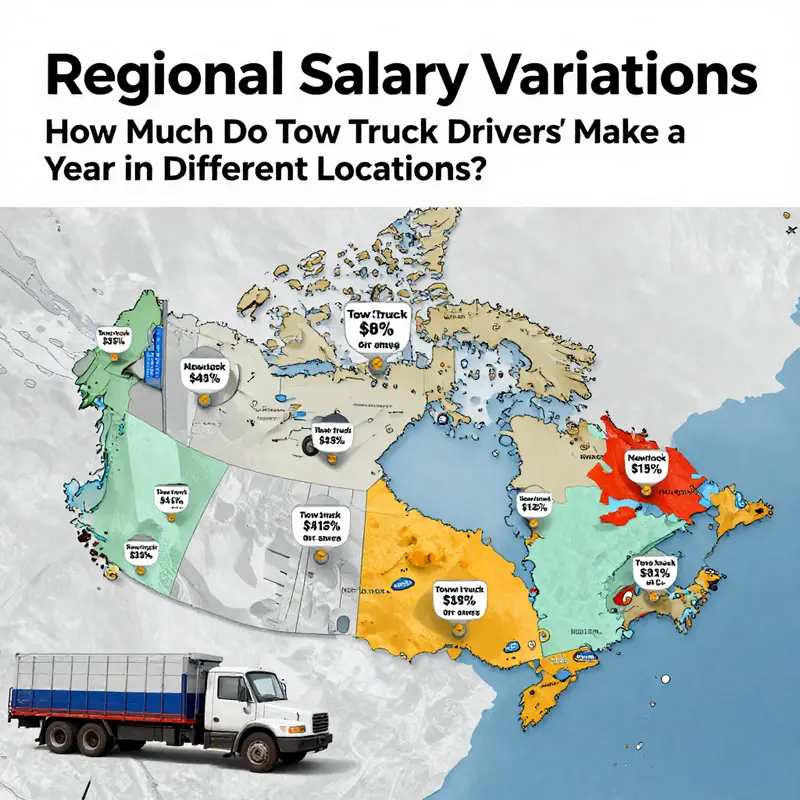
Regional pay patterns for tow truck drivers unfold like a living map, revealing how location, demand, and local economies collide to shape a year’s worth of income. The simple, hourly math of a base wage can, in practice, bend dramatically when you account for hours worked, on-call shifts, weekends, and the sheer volatility of roadside incidents. Across Canada and beyond, the numbers tell a story: pay is as much about where you work as how long you work, and a driver’s portfolio of hours can stretch a modest wage into a surprisingly robust annual total in the right place. When we translate the data into a single, practical picture, a few regional constants emerge. The baseline is a starting point—an average that looks reasonable on paper but often understates the real possibilities waiting in busier markets. In Canada, for example, the national average base rate hovers around $17.75 per hour, which translates to roughly $36,900 per year for a standard 40-hour week. Yet the geography of that figure varies as surely as the weather. In the metropolitan belt of British Columbia, the daily demand for urgent roadside service interacts with higher living costs to push wages toward the upper end of the spectrum. In Richmond, an ordinary day on the job reveals an average hourly wage of $24.06, enough to reach about $50,000 a year when hours are steady and the clock runs through a full 2,080-hour year. But the city also hosts standout shops that pay more for seasoned drivers. At Rusty’s Auto Towing Ltd, the rate climbs to $37 per hour, a return that can push annual earnings up to about $76,840 if the full-time hours are maintained. Another local employer, Tonks Towing, offers a range around $22 to $24 per hour, translating to roughly $45,760 to $50,160 annually at a 40-hour week. The contrast between those pay scales within the same city underscores how individual employers, job duties, and shift differentials can widen the income gap well beyond the city-wide average. The regional picture becomes even more instructive when we widen the lens to cover nearby cities. Surrey, just to the south of Vancouver, presents a striking illustration of how a single employer’s rate policy can lift a driver’s yearly take. Brown Boys Transport Ltd posts an hourly wage of $39.50, a rate that swells annual earnings to about $82,640 for full-time workers. This is not an isolated case; it is a signal that in high-demand corridors—where the balance of supply and demand tilts toward the service sector—employers reward availability and reliability with higher pay. A little farther east in Ontario, the city of Guelph is another useful data point. Professional Towing Services offers $36 per hour, which equates to around $74,880 annually for a driver who clocks 2,080 hours. It is not merely the hour rate that matters; it is the total hours multiplied by the wage rate, especially when overtime or overnight shifts are common. The same principle holds in Alberta, where Chestermere’s Champion Towing Ltd pays $36.10 per hour, roughly $75,288 per year at full-time hours. These figures illustrate how provinces with strong urban networks and a high concentration of service calls can push wages higher than the national average, even when the base rates resemble those of other regions. In Atlantic Canada, Dieppe shows a different side of the spectrum. Wages there typically range from $18 to $25 per hour, producing annual incomes between about $37,440 and $52,000. The spread reflects local market conditions, the scale of operations available to drivers, and the opportunities to pick up additional shifts or weekend work. Across the country’s interior and northern regions, the variation continues. Thunder Bay, Ontario, for instance, sits in a middle ground with an average around $26.53 per hour, translating to about $55,000 annually. The spread there, as elsewhere, widens when drivers take advantage of overtime, on-call schedules, and the freedom to select extra hours during peak demand. If we widen the field to one of the country’s most dynamic markets, Vancouver, British Columbia, another highlight emerges. A job listing there cites a monthly salary range of $4,000 to $8,000, which translates to roughly $48,000 to $96,000 per year. This is a telling indication that a single market can deliver a broad spectrum of earnings depending on hours, overtime, and the employer’s compensation structure. It also hints at the advantages and risks of working in high-cost, high-demand urban centers where the cost of living is steep and the work tempo is relentless. The Canadian map gains additional texture when we cross into Australia, where the data for certain regions remains sparse. In places like Darra and West End, Queensland, salary data may not be readily available with precision, but the way pay scales align with regional truck driving patterns in other sectors provides a useful guide. In general, pay tends to reflect the same regional dynamics—cities with bustling traffic, dense service networks, and a higher volume of roadside calls tend to offer more favorable hourly rates and greater opportunities for overtime. Readers should treat Australian figures as indicative rather than definitive until localized surveys tighten the numbers. The United States adds another layer of contrast to the regional pay story. Here, Indeed’s data indicates an average hourly wage of about $21.27, which translates to roughly $44,200 per year for a typical full-time role. Yet within that framework there is a wide gradient. Some positions—especially those involving heavy-duty towing, complex repairs, or extended on-call obligations—can push yearly earnings past the $80,000 mark. The difference often hinges on market demand, the volume of emergency calls, and the willingness of employers to offer higher overtime rates or shift differentials in exchange for reliability and availability. The regional differences are not only about city size or national borders; they are also connected to the labor market structures that shape compensation. In Canada, wage data is frequently collected and reported at the city or metro level, revealing how the same nominal rate can generate very different annual totals depending on the number of hours drivers can count on. A driver in Surrey, where a single employer advertises $39.50 per hour, may land in the six-figure territory if the work schedule includes substantial overtime. In smaller towns or provinces with lower living costs and fewer on-call opportunities, the same number of hours might yield a more modest yearly sum. The Washington, DC area presents a particularly illustrative case of the U.S. market’s complexity. It serves as a microcosm of how urban economics, public transport alternatives, and the density of incidents coexist with high living costs to push pay upward, but not uniformly across all employers or shifts. For readers curious about how this dynamics plays out across a given region, the experience in the nation’s capital can serve as a useful reference point—a practical lens through which to gauge what a local pay packet might look like. For a sense of market dynamics in the U.S. capital region, see Washington, DC towing. Washington, DC towing. The broader conclusion holds across markets: location remains the strongest predictor of annual earnings for tow truck drivers, even more than seniority or tenure, though experience and skill still matter. The industry rewards drivers who are not only reliable and quick with a tow but who also stay flexible with scheduling, adapt to varying shift demands, and respond to the evolving needs of helicopter-like urban traffic patterns that produce peaks at dawn, dusk, and after-hours. The data also underscores a practical takeaway for anyone evaluating a career in towing. If your goal is to maximize annual earnings, prioritize markets with higher hourly rates and more abundant opportunities for overtime and on-call work. If your goal is stability and predictable income, a steady 40-hour schedule in a market with a reasonable base rate can still produce a comfortable living, especially when benefits and per-call bonuses come into play. And if you are a prospective driver weighing geography against cost of living, the numbers remind us to align expectations with the local economy. The cost of living in high-pay regions often accompanies higher housing costs, insurance, and everyday expenses. A higher wage is meaningful only if it translates into greater purchasing power after taxes and essential costs. In that sense, a driver’s year-end total is not simply a function of hourly rate but of the full package of hours worked, benefits, overtime opportunities, and the relative price of everyday life in that location. As with any profession tied to the uncertainties of road conditions and roadside incidents, the path to earning more is rarely a straight line. It depends on where you work, how much you work, and how effectively you leverage opportunities to earn overtime while maintaining a strong safety and service record. The chapter’s regional focus does not aim to prescribe a universal blueprint. Instead, it provides a framework for understanding the real-world implications of geography on pay. The most valuable insight for readers is that wage comparisons must be anchored in the minutes of a driver’s actual schedule. An hourly rate is only part of the story; the annual sum is forged by the cadence of shifts, the tempo of demand, and the willingness of employers to reward dependable coverage with enhanced compensation. For those weighing career choices, the data encourage a twofold approach: seek markets with robust call volumes and flexible scheduling, and evaluate the total compensation package, not just the nominal hourly rate. Finally, the chapter acknowledges the importance of real-time data. Wages shift with demand, seasonality, and local labor dynamics. To stay current, job seekers and researchers should consult live postings and salary aggregators like Indeed, which update as markets tighten and loosen. The dynamic nature of tow-truck work means that today’s numbers capture a moment in a living, breathing labor market. External resource for benchmarking: https://www.indeed.com/career/tow-truck-driver/salaries
null

null
Final thoughts
Tow truck drivers are indispensable to the towing industry, and understanding their earnings can significantly impact business strategies for owners and decision-makers. Regional differences highlight the need for competitive salaries to attract skilled drivers, while variations in demand and experience underscore the importance of offering comprehensive compensation packages to retain top talent. By staying informed on these trends, business owners can effectively navigate the hiring landscape and foster a successful towing operation.