
For business owners who rely on trucks for transporting goods and equipment, understanding your vehicle’s towing capacity is crucial. Knowing how much weight your truck can safely tow not only determines the effectiveness of your operations but also influences the choices you make about equipment, trailers, and materials. This guide will help you grasp the concept of towing capacity and provide you with the tools to calculate it accurately, ensuring you can operate your business efficiently and safely. Each chapter will build upon the last, leading you to a comprehensive understanding of what you can tow and how to do it responsibly.
Tow Weight, Not Just Horsepower: Reading Your Truck’s Towing Capacity for Safer Hauls
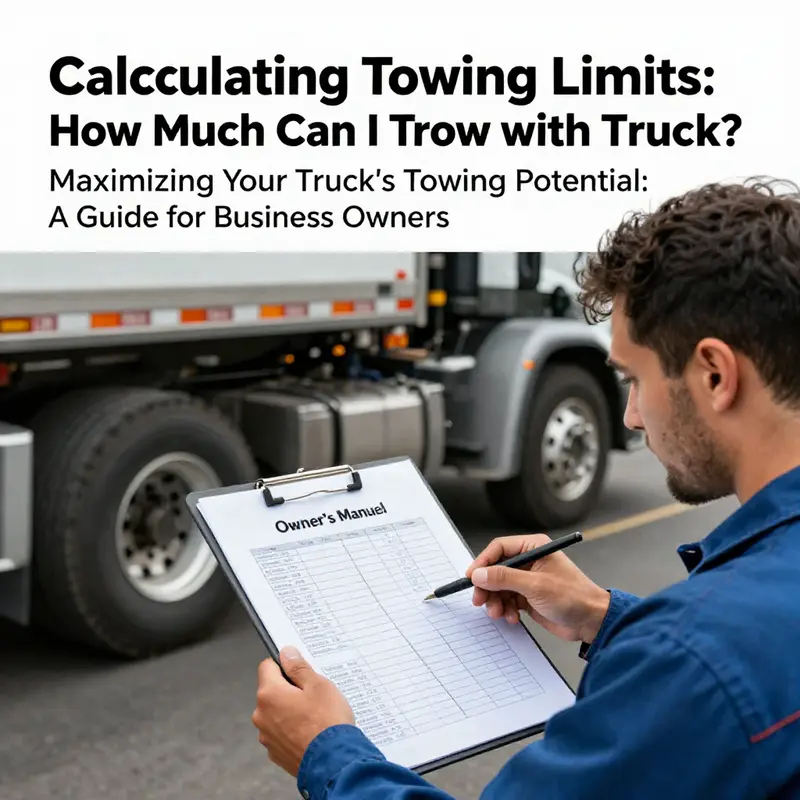
When you ask, how much can I tow with my truck, the answer isn’t simply a number tied to engine size or swaggering horsepower. It’s a definition built into the truck’s design—the towing capacity that the manufacturer specifies after accounting for the frame, cooling, brakes, suspension, and even the transmission. This capacity is not a rough target; it’s a safety limit grounded in engineering. To know exactly how much you can pull, you need to consult the truck’s Owner’s Manual or verify the Vehicle Identification Number online through the manufacturer’s site. The towing capacity you’ll find is typically listed in the Specifications section and reflects a carefully calculated ceiling rather than a rough guess. In practice, this means you should measure, verify, and respect that number as the safe cap on what you haul behind the truck.
At the heart of the matter is a simple but crucial distinction: towing capacity versus payload. Towing capacity is the maximum weight that can be pulled externally, including the trailer and its load, as well as the weight of any passengers, cargo, and fuel that sits in the truck while towing. Payload capacity, on the other hand, describes how much weight the truck itself can carry in its bed and cabin separate from anything you tow. These figures are intertwined but not interchangeable. A truck with a high towing capacity can still be limited by its payload if you load the cabin and bed heavily; that load then eats into the truck’s ability to accelerate and brake safely once a trailer is attached. The practical upshot is simple: never treat towing capacity as a green light to push the limits. Always verify both the towing capacity and payload to understand what you can actually handle in a given trip.
To grasp the math behind the towing figure, you first need to understand Gross Combined Weight Rating, or GCWR, and curb weight. GCWR is the maximum combined weight of the truck, its occupants, cargo, fuel, and the trailer in tow. Curb weight is the truck’s own weight when it’s ready to drive—empty of passengers and payload but with a full tank and all fluids. The core calculation is Towing Capacity = GCWR minus Curb Weight. As a concrete example, imagine a truck with a GCWR of 14,000 pounds and a curb weight of 5,500 pounds. Subtracting 5,500 from 14,000 yields 8,500 pounds, which would be the maximum towing capacity under those exact conditions. This is the ceiling you must not exceed when selecting a trailer and planning a tow.
These numbers aren’t arbitrary numbers pulled from a catalog; they reflect a holistic assessment of the truck’s design. A heavy trailer places more demand on the engine’s cooling system, the transmission, and the braking network. It also changes the dynamic handling of the vehicle, increasing stopping distance and altering weight transfer during acceleration and deceleration. When the trailer’s weight is added, the truck’s effective weight distribution changes across the axles, which impacts steering response, tire contact with the road, and overall stability. This is why the calculated towing capacity must be treated as the safe maximum and not a target to push toward on every trip. The risk of surpassing the limit is real: brake fade, overheated axles, and even loss of control can follow. In a practical sense, the manufacturer’s specification is a warning to keep your towing within tested and validated ranges.
Finding the exact numbers is easier than it sounds, but it requires care. Your owner’s manual is the primary source, but the VIN can unlock model-specific data that may not be obvious from a generic specification sheet. The VIN holds the precise configuration of your truck, including its GCWR and curb weight as built for its particular trim, drivetrain, and equipment package. This is why entering the VIN on the manufacturer’s site or consulting the official specifications page is essential. If you own a modern truck with multiple trim levels, packages, and optional equipment, those little differences can add or subtract hundreds of pounds from your GCWR and curb weight. The result is an updated towing capacity you must rely on for every tow.
An important distinction to keep in mind is that the calculation for towing capacity does not tell you everything you need to know for a safe tow. You also need to ensure your hitch and ball are rated for the total weight you intend to pull, and you must verify that your tires are rated for the load and properly inflated. A trailer’s braking system also plays a decisive role in safety. If you’re pulling a heavier trailer, a brake controller is often a wise addition, particularly for trailers over 3,000 pounds. The overall safety equation relies on secure connections, appropriate braking, correct load distribution, and robust tires. Each element has to be compatible with the combined weight you’re about to tow.
The real-world takeaway is simple: do not rely on appearances or old habits to judge what your truck can handle. Vehicle age does matter. Older models with sturdier frames and heavy-duty components sometimes carried high towing expectations that new models still uphold, but the only dependable source is the manufacturer’s current specifications. Full-frame designs, common in older and some heavy-duty trucks, tend to be built for higher towing capacities because of their robust chassis. However, even the strongest frame cannot compensate for a miscalculated load or a mismatch between the trailer and the tow vehicle’s capabilities. Safety hinges on accurate data and disciplined practice, not bravado.
These principles feed into every practical decision you make on the road. When you’re planning a tow, you should first confirm the truck’s GCWR and curb weight exactly as built for your model year. Then, you compare that to the trailer’s gross vehicle weight rating and the trailer’s actual weight when loaded. The combined weight must stay under GCWR, and you must also verify that the trailer’s hitch and ball rating match or exceed the weight of the trailer plus its load. Don’t forget the trailer’s payload, the weight of cargo inside the trailer itself, which adds to the total that your truck must haul. The chain of weight begins with your truck and extends to every element behind it, so every component must be coordinated for safety.
As you consider brake performance, remember that a capable vehicle needs a proportionate braking system for the combined weight. If the trailer is heavy, your truck’s brakes must handle the extra load and heat. In many regions, a brake controller becomes a standard recommendation for heavier tows. Tire ratings matter, too. If the tires aren’t rated for the load, even a correctly matched hitch and trailer can fail. And load distribution matters as well; a proper weight distribution hitch helps keep tongue weight down and ensures smoother steering and braking. With these checks in place, you can plan trips that stay inside the safe envelope and avoid the risk of overloading the drivetrain or compromising control.
If you’re seeking practical, local guidance on towing strategy and safety practices, you can consult a professional service in Washington DC. This resource offers on-site assessments and advice on equipment matching and safe loading practices. Washington DC towing service can provide context for how towing realities play out in traffic, on highways, and in urban environments, helping you translate the numbers into safer everyday practice.
Beyond the mechanical numbers, the experience of towing well depends on preparation, discipline, and respect for the numbers provided by the manufacturer. You should not rely on memory or guesswork when it comes to critical limits. The towing capacity is a ceiling, not a target; your goal is to stay well within it, accounting for cargo, passengers, and fuel. You should also be mindful of day-to-day variations: a full fuel tank increases curb weight; a trailer with extra water, gear, or equipment adds to the total; a single passenger can alter the dynamic even if the load seems modest. Each of these factors nudges you closer to the ceiling, which is why double-checking your figures before every tow is essential.
In sum, the question of how much you can tow with your truck resolves to accurate data and careful planning. The GCWR minus curb weight calculation gives you the theoretical maximum, but real-world safety requires you to confirm the exact numbers for your year, trim, and equipment, verify hitch and trailer ratings, and account for the trailer’s weight, tongue weight, payload, and braking requirements. With a precise understanding of these elements, you can choose a trailer wisely, distribute weight correctly, and tow with the confidence that your vehicle and your cargo will arrive safely at the destination.
For additional official guidance on towing practices and capacity calculations, consult the manufacturer’s towing resources or an established automotive safety resource. External reference: Ford’s official towing guidance provides a comprehensive outline of towing capacity calculations and recommended practices for current truck models: https://www.ford.com/trucks/towing/.
null
null
Final thoughts
Understanding how much you can tow with your truck is not just a matter of convenience; it’s a vital aspect of ensuring efficiency and safety in your business operations. By familiarizing yourself with your vehicle’s specifications and utilizing the calculations presented, you can make informed decisions that enhance your productivity while maintaining the safety of your equipment and personnel. Always remember the importance of adhering to towing limits to avoid legal and mechanical issues that could hinder your operations. With this knowledge, you can confidently maximize your truck’s potential and streamline your business logistics.