
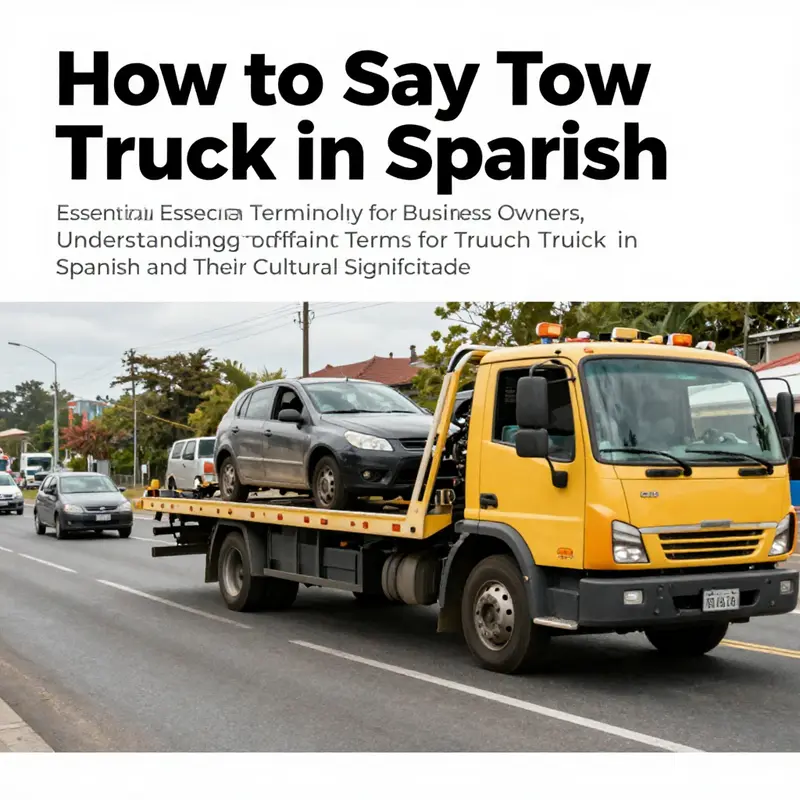
Understanding how to communicate effectively in Spanish, particularly in specialized fields like towing, is crucial for business owners involved in emergency services and roadside assistance. The term ‘tow truck’ translates to several phrases in Spanish, with varying levels of formality and usage across different regions. This article delves into the primary terms used to refer to ‘tow truck’ in Spanish and explores the cultural context that shapes how these translations are understood in Spanish-speaking countries. By the end of this discussion, readers will not only be familiar with the relevant terminology but also gain insights into how cultural nuances influence communication in the towing industry.
Tow Truck Talk in Spanish: Mastering grúa, camión grúa, and remolcar for Real-Life Encounters
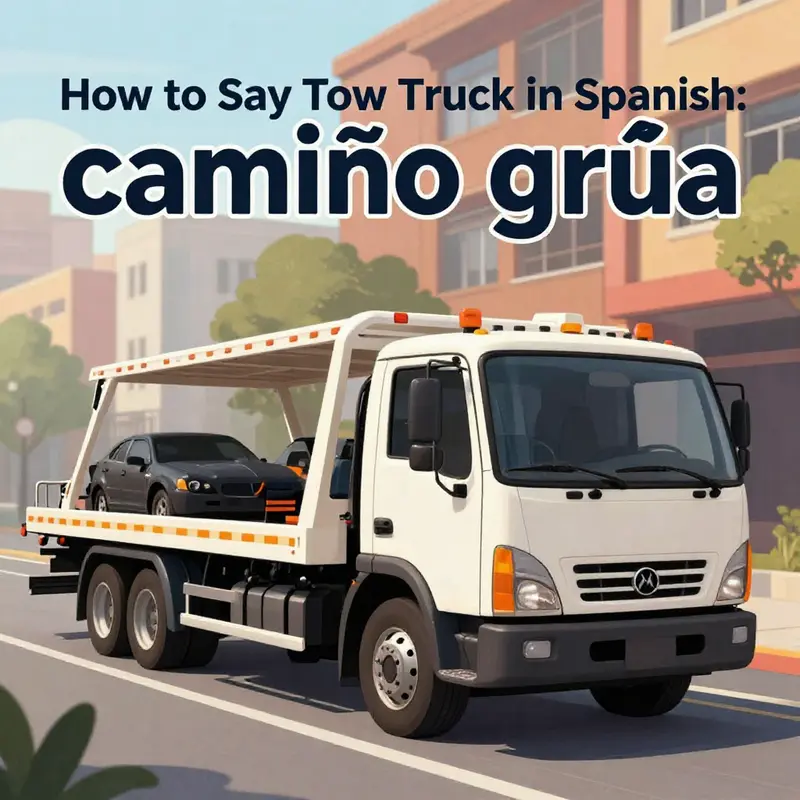
When you plan a road trip through a Spanish-speaking region or navigate a multilingual city in the United States, one practical word can save time, reduce stress, and improve safety: the term for a tow truck. Saying the right thing at the right moment matters when a breakdown leaves you stranded, when a car stalls on a busy highway, or when you need to arrange assistance for someone else. The key is to recognize the core options, understand how regional usage shifts, and learn a few ready-made phrases that get the job done without turning a tow into a linguistic ordeal. In Spanish, the most immediate and widely understood word is grúa. This single syllable captures the essence of a vehicle designed to lift or tow a disabled car and towed operations in everyday conversation. If you hear someone say, simply, “ necesito una grúa,” you know they are asking for a tow truck. Yet the story of how to say tow truck in Spanish is richer than a single term, because several forms exist and different contexts call for different choices.
The simplest and most common variant is grúa. This term, when used alone, is unambiguous in most Spanish-speaking contexts. It pinpoints the vehicle devoted to towing and rescue tasks. For example, imagine a driver on the shoulder of a road with hazards ahead. The most straightforward request would be, “Necesito una grúa para remolcar mi coche.” Here, grúa anchors the request, and remolcar ties the action to the process of towing. The versatility of grúa is part of its strength: it operates in everyday speech across urban lanes and rural roads alike. Its clarity becomes even more evident when a responder asks for the location or the exact problem, and you can reply with a crisp description that begins with, “La grúa está remolcando el coche” if you observe the operation in progress.
If the context requires a stronger emphasis on the mechanical or professional aspect of the vehicle, many speakers opt for camión grúa—the literal construction is “truck crane.” This phrase casts the vehicle in a slightly more technical light, which can be useful when discussing services in formal settings, in work orders, or in scenarios where you want to emphasize the equipment involved in lifting and towing. The addition of camión emphasizes the chassis and towing crane aspect, signaling to a mechanic or dispatcher that the equipment is more than a simple car carrier; it is a specialized vehicle capable of heavy lifting. In conversations with towing operators, especially in larger cities or in professional communications, you might hear someone say, “Necesito un camión grúa para remolcar este coche desde la autopista,” which clearly communicates that a crane-equipped truck is required for the job.
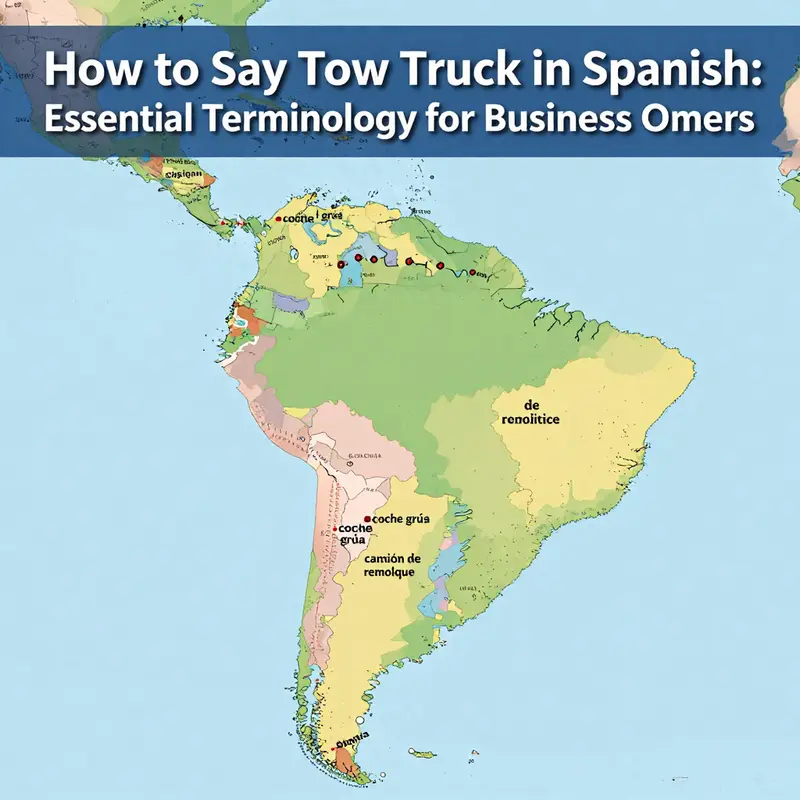
In Latin American regions, another variant that often makes its appearance is coche grúa. This form translates to “towing car” and can be perfectly adequate in many everyday contexts. It is widely understood, though it carries a touch more casual or conversational tone than grúa or camión grúa. In the rhythm of street-level interaction, saying “Necesito una coche grúa” effectively communicates the need, particularly if you are speaking with a neighbor or a local who may not be as familiar with the word grúa alone. The choice between grúa and coche grúa can reflect subtle cues about formality, regional habit, or the level of technical specificity your situation requires. In technical or insurance-related discussions, however, camión de remolque might appear, especially when a very formal or descriptive phrase is preferred. This form translates as “truck for towing” and is a reliable option when documenting the vehicle type in a report or when drafting a service order for a company that handles a range of heavy-duty recovery tasks.
Beyond the main noun, you will often encounter the verb remolcar, which anchors the action of towing as part of a sentence. In Spanish, a common construction is la grúa está remolcando el coche—the tow truck is towing the car. The verb gives you a precise verb choice to describe the ongoing operation and to convey the chain of events clearly. Integrating remolcar into your speech makes your communication more precise, especially when you are coordinating with a dispatcher or explaining the situation to a roadside assistance operator. You can also use the infinitive form: remolcar, as in, “Quiero que remolquen mi coche a un taller cercano.” In practice, you will find remolcar paired with grúa or camión grúa in both formal and informal registers, underscoring that the act of towing is inseparable from the vehicle performing it.
The nuances of regional usage are worth paying attention to, not just for politeness but for effectiveness. In some Latin American contexts, coche grúa can denote a vehicle that participates in towing operations more broadly, sometimes including the tow truck as well as the vehicle being towed in casual speech. In other regions, the phrase camión grúa is the go-to term when the aim is to stress the mechanics or the industrial character of the device. When you travel or communicate across borders within the Spanish-speaking world, you may hear both grúa and camión grúa used interchangeably in everyday talk, yet you will often notice a preference for grúa in phrases that revolve around asking for help or describing the service you need. Acknowledging these differences helps in two ways: you can ask for help using terms that are familiar to the local listener, and you can recognize when a dispatcher is relying on a more technical description to assign the appropriate vehicle for the job.
A practical awareness of signage and codes adds another layer to your understanding. In urban centers with strict parking regulations, you might see signage that mentions zona de remolque, or tow zones. If you encounter this sign, it is typically a warning that unlawfully parked vehicles could be towed by a grúa. If you need to avoid penalties yourself, mastering the phrase and the signs helps you navigate and comply with local rules. At a service desk or a roadside shop, you may encounter forms or checklists that refer to camión de remolque, particularly in contexts that involve insurance documentation or formal towing for investigative or legal purposes. Keeping track of these terms in the moment—grúa, camión grúa, coche grúa, and camión de remolque—helps you respond appropriately whether you are the person needing service or the one coordinating it.
In the flow of a real encounter, you might hear a dispatcher or a driver explain what kind of equipment will arrive. If the situation is urgent and the vehicle is severely damaged, the operator may specify that they will dispatch a camión grúa, signaling a more robust machine suited to the task. If the scene is less severe, a grúa might suffice. The distinction, while subtle, can affect how fast a response is, especially in high-traffic zones or when clearance is tight. As a traveler or someone learning Spanish for practical use, you should feel confident asking for a grúa and indicating your needs with the simplest possible phrases. A straightforward request like “Necesito una grúa para remolcar mi coche en la autopista” communicates both the need and the setting in a single sentence. Then you can add whether you require a camión grúa due to the car’s size or the terrain—this level of detail can help the dispatcher assign the correct vehicle without delay.
The study of this vocabulary also reveals how to phrase your situation in a way that reduces ambiguity. For example, if you want to describe the current state of your vehicle, you can say, “Mi coche se descompuso en la carretera y no puedo moverlo.” If you want to preface the request for a particular type of vehicle, you can add, “Necesito una grúa pequeña” or “Necesito un camión grúa grande,” depending on whether you are dealing with a compact car or a larger vehicle. The emphasis on clarity helps prevent miscommunication under stress, which is precisely when many roadside interactions occur. You may find yourself needing to describe the location and the hazards, too. Expressions like “Estoy en la zona de acotamiento con tráfico” or “La grúa debe llegar a la entrada de la autopista” provide a fuller picture to the operator and can facilitate quicker, safer assistance.
Language learning and practical usage come together most effectively when you incorporate these terms into a single, coherent mental map. The map begins with grúa as the everyday anchor for a tow truck. It expands to camión grúa for more explicit mechanical distinction, and it broadens further with coche grúa for regional comfort or casual dialogue. When the situation demands formality or technical precision, camión de remolque fits in as a descriptive alternative. The verb remolcar ties everything to the action and allows you to frame your story in a way that the listener can immediately act upon. And finally, awareness of phrases like zona de remolaje and la grúa está remolcando el coche helps you interpret signs and on-site communications, even when your stress level is high.
In a broader sense, the aim of learning these phrases is not merely linguistic accuracy. It is about building confidence in cross-cultural communication, especially when time matters and safety is at stake. Knowing which term to use in a given region can prevent a delay in response and ensures that the right equipment arrives at the right place at the right time. It is also a reminder that language evolves in the service of practicality. The way people talk about a tow is shaped by the road, the climate, the size of the vehicle, and the policies of the local service networks. By internalizing the main options and their nuances, you equip yourself to communicate with authority and calm, no matter where you are on a Spanish-speaking road map.
To summarize in one compact scenario: If you are in a Spanish-speaking area and your car breaks down, you would typically say, “Necesito una grúa para remolcar mi coche.” If the situation calls for a heavier machines unit or you are documenting a formal case, you might hear or say, “Necesito un camión grúa para remolcar este coche.” In Latin American contexts, you might hear “coche grúa,” especially in casual exchanges. And in professional paperwork or technical descriptions, “camión de remolque” is a precise choice. Remember the ongoing action with remolcar: “La grúa está remolcando el coche” captures both the tool and the behavior in progress. While the exact term may vary by region, the core idea remains the same, and with these phrases you can navigate the moment with clarity and assurance. For travelers and learners, this is a practical map rather than a rigid dictionary, designed to keep you safe and moving forward when the road presents its inevitable hurdles.
For readers who want a quick reference during real-world use, a reliable dictionary entry can anchor your understanding. The Cambridge English–Spanish dictionary provides an accessible validation of these translations and offers context-rich examples to illustrate how each term is employed in sentences. This external resource complements the explanations above and can serve as a confidence booster when you need a last-minute check before calling for help on a highway or city street. External link: https://dictionary.cambridge.org/dictionary/english-spanish/tow-truck. In the same spirit, you may also consult a widely cited dictionary that confirms the practical usage of grúa and camión grúa across diverse Spanish-speaking regions. Such references are useful companions when you are building a pocket guide for travel, work, or study.
When you translate a practical need like a tow, you are translating more than a word; you are translating a situation into a form that a responder can act upon. The vocabulary you choose—grúa, camión grúa, coche grúa, camión de remolque—becomes a bridge between distress and relief. It is a bridge that, once built, helps turn a roadside emergency into a manageable moment. The chapter above sketches the main lines of this bridge, showing how a handful of terms can cover most real-world needs, from a casual roadside call to a formal service order. And it is worth noting how this small semantic toolkit intersects with the broader topic of multilingual communication in service industries. Being prepared with the right words allows you to cross language barriers with less friction, fosters smoother interactions with professionals, and demonstrates respect for the local language and practices. In short, knowing how to say tow truck in Spanish is not just a lexical exercise; it is a practical skill that helps you stay safe, informed, and connected wherever the road takes you.
Internal link reference: For further reading on towing services in a major metro area and real-world application of these terms in a service context, you can explore this resource: Tow Truck Service Washington DC. This page provides a sense of how a dispatcher might phrase requests and what equipment arrives on scene within a bustling urban environment. Tow Truck Service Washington DC
External resource: For reference, see the Cambridge English-Spanish dictionary entry on tow truck: https://dictionary.cambridge.org/dictionary/english-spanish/tow-truck
Tow Trucks in Translation: How Spanish-Speaking Roads Speak Camión Grúa Across Cultures
When we ask a simple question—how do you say tow truck in Spanish?—we are really probing a wider terrain: the intimate tie between language, infrastructure, and everyday life on the road. The answer is not a single word but a spectrum of terms that travelers, drivers, and roadside technicians use across different countries, regions, and social contexts. In Spanish, the phrase that most people would recognize in daily conversation is camión grúa. It is the sturdy combination of a vehicle noun and a specialized support word that signals both function and form. Yet, as with many technical terms that migrate through languages, the translation grows more nuanced the closer you look. The word grúa, which surfaces in a wide range of contexts—from cranes to towing equipment—has deep roots in road assistance culture throughout Latin America and Spain. This open-ended nature of the term makes the Spanish lexicon for towing more fluid than a literal dictionary might suggest, and it reveals how language adapts to the realities of road safety, urban design, and the logistics of helping a stranded motorist.
A closer look at the common variants helps map the terrain. Camión grúa stands as the standard, widely understood label for a large tow truck designed for heavy-duty recovery. This pairing of camión (truck) and grúa (crane or tow vehicle) communicates both the vehicle’s scale and its purpose. It is the phrase that a driver or a dispatcher would use when requesting assistance in many contexts, from a city street to a rural highway. But the story does not end there. The single word grúa functions as a catch-all for mobile lifting and towing capabilities, and in many places it has eclipsed more formal descriptors in everyday talk. If you were to hear someone say “la grúa” in a Mexican, Argentine, or Colombian city, you would likely infer a roadside service that people rely on to recover a malfunctioning car, transport it to a repair shop, or clear space after an accident. The broader usage of grúa makes it a practical shorthand in conversations, signage, and even promotional materials for roadside assistance.
In other registers, the phrase camión de remolque elevates the specificity of the object. Here, the emphasis is on the remolque—tow—action—rendering a more technical, almost documentary tone. This construction is common in formal or regulatory settings, where government notices, insurance paperwork, or professional dispatch communications require clear, explicit terminology. The idea of a camion de remolque connects back to the mechanical realities of a vehicle built to tow, often a sizeable truck with a winch or multiple axles designed for controlled recovery in varied terrain. In contexts like these, the language mirrors the complexity of the operation: equipment, licensing, routes, and safety rules converge in a phrase that communicates not just a vehicle but a method.
To complicate the landscape further, some regions favor a much simpler, more colloquial label: remolque. It is short, instantly recognizable, and sufficient in many everyday contexts when the meaning is clear from the situation. If a driver calls out for assistance over a radio or mobile app, the shorthand remolque can be enough to trigger the necessary response. The informal cadence of this term resonates with the immediacy of roadside life, where speed and clarity often outrun precision. In daily traffic scenarios in several Latin American countries, remolque is the word an onlooker might hear when a bystander explains, in a single breath, what is needed to get a stalled vehicle back on the road.
The interplay of camión grúa, grúa, camión de remolque, and remolque is not simply a matter of vocabulary. It reflects the social and regulatory fabric surrounding towing services. In countries like Mexico, Argentina, and Colombia, grúas are a visibly integrated component of road safety infrastructure. They appear on highways and city streets alike, ready to intervene in breakdowns, accidents, or even situations where vehicles are impounded for parking violations. Municipal authorities regulate their operations, and public information campaigns often use the term grúa to describe the service. This regulatory dimension helps explain why grúa has such broad acceptance across diverse audiences: it denounces the language of a service that is essential to the traffic ecosystem, underlining that roadside help is a public good as much as a private service. The cultural weight of grúa is reinforced by its presence in media, signage, and everyday speech, where people talk about the service as a familiar companion in the urban landscape.
Linguistic nuance becomes even more interesting when we consider Spain separately from Latin America. Spaniards might lean toward camión de remolque or simply grúa in day-to-day conversations, depending on whether the context is a roadside interaction, a workshop discussion, or a legal document about towing restrictions. The Spanish term grúa carries the same broad sense as in its American counterparts, yet regional pronunciation, tone, and social cues color its perception. In a city known for its dense traffic, the grúa looms as a practical, almost endemic presence—one that drivers encounter regularly and that technicians rely on to keep streets moving. Across both continents, the cultural resonance of these terms is tied to the rhythm of work on the road: the dispatch announcer who negotiates a route; the mechanic who explains the issue to a puzzled owner; the tow truck operator who coordinates with a police officer to clear a jammed lane. Each figure uses language that reflects a shared understanding of the road’s demands and the stakes of getting a vehicle to safety or repair.
The informal expression dar un remolque—literally, to give a tow—offers another cultural window into how the idea of towing has traveled beyond the mechanics of a truck. Beyond the literal act, this expression has accrued metaphorical meaning in everyday speech, much as English speakers might say, “to give someone a lift” in a non-transport sense. When used in social circles, it can convey a sense of assistance and solidarity, a reminder that towing is not only a service offered by a vehicle but also a social gesture—an act of pulling someone back from a difficult moment. In this sense, the vocabulary for tow trucks becomes part of a broader cultural vocabulary about help, cooperation, and mobility. The metaphor underscores how a technical term can acquire human warmth, thereby strengthening its place in everyday life and storytelling about the road.
Understanding these layers is essential for anyone engaging with Spanish-language road communications, whether they are planning travel, learning a new language, or studying how infrastructure and language shape public life. The Cambridge English-Spanish Dictionary, often cited by learners and professionals alike, confirms camión grúa as the widely used translation and highlights its practical nature for everyday conversations. Yet dictionaries also acknowledge alternative forms, including grúa, coche grúa, and camión de remolque, each carrying its own register and connotation. The interaction between formal documentation and colloquial speech is not simply a matter of translation; it is a reflection of how societies create common ground for shared spaces on the road. In Mexico, the SCT (Secretariat of Communications and Transportation) has published materials that consistently deploy grúa and servicios de remolque in public communications and regulation. This official usage anchors the term in a legal and administrative framework, reinforcing its everyday legitimacy with legitimacy of policy and safety guidelines. Readers curious about the exact regulatory language can consult the SCT’s official materials for the most precise terminology as used in public discourse.
From a practical point of view, the translations carry implications for travelers and professionals alike. For someone setting out on a journey through a Spanish-speaking country, knowing that camión grúa is likely to be understood, and that grúa can stand in for the towing service in informal talk, can ease communication with both locals and service providers. For a driver whose vehicle breaks down in a region where remolque is the preferred word, recognizing that remolque may be a general term rather than a specific vehicle type can help in explaining the situation accurately to a mechanic or a police officer. The nuance matters because it shapes the expectations about the kind of equipment that will respond, the probable location of the tow, and the kinds of procedures that will follow, including whether a tow will happen at the roadside, whether a winch will be needed, or whether a transport to a garage is involved. The subtle variations in the term can also influence the tone of communication when dealing with a dispatch center, a roadside assistance club, or a municipal authority.
Beyond the road and into the everyday, the way people talk about towing reveals a broader story about urban design and the way cities plan for disruption. Highways across Spanish-speaking countries are peppered with grúas, their presence signaling both resilience and the need for rapid response to incidents that threaten traffic flow. The visibility of tow trucks on major corridors speaks to a culture of preparedness: a recognition that breakdowns and accidents are inevitable, and that a swift, reliable response can restore movement and safety. In many urban centers, the roadside assistance ecosystem—comprising grúas, talleres de grúas (tow workshops), and public agencies—forms a critical artery of mobility. This ecosystem requires clear language that all parties can share in moments of stress: the driver whose car won’t move, the passenger waiting in the car, the operator who must secure a vehicle, and the officer who manages the scene. The vocabulary of tow trucks, then, becomes part of how a city maintains order on the road and communicates trust to its residents and visitors.
For those studying translation or planning to engage with Spanish-speaking customers in the towing industry, the practical takeaway is to cultivate familiarity with the range of terms and their contexts. If a formal report, a contract, or a procedural guideline is needed, camión de remolque conveys a degree of precision that may be preferable. In everyday or roadside settings, grúa is often sufficient and widely understood. If you are addressing an audience that might be bilingual or primarily Spanish-speaking, offering both terms with a clarifying note—such as camión grúa for the standard tow truck and grúa for the service vehicle—can help bridge gaps and prevent miscommunication. This approach mirrors how bilingual communities negotiate language to maintain clarity while preserving local flavor and cultural nuance.
As you navigate the linguistic landscape of towing in Spanish, you may notice how a seemingly minor lexical choice can carry wider implications for service delivery, legal clarity, and cultural resonance. The terms are more than translations; they are signs of how societies organize their roads, regulate their helpers, and describe the act of moving a vehicle from one place to another. In a world where road networks cross national borders and travelers frequently encounter multiple dialects, the ability to understand and adapt to these terms becomes part of being a responsible, capable traveler. The notion of a tow truck in Spanish, then, is not a fixed dictionary entry but a living practice within a dynamic urban ecology, where language, technology, and human cooperation travel together on the same stretch of asphalt.
For readers who want to explore more about regional usage in real-world contexts, a practical example can be found in local service pages that reflect how language is deployed on the ground. One relevant resource—embedded here for convenience in future traveling or local research—offers insights into how a distant, American market describes tow services in English and Spanish-inflected forms. This link is provided as a practical touchpoint rather than a formal authority on linguistic usage, acknowledging that translations evolve as services, regulations, and everyday speech evolve on the street. The broader lesson remains stable: camión grúa is a dependable anchor term, with grúa, camión de remolque, and remolque functioning as complementary voices within a living, multilingual road culture. The result is a richer understanding of how to say tow truck in Spanish—an understanding that combines literal translation with cultural context, regulatory reality, and the lived experience of driving on roads that cross linguistic boundaries.
Internal reference for readers curious about local service contexts: towing service in Washington DC.
External resource: https://www.gob.mx/sct
Final thoughts
Understanding how to effectively communicate the term ‘tow truck’ in Spanish is not only about language but also recognizing the cultural contexts that influence its use. By familiarizing yourself with terms like ‘camión grúa,’ ‘grúa,’ ‘coche grúa,’ and ‘camión de remolque,’ you can better serve your clientele in Spanish-speaking regions, ensuring clear communication and enhancing customer service. Ensure that your staff is well-trained in these terminologies to foster better relationships and avoid misunderstandings in crucial situations.